

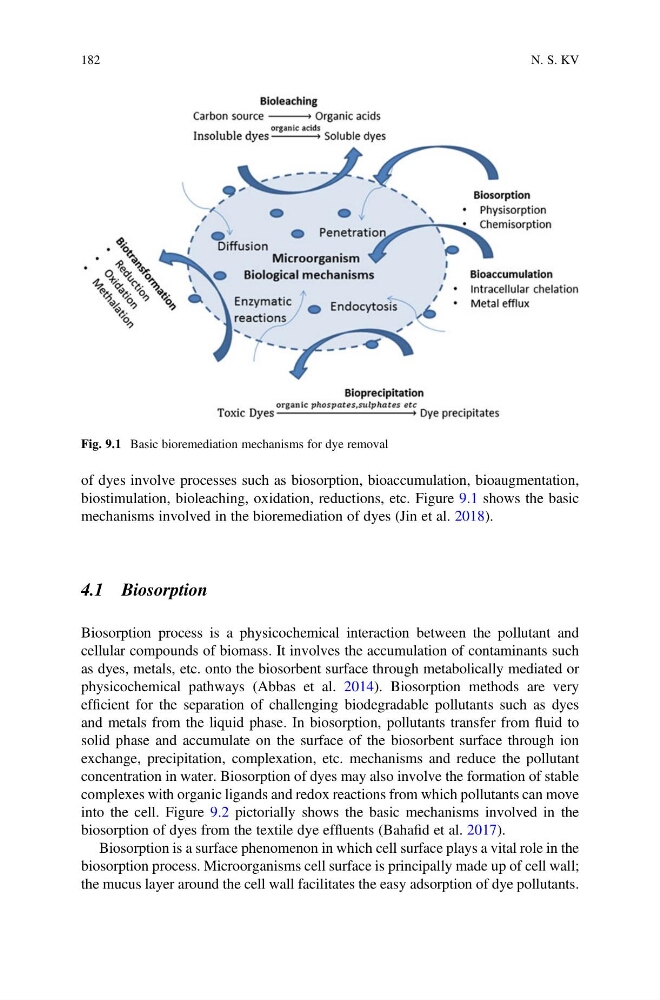
of dyes involve processes such as biosorption, bioaccumulation, bioaugmentation,
biostimulation, bioleaching, oxidation, reductions, etc. Figure 9.1 shows the basic
mechanisms involved in the bioremediation of dyes (Jin et al. 2018).
4.1 Biosorption
Biosorption process is a physicochemical interaction between the pollutant and
cellular compounds of biomass. It involves the accumulation of contaminants such
as dyes, metals, etc. onto the biosorbent surface through metabolically mediated or
physicochemical pathways (Abbas et al. 2014). Biosorption methods are very
efficient for the separation of challenging biodegradable pollutants such as dyes
and metals from the liquid phase. In biosorption, pollutants transfer from fluid to
solid phase and accumulate on the surface of the biosorbent surface through ion
exchange, precipitation, complexation, etc. mechanisms and reduce the pollutant
concentration in water. Biosorption of dyes may also involve the formation of stable
complexes with organic ligands and redox reactions from which pollutants can move
into the cell. Figure 9.2 pictorially shows the basic mechanisms involved in the
biosorption of dyes from the textile dye effluents (Bahafid et al. 2017).
Biosorption is a surface phenomenon in which cell surface plays a vital role in the
biosorption process. Microorganisms cell surface is principally made up of cell wall;
the mucus layer around the cell wall facilitates the easy adsorption of dye pollutants.
Fig. 9.1 Basic bioremediation mechanisms for dye removal
182
N. S. KV
biostimulation, bioleaching, oxidation, reductions, etc. Figure 9.1 shows the basic
mechanisms involved in the bioremediation of dyes (Jin et al. 2018).
4.1 Biosorption
Biosorption process is a physicochemical interaction between the pollutant and
cellular compounds of biomass. It involves the accumulation of contaminants such
as dyes, metals, etc. onto the biosorbent surface through metabolically mediated or
physicochemical pathways (Abbas et al. 2014). Biosorption methods are very
efficient for the separation of challenging biodegradable pollutants such as dyes
and metals from the liquid phase. In biosorption, pollutants transfer from fluid to
solid phase and accumulate on the surface of the biosorbent surface through ion
exchange, precipitation, complexation, etc. mechanisms and reduce the pollutant
concentration in water. Biosorption of dyes may also involve the formation of stable
complexes with organic ligands and redox reactions from which pollutants can move
into the cell. Figure 9.2 pictorially shows the basic mechanisms involved in the
biosorption of dyes from the textile dye effluents (Bahafid et al. 2017).
Biosorption is a surface phenomenon in which cell surface plays a vital role in the
biosorption process. Microorganisms cell surface is principally made up of cell wall;
the mucus layer around the cell wall facilitates the easy adsorption of dye pollutants.
Fig. 9.1 Basic bioremediation mechanisms for dye removal
182
N. S. KV