

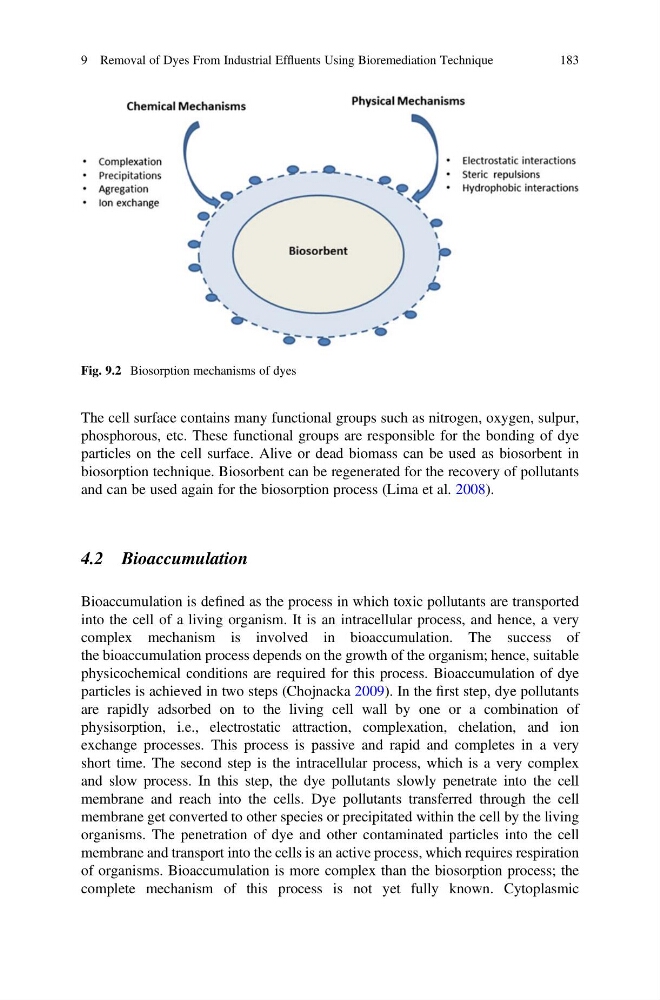
The cell surface contains many functional groups such as nitrogen, oxygen, sulpur,
phosphorous, etc. These functional groups are responsible for the bonding of dye
particles on the cell surface. Alive or dead biomass can be used as biosorbent in
biosorption technique. Biosorbent can be regenerated for the recovery of pollutants
and can be used again for the biosorption process (Lima et al. 2008).
4.2 Bioaccumulation
Bioaccumulation is defined as the process in which toxic pollutants are transported
into the cell of a living organism. It is an intracellular process, and hence, a very
complex mechanism is involved in bioaccumulation. The success of
the bioaccumulation process depends on the growth of the organism; hence, suitable
physicochemical conditions are required for this process. Bioaccumulation of dye
particles is achieved in two steps (Chojnacka 2009). In the first step, dye pollutants
are rapidly adsorbed on to the living cell wall by one or a combination of
physisorption, i.e., electrostatic attraction, complexation, chelation, and ion
exchange processes. This process is passive and rapid and completes in a very
short time. The second step is the intracellular process, which is a very complex
and slow process. In this step, the dye pollutants slowly penetrate into the cell
membrane and reach into the cells. Dye pollutants transferred through the cell
membrane get converted to other species or precipitated within the cell by the living
organisms. The penetration of dye and other contaminated particles into the cell
membrane and transport into the cells is an active process, which requires respiration
of organisms. Bioaccumulation is more complex than the biosorption process; the
complete mechanism of this process is not yet fully known. Cytoplasmic
Fig. 9.2 Biosorption mechanisms of dyes
9 Removal of Dyes From Industrial Effluents Using Bioremediation Technique
183
phosphorous, etc. These functional groups are responsible for the bonding of dye
particles on the cell surface. Alive or dead biomass can be used as biosorbent in
biosorption technique. Biosorbent can be regenerated for the recovery of pollutants
and can be used again for the biosorption process (Lima et al. 2008).
4.2 Bioaccumulation
Bioaccumulation is defined as the process in which toxic pollutants are transported
into the cell of a living organism. It is an intracellular process, and hence, a very
complex mechanism is involved in bioaccumulation. The success of
the bioaccumulation process depends on the growth of the organism; hence, suitable
physicochemical conditions are required for this process. Bioaccumulation of dye
particles is achieved in two steps (Chojnacka 2009). In the first step, dye pollutants
are rapidly adsorbed on to the living cell wall by one or a combination of
physisorption, i.e., electrostatic attraction, complexation, chelation, and ion
exchange processes. This process is passive and rapid and completes in a very
short time. The second step is the intracellular process, which is a very complex
and slow process. In this step, the dye pollutants slowly penetrate into the cell
membrane and reach into the cells. Dye pollutants transferred through the cell
membrane get converted to other species or precipitated within the cell by the living
organisms. The penetration of dye and other contaminated particles into the cell
membrane and transport into the cells is an active process, which requires respiration
of organisms. Bioaccumulation is more complex than the biosorption process; the
complete mechanism of this process is not yet fully known. Cytoplasmic
Fig. 9.2 Biosorption mechanisms of dyes
9 Removal of Dyes From Industrial Effluents Using Bioremediation Technique
183