

which in turn suits for the rural community. SSF is known for the removal of
turbidity, waterborne pathogens, and suspended solids. The factors that affect the
performance of the filter are temperature, sand size, filter depth, and flow rate.
Particularly, some of the microbes are small enough to pass through filters as
individual particles. Further, the turbidity in water can affect the removal efficiencies
of microbes due to the presence of particulate matter, which can block the filters and
results in bypasses. Therefore, the combination of pretreatment, sand filtration, and
chemical disinfection methods are possible ways to reduce microbial contaminants
in drinking water (Alvarez et al. 2008; Hoslett et al. 2018).
3.3.3 Rapid Sand Filtration
RSF is an important physical process in drinking water treatment plants that involves
the removal of large suspended solids. It requires prior and post-treatment stages.
Typically, RSF is made of a sand bed with a height ranging from 1.5 to 2.5 m, and it
is operated in the downward direction at a filtration velocity of 3–8 m/h (Fig. 6.8).
The filter medium (usually sand) size ranges from 0.4 to 1.5 mm. These filters
perform well when the turbidity of the incoming water should be below 20 NTU.
RSF involves solid-liquid separation with an objective to reduce turbidity (0.3–1.0
NTU). Recently, the removal of Giardia cysts and Cryptosporidium oocysts with a
turbidity of 0.1–0.3 NTU. It requires preparatory treatment (coagulation and flocculation) to have a higher throughput of water. The hydraulic loading rate depends on
the incoming water quality, temperature, and the media that we used in the filter.
Typically, the filter with sand exhibits around 6 m
3 /m
2 /h. It is reported that a clean
filter will possess a head loss of around 0.3 m. Once the filter reaches the head loss of
Raw
Water
In
Filtrated
Water Out
Fine Sand
Gravel
Perforated
Drain Pipe
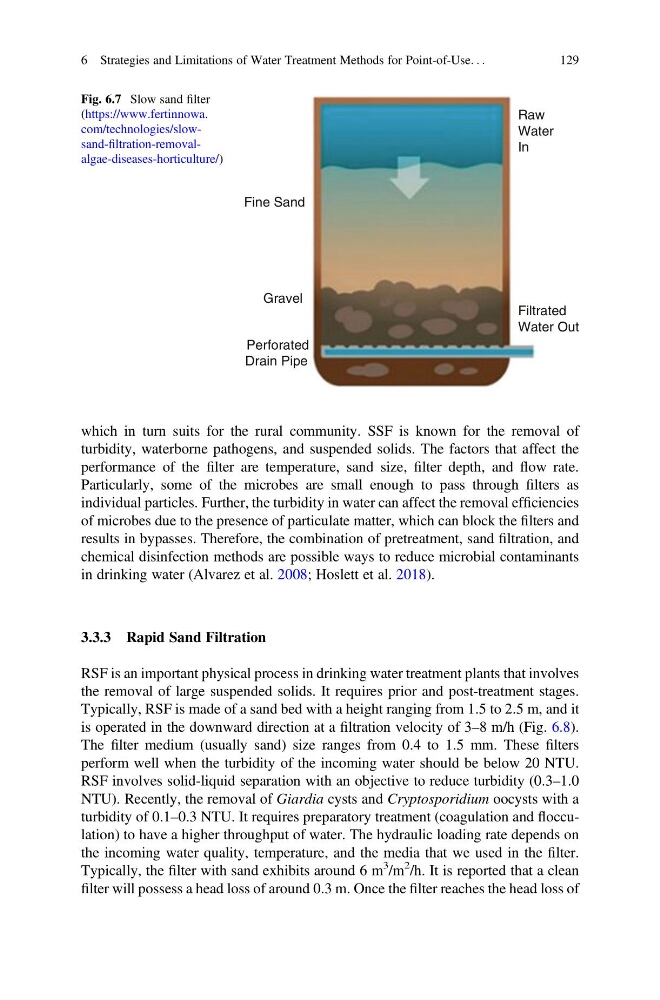
Fig. 6.7 Slow sand filter
(https://www.fertinnowa.
sand-filtration-removalalgae-diseases-horticulture/)
6 Strategies and Limitations of Water Treatment Methods for Point-of-Use. . .
129
turbidity, waterborne pathogens, and suspended solids. The factors that affect the
performance of the filter are temperature, sand size, filter depth, and flow rate.
Particularly, some of the microbes are small enough to pass through filters as
individual particles. Further, the turbidity in water can affect the removal efficiencies
of microbes due to the presence of particulate matter, which can block the filters and
results in bypasses. Therefore, the combination of pretreatment, sand filtration, and
chemical disinfection methods are possible ways to reduce microbial contaminants
in drinking water (Alvarez et al. 2008; Hoslett et al. 2018).
3.3.3 Rapid Sand Filtration
RSF is an important physical process in drinking water treatment plants that involves
the removal of large suspended solids. It requires prior and post-treatment stages.
Typically, RSF is made of a sand bed with a height ranging from 1.5 to 2.5 m, and it
is operated in the downward direction at a filtration velocity of 3–8 m/h (Fig. 6.8).
The filter medium (usually sand) size ranges from 0.4 to 1.5 mm. These filters
perform well when the turbidity of the incoming water should be below 20 NTU.
RSF involves solid-liquid separation with an objective to reduce turbidity (0.3–1.0
NTU). Recently, the removal of Giardia cysts and Cryptosporidium oocysts with a
turbidity of 0.1–0.3 NTU. It requires preparatory treatment (coagulation and flocculation) to have a higher throughput of water. The hydraulic loading rate depends on
the incoming water quality, temperature, and the media that we used in the filter.
Typically, the filter with sand exhibits around 6 m
3 /m
2 /h. It is reported that a clean
filter will possess a head loss of around 0.3 m. Once the filter reaches the head loss of
Raw
Water
In
Filtrated
Water Out
Fine Sand
Gravel
Perforated
Drain Pipe
Fig. 6.7 Slow sand filter
(https://www.fertinnowa.
sand-filtration-removalalgae-diseases-horticulture/)
6 Strategies and Limitations of Water Treatment Methods for Point-of-Use. . .
129