

around 1.5–2 m, the filter needs to be cleaned by backwashing. A critical stage is
reached when the frictional resistance increase in the top layer of the sand bed
exceeds the static head of water above the bed of sand. The bottom sand layer
behaves like a vacuum, and water just passed through the media rather than getting
filtered through them. As a result, the developed negative pressure tends to release
the gases present in water. The gas bubbles prefers to stick with the surface of the
sand. This phenomenon is called as air binding. Hence, the filter needs to be cleaned
as soon as it reaches the optimum value. Interestingly, mud accumulates on the
surface of sand particles. Over a period of time, mud becomes like a ball when there
is an inadequate washing. Once mud balls are formed in a filter, it is difficult to clear.
The fine sand particle in the top layer of the bed shrinks and causes cracks in the bed.
The crack becomes large with the increase in loss of head.
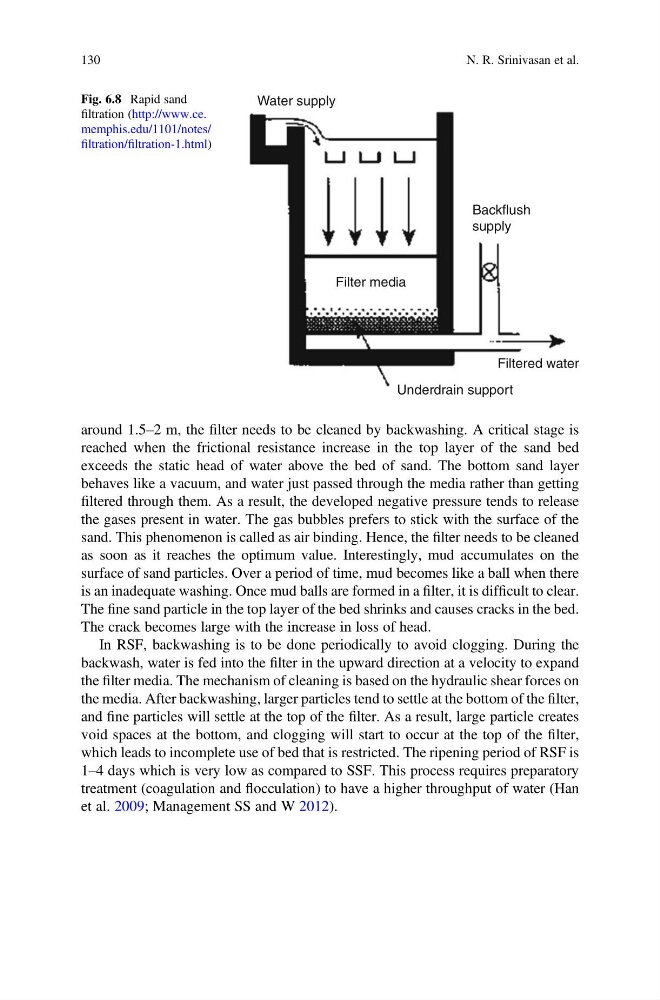
In RSF, backwashing is to be done periodically to avoid clogging. During the
backwash, water is fed into the filter in the upward direction at a velocity to expand
the filter media. The mechanism of cleaning is based on the hydraulic shear forces on
the media. After backwashing, larger particles tend to settle at the bottom of the filter,
and fine particles will settle at the top of the filter. As a result, large particle creates
void spaces at the bottom, and clogging will start to occur at the top of the filter,
which leads to incomplete use of bed that is restricted. The ripening period of RSF is
1–4 days which is very low as compared to SSF. This process requires preparatory
treatment (coagulation and flocculation) to have a higher throughput of water (Han
et al. 2009; Management SS and W 2012).
Water supply
Backflush
supply
Filter media
Filtered water
Underdrain support
Fig. 6.8 Rapid sand
filtration (http://www.ce.
memphis.edu/1101/notes/
filtration/filtration-1.html)
130
N. R. Srinivasan et al.
reached when the frictional resistance increase in the top layer of the sand bed
exceeds the static head of water above the bed of sand. The bottom sand layer
behaves like a vacuum, and water just passed through the media rather than getting
filtered through them. As a result, the developed negative pressure tends to release
the gases present in water. The gas bubbles prefers to stick with the surface of the
sand. This phenomenon is called as air binding. Hence, the filter needs to be cleaned
as soon as it reaches the optimum value. Interestingly, mud accumulates on the
surface of sand particles. Over a period of time, mud becomes like a ball when there
is an inadequate washing. Once mud balls are formed in a filter, it is difficult to clear.
The fine sand particle in the top layer of the bed shrinks and causes cracks in the bed.
The crack becomes large with the increase in loss of head.
In RSF, backwashing is to be done periodically to avoid clogging. During the
backwash, water is fed into the filter in the upward direction at a velocity to expand
the filter media. The mechanism of cleaning is based on the hydraulic shear forces on
the media. After backwashing, larger particles tend to settle at the bottom of the filter,
and fine particles will settle at the top of the filter. As a result, large particle creates
void spaces at the bottom, and clogging will start to occur at the top of the filter,
which leads to incomplete use of bed that is restricted. The ripening period of RSF is
1–4 days which is very low as compared to SSF. This process requires preparatory
treatment (coagulation and flocculation) to have a higher throughput of water (Han
et al. 2009; Management SS and W 2012).
Water supply
Backflush
supply
Filter media
Filtered water
Underdrain support
Fig. 6.8 Rapid sand
filtration (http://www.ce.
memphis.edu/1101/notes/
filtration/filtration-1.html)
130
N. R. Srinivasan et al.