

80
Algae
facing opposite directions. In the Glaucophyta, the two basal bodies are inclined toward each
other; in the Heterokontophyta, they are parallel in the Chrysophyceae Mallomonas and Synura,
almost perpendicular in Ochromonas, lie at an obtuse angle to each other in the Xanthophyceae and
Phaeophyceae, are inclined to each other at an angle of about 90° in the Eustigmatophyceae and
Raphidophyceae; in the Haptophyta, the angle between the two basal bodies can be acute or obtuse;
in both Cryptophyceae and Euglenophyceae, the basal bodies are almost parallel, while in the
Dinophyceae they lie at almost 180° to each other and slightly overlap. In the Chlorophyta, the angle
between the two basal bodies can vary (about 90° in Chlamydomonas and 180° in Acrosiphonia
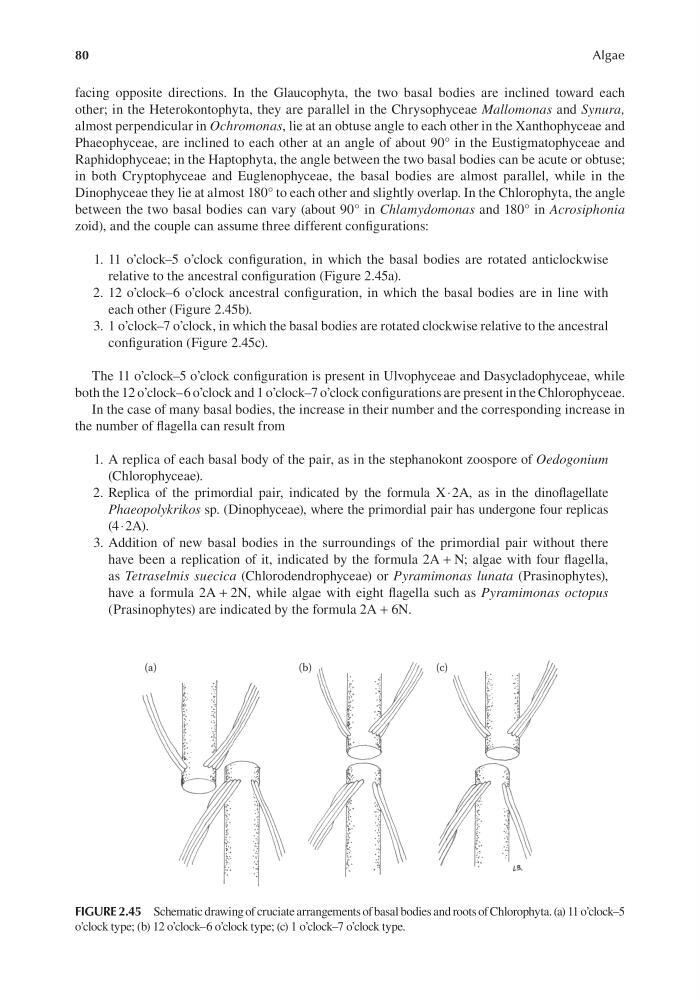
zoid), and the couple can assume three different configurations:
1. 11 o’clock–5 o’clock configuration, in which the basal bodies are rotated anticlockwise
relative to the ancestral configuration (Figure 2.45a).
2. 12 o’clock–6 o’clock ancestral configuration, in which the basal bodies are in line with
each other (Figure 2.45b).
3. 1 o’clock–7 o’clock, in which the basal bodies are rotated clockwise relative to the ancestral
configuration (Figure 2.45c).
The 11 o’clock–5 o’clock configuration is present in Ulvophyceae and Dasycladophyceae, while
both the 12 o’clock–6 o’clock and 1 o’clock–7 o’clock configurations are present in the Chlorophyceae.
In the case of many basal bodies, the increase in their number and the corresponding increase in
the number of flagella can result from
1. A replica of each basal body of the pair, as in the stephanokont zoospore of Oedogonium
(Chlorophyceae).
2. Replica of the primordial pair, indicated by the formula X ⋅ 2A, as in the dinoflagellate
Phaeopolykrikos sp. (Dinophyceae), where the primordial pair has undergone four replicas
(4 ⋅ 2A).
3. Addition of new basal bodies in the surroundings of the primordial pair without there
have been a replication of it, indicated by the formula 2A + N; algae with four flagella,
as Tetraselmis suecica (Chlorodendrophyceae) or Pyramimonas lunata (Prasinophytes),
have a formula 2A + 2N, while algae with eight flagella such as Pyramimonas octopus
(Prasinophytes) are indicated by the formula 2A + 6N.
FIGURE 2.45 Schematic drawing of cruciate arrangements of basal bodies and roots of Chlorophyta. (a) 11 o’clock–5
o’clock type; (b) 12 o’clock–6 o’clock type; (c) 1 o’clock–7 o’clock type.
Algae
facing opposite directions. In the Glaucophyta, the two basal bodies are inclined toward each
other; in the Heterokontophyta, they are parallel in the Chrysophyceae Mallomonas and Synura,
almost perpendicular in Ochromonas, lie at an obtuse angle to each other in the Xanthophyceae and
Phaeophyceae, are inclined to each other at an angle of about 90° in the Eustigmatophyceae and
Raphidophyceae; in the Haptophyta, the angle between the two basal bodies can be acute or obtuse;
in both Cryptophyceae and Euglenophyceae, the basal bodies are almost parallel, while in the
Dinophyceae they lie at almost 180° to each other and slightly overlap. In the Chlorophyta, the angle
between the two basal bodies can vary (about 90° in Chlamydomonas and 180° in Acrosiphonia
zoid), and the couple can assume three different configurations:
1. 11 o’clock–5 o’clock configuration, in which the basal bodies are rotated anticlockwise
relative to the ancestral configuration (Figure 2.45a).
2. 12 o’clock–6 o’clock ancestral configuration, in which the basal bodies are in line with
each other (Figure 2.45b).
3. 1 o’clock–7 o’clock, in which the basal bodies are rotated clockwise relative to the ancestral
configuration (Figure 2.45c).
The 11 o’clock–5 o’clock configuration is present in Ulvophyceae and Dasycladophyceae, while
both the 12 o’clock–6 o’clock and 1 o’clock–7 o’clock configurations are present in the Chlorophyceae.
In the case of many basal bodies, the increase in their number and the corresponding increase in
the number of flagella can result from
1. A replica of each basal body of the pair, as in the stephanokont zoospore of Oedogonium
(Chlorophyceae).
2. Replica of the primordial pair, indicated by the formula X ⋅ 2A, as in the dinoflagellate
Phaeopolykrikos sp. (Dinophyceae), where the primordial pair has undergone four replicas
(4 ⋅ 2A).
3. Addition of new basal bodies in the surroundings of the primordial pair without there
have been a replication of it, indicated by the formula 2A + N; algae with four flagella,
as Tetraselmis suecica (Chlorodendrophyceae) or Pyramimonas lunata (Prasinophytes),
have a formula 2A + 2N, while algae with eight flagella such as Pyramimonas octopus
(Prasinophytes) are indicated by the formula 2A + 6N.
FIGURE 2.45 Schematic drawing of cruciate arrangements of basal bodies and roots of Chlorophyta. (a) 11 o’clock–5
o’clock type; (b) 12 o’clock–6 o’clock type; (c) 1 o’clock–7 o’clock type.