

76
Algae
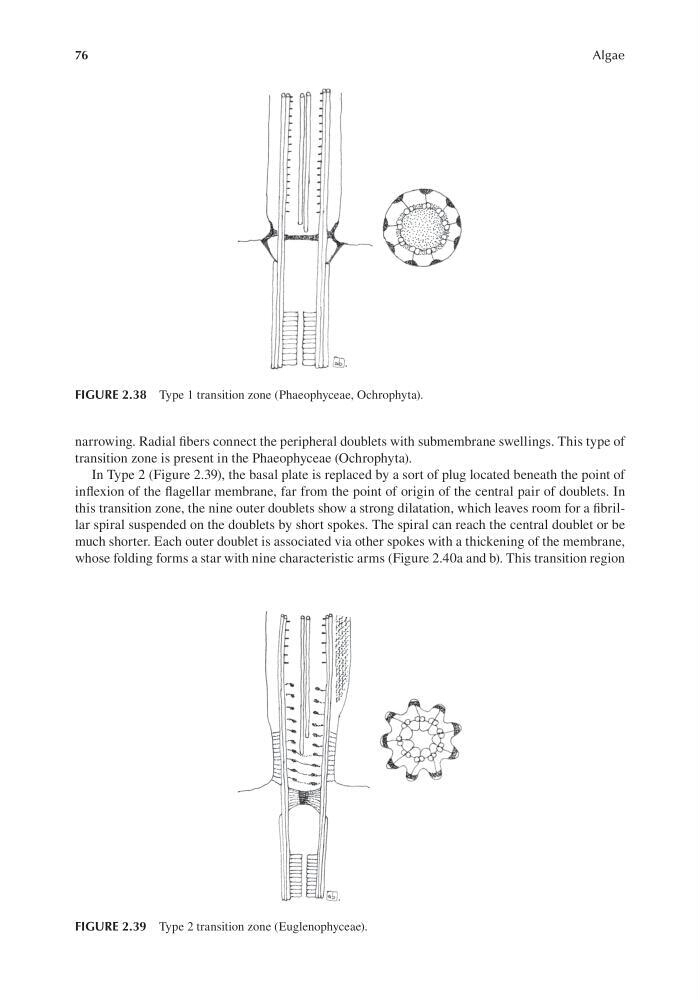
narrowing. Radial fibers connect the peripheral doublets with submembrane swellings. This type of
transition zone is present in the Phaeophyceae (Ochrophyta).
In Type 2 (Figure 2.39), the basal plate is replaced by a sort of plug located beneath the point of
inflexion of the flagellar membrane, far from the point of origin of the central pair of doublets. In
this transition zone, the nine outer doublets show a strong dilatation, which leaves room for a fibrillar spiral suspended on the doublets by short spokes. The spiral can reach the central doublet or be
much shorter. Each outer doublet is associated via other spokes with a thickening of the membrane,
whose folding forms a star with nine characteristic arms (Figure 2.40a and b). This transition region
FIGURE 2.38 Type 1 transition zone (Phaeophyceae, Ochrophyta).
FIGURE 2.39 Type 2 transition zone (Euglenophyceae).
Algae
narrowing. Radial fibers connect the peripheral doublets with submembrane swellings. This type of
transition zone is present in the Phaeophyceae (Ochrophyta).
In Type 2 (Figure 2.39), the basal plate is replaced by a sort of plug located beneath the point of
inflexion of the flagellar membrane, far from the point of origin of the central pair of doublets. In
this transition zone, the nine outer doublets show a strong dilatation, which leaves room for a fibrillar spiral suspended on the doublets by short spokes. The spiral can reach the central doublet or be
much shorter. Each outer doublet is associated via other spokes with a thickening of the membrane,
whose folding forms a star with nine characteristic arms (Figure 2.40a and b). This transition region
FIGURE 2.38 Type 1 transition zone (Phaeophyceae, Ochrophyta).
FIGURE 2.39 Type 2 transition zone (Euglenophyceae).