

75
Anatomy
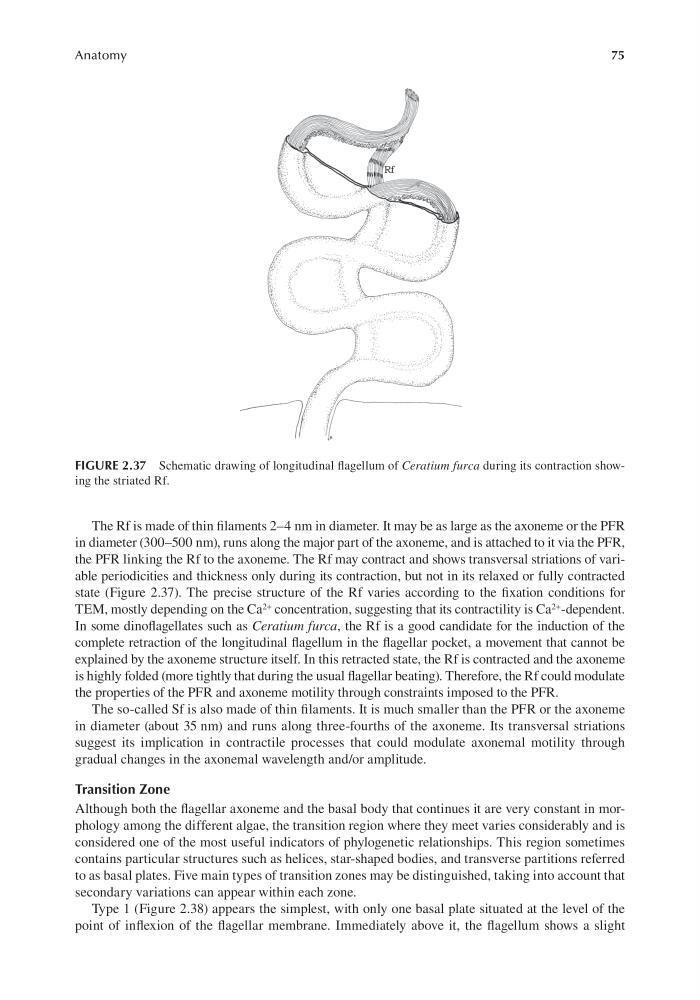
The Rf is made of thin filaments 2–4 nm in diameter. It may be as large as the axoneme or the PFR
in diameter (300–500 nm), runs along the major part of the axoneme, and is attached to it via the PFR,
the PFR linking the Rf to the axoneme. The Rf may contract and shows transversal striations of variable periodicities and thickness only during its contraction, but not in its relaxed or fully contracted
state (Figure 2.37). The precise structure of the Rf varies according to the fixation conditions for
TEM, mostly depending on the Ca 2+ concentration, suggesting that its contractility is Ca 2+ -dependent.
In some dinoflagellates such as Ceratium furca, the Rf is a good candidate for the induction of the
complete retraction of the longitudinal flagellum in the flagellar pocket, a movement that cannot be
explained by the axoneme structure itself. In this retracted state, the Rf is contracted and the axoneme
is highly folded (more tightly that during the usual flagellar beating). Therefore, the Rf could modulate
the properties of the PFR and axoneme motility through constraints imposed to the PFR.
The so-called Sf is also made of thin filaments. It is much smaller than the PFR or the axoneme
in diameter (about 35 nm) and runs along three-fourths of the axoneme. Its transversal striations
suggest its implication in contractile processes that could modulate axonemal motility through
gradual changes in the axonemal wavelength and/or amplitude.
Transition Zone
Although both the flagellar axoneme and the basal body that continues it are very constant in morphology among the different algae, the transition region where they meet varies considerably and is
considered one of the most useful indicators of phylogenetic relationships. This region sometimes
contains particular structures such as helices, star-shaped bodies, and transverse partitions referred
to as basal plates. Five main types of transition zones may be distinguished, taking into account that
secondary variations can appear within each zone.
Type 1 (Figure 2.38) appears the simplest, with only one basal plate situated at the level of the
point of inflexion of the flagellar membrane. Immediately above it, the flagellum shows a slight
FIGURE 2.37 Schematic drawing of longitudinal flagellum of Ceratium furca during its contraction showing the striated Rf.
Anatomy
The Rf is made of thin filaments 2–4 nm in diameter. It may be as large as the axoneme or the PFR
in diameter (300–500 nm), runs along the major part of the axoneme, and is attached to it via the PFR,
the PFR linking the Rf to the axoneme. The Rf may contract and shows transversal striations of variable periodicities and thickness only during its contraction, but not in its relaxed or fully contracted
state (Figure 2.37). The precise structure of the Rf varies according to the fixation conditions for
TEM, mostly depending on the Ca 2+ concentration, suggesting that its contractility is Ca 2+ -dependent.
In some dinoflagellates such as Ceratium furca, the Rf is a good candidate for the induction of the
complete retraction of the longitudinal flagellum in the flagellar pocket, a movement that cannot be
explained by the axoneme structure itself. In this retracted state, the Rf is contracted and the axoneme
is highly folded (more tightly that during the usual flagellar beating). Therefore, the Rf could modulate
the properties of the PFR and axoneme motility through constraints imposed to the PFR.
The so-called Sf is also made of thin filaments. It is much smaller than the PFR or the axoneme
in diameter (about 35 nm) and runs along three-fourths of the axoneme. Its transversal striations
suggest its implication in contractile processes that could modulate axonemal motility through
gradual changes in the axonemal wavelength and/or amplitude.
Transition Zone
Although both the flagellar axoneme and the basal body that continues it are very constant in morphology among the different algae, the transition region where they meet varies considerably and is
considered one of the most useful indicators of phylogenetic relationships. This region sometimes
contains particular structures such as helices, star-shaped bodies, and transverse partitions referred
to as basal plates. Five main types of transition zones may be distinguished, taking into account that
secondary variations can appear within each zone.
Type 1 (Figure 2.38) appears the simplest, with only one basal plate situated at the level of the
point of inflexion of the flagellar membrane. Immediately above it, the flagellum shows a slight
FIGURE 2.37 Schematic drawing of longitudinal flagellum of Ceratium furca during its contraction showing the striated Rf.