

70
Algae
The scales are synthesized within the Golgi vesicles. The vesicles then migrate to the base of the
flagella and from here are extruded and arranged on the flagella.
Flagellar Hairs
Flagellar hairs can be grouped into two types: tubular and nontubular (simple) hairs.
Tubular hairs consist of two or more distinct regions, at least one of which is thick and tubular,
while the distal elements may be simpler. This type of hairs is further divided into cryptophycean
hairs, tripartite hairs, and prasinophycean hairs.
The cryptophycean hairs are unique for arrangement to the Cryptophyceae (Cryptophyta), being
attached in two opposite rows on the longer flagellum, and on a single row on the shorter one. On
the long flagellum, the hairs consist of a tubular proximal part, 1.5–2.5-μm long, and a nontubular
distal filament, 1 μm long, while the hairs on the shorter flagellum are shorter, 1–1.5-μm long, with
a distal filament 1-μm long.
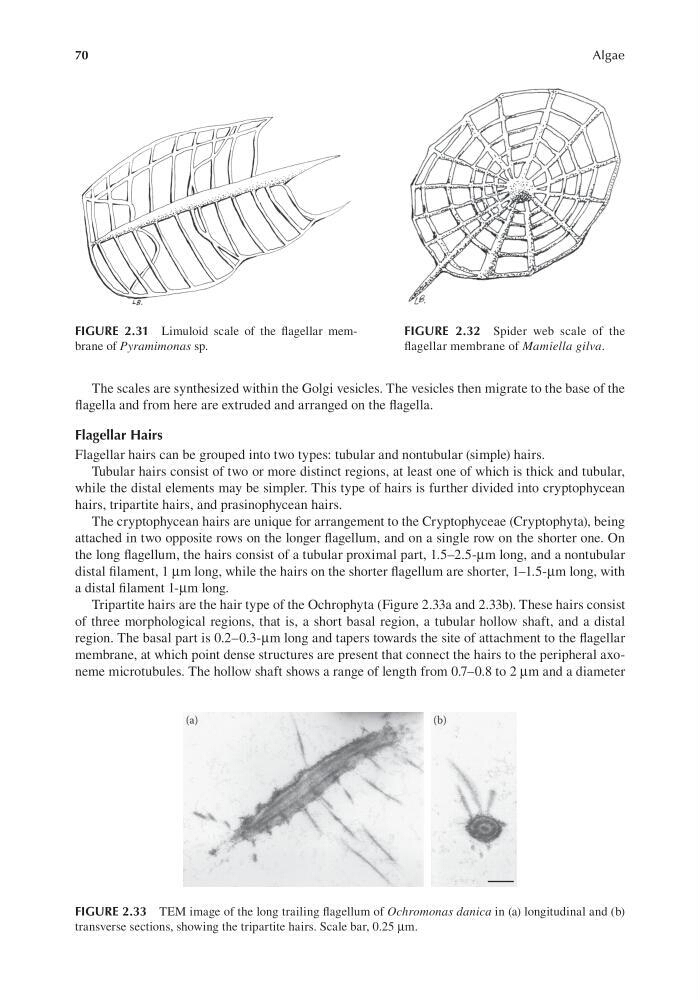
Tripartite hairs are the hair type of the Ochrophyta (Figure 2.33a and 2.33b). These hairs consist
of three morphological regions, that is, a short basal region, a tubular hollow shaft, and a distal
region. The basal part is 0.2–0.3-μm long and tapers towards the site of attachment to the flagellar
membrane, at which point dense structures are present that connect the hairs to the peripheral axoneme microtubules. The hollow shaft shows a range of length from 0.7–0.8 to 2 μm and a diameter
FIGURE 2.31 Limuloid scale of the flagellar membrane of Pyramimonas sp.
FIGURE 2.32 Spider web scale of the
flagellar membrane of Mamiella gilva.
FIGURE 2.33 TEM image of the long trailing flagellum of Ochromonas danica in (a) longitudinal and (b)
transverse sections, showing the tripartite hairs. Scale bar, 0.25 μm.
Algae
The scales are synthesized within the Golgi vesicles. The vesicles then migrate to the base of the
flagella and from here are extruded and arranged on the flagella.
Flagellar Hairs
Flagellar hairs can be grouped into two types: tubular and nontubular (simple) hairs.
Tubular hairs consist of two or more distinct regions, at least one of which is thick and tubular,
while the distal elements may be simpler. This type of hairs is further divided into cryptophycean
hairs, tripartite hairs, and prasinophycean hairs.
The cryptophycean hairs are unique for arrangement to the Cryptophyceae (Cryptophyta), being
attached in two opposite rows on the longer flagellum, and on a single row on the shorter one. On
the long flagellum, the hairs consist of a tubular proximal part, 1.5–2.5-μm long, and a nontubular
distal filament, 1 μm long, while the hairs on the shorter flagellum are shorter, 1–1.5-μm long, with
a distal filament 1-μm long.
Tripartite hairs are the hair type of the Ochrophyta (Figure 2.33a and 2.33b). These hairs consist
of three morphological regions, that is, a short basal region, a tubular hollow shaft, and a distal
region. The basal part is 0.2–0.3-μm long and tapers towards the site of attachment to the flagellar
membrane, at which point dense structures are present that connect the hairs to the peripheral axoneme microtubules. The hollow shaft shows a range of length from 0.7–0.8 to 2 μm and a diameter
FIGURE 2.31 Limuloid scale of the flagellar membrane of Pyramimonas sp.
FIGURE 2.32 Spider web scale of the
flagellar membrane of Mamiella gilva.
FIGURE 2.33 TEM image of the long trailing flagellum of Ochromonas danica in (a) longitudinal and (b)
transverse sections, showing the tripartite hairs. Scale bar, 0.25 μm.