

71
Anatomy
of about 16 nm. The distal parts of each hair, called terminal filaments or fibers, are extremely fragile, hence difficult to detect because readily shed during electron microscopy preparation. In some
cases, they are organized in a 2 + 1 structure, that is, two short filaments 0.3-μm long and one long
filament 1-μm long; however, differences exist in their number, length, and diameter.
Cells of the Prasinophytes carry hairs on all their flagella, whether one, two, four, or eight,
which are very diverse in morphology. They can vary in length from 0.5 to 3 μm, and a single
flagellum may carry more than one hair type. In Pyramimonas orientalis, both lateral and apical hairs are bipartite and of the same length, with the lateral hairs being divided into a short,
thick base, of 160 nm, and a long, thin distal part, of 650 nm, and the apical hairs possessing a
long thick base and a very short, thin tip. Another example of flagellar hairs is Mantoniella sp.
(Mamiellophyceae), bearing hairs on the flagellar tip which are longer than those on the side. In
Nephroselmis (Nephroselmidophyceae) and Tetraselmis (Chlorodendrophyceae), there is a single
hair type divided into two regions of roughly the same length (0.5 μm).
Unlike tubular hairs, simple, nontubular hairs are not differentiated into regions; they are thin,
and very delicate, probably consisting of a single row of subunits. These hairs occur in a variety
of groups, but are unique in the Euglenophyceae and Dinophyceae, whose hairy coverings share
certain features not known to occur in any other algal group.
In Euglenophyceae, long, simple hairs are arranged in a single row on the emergent part of the
flagella. In general, with two emergent flagella, the hair covering is similar on the two flagella.
In Euglena gracilis, these long hairs consist of a single filament 3–4-μm long, with a diameter of
10 nm, while in Eutreptiella gymnastica, they are 4–5-μm long and assembled in unilateral bundles. In addition to these long hairs, euglenoid flagella carry a dense felt of shorter hairs, which
in Euglena are approximately half as long and half as thick as the long hairs. These short hairs,
precisely positioned with respect to each other and to axonemal components, consist of a sheath
about 240–300 nm in length, which represents the basic unit. The units, each formed by loops,
side arms, and filaments lie parallel to each other in the longitudinal direction of the flagellum
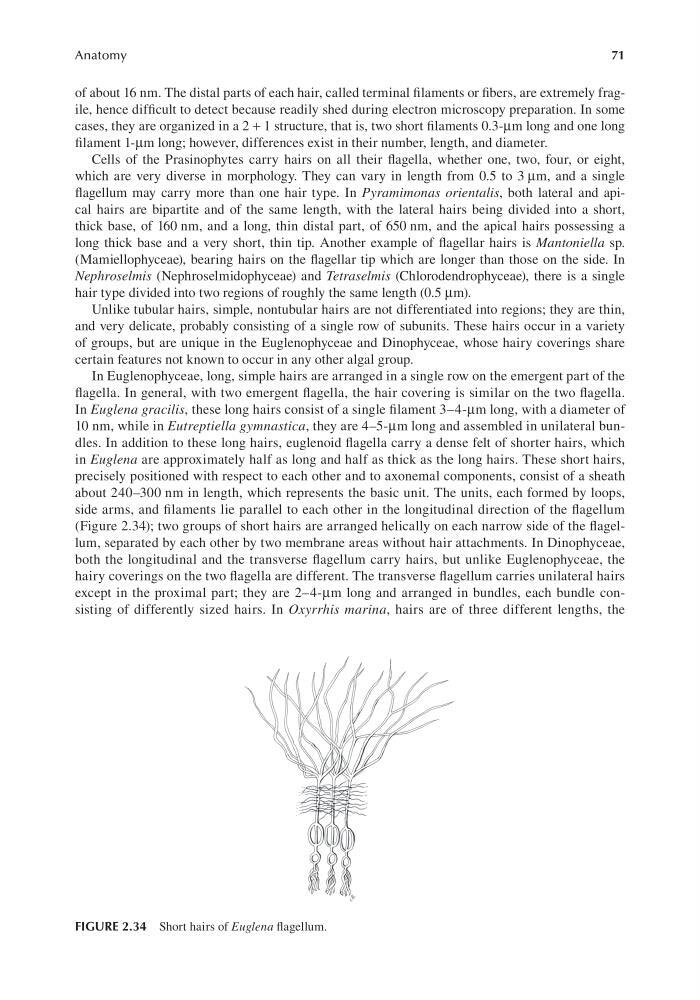
(Figure 2.34); two groups of short hairs are arranged helically on each narrow side of the flagellum, separated by each other by two membrane areas without hair attachments. In Dinophyceae,
both the longitudinal and the transverse flagellum carry hairs, but unlike Euglenophyceae, the
hairy coverings on the two flagella are different. The transverse flagellum carries unilateral hairs
except in the proximal part; they are 2–4-μm long and arranged in bundles, each bundle consisting of differently sized hairs. In Oxyrrhis marina, hairs are of three different lengths, the
FIGURE 2.34 Short hairs of Euglena flagellum.
Anatomy
of about 16 nm. The distal parts of each hair, called terminal filaments or fibers, are extremely fragile, hence difficult to detect because readily shed during electron microscopy preparation. In some
cases, they are organized in a 2 + 1 structure, that is, two short filaments 0.3-μm long and one long
filament 1-μm long; however, differences exist in their number, length, and diameter.
Cells of the Prasinophytes carry hairs on all their flagella, whether one, two, four, or eight,
which are very diverse in morphology. They can vary in length from 0.5 to 3 μm, and a single
flagellum may carry more than one hair type. In Pyramimonas orientalis, both lateral and apical hairs are bipartite and of the same length, with the lateral hairs being divided into a short,
thick base, of 160 nm, and a long, thin distal part, of 650 nm, and the apical hairs possessing a
long thick base and a very short, thin tip. Another example of flagellar hairs is Mantoniella sp.
(Mamiellophyceae), bearing hairs on the flagellar tip which are longer than those on the side. In
Nephroselmis (Nephroselmidophyceae) and Tetraselmis (Chlorodendrophyceae), there is a single
hair type divided into two regions of roughly the same length (0.5 μm).
Unlike tubular hairs, simple, nontubular hairs are not differentiated into regions; they are thin,
and very delicate, probably consisting of a single row of subunits. These hairs occur in a variety
of groups, but are unique in the Euglenophyceae and Dinophyceae, whose hairy coverings share
certain features not known to occur in any other algal group.
In Euglenophyceae, long, simple hairs are arranged in a single row on the emergent part of the
flagella. In general, with two emergent flagella, the hair covering is similar on the two flagella.
In Euglena gracilis, these long hairs consist of a single filament 3–4-μm long, with a diameter of
10 nm, while in Eutreptiella gymnastica, they are 4–5-μm long and assembled in unilateral bundles. In addition to these long hairs, euglenoid flagella carry a dense felt of shorter hairs, which
in Euglena are approximately half as long and half as thick as the long hairs. These short hairs,
precisely positioned with respect to each other and to axonemal components, consist of a sheath
about 240–300 nm in length, which represents the basic unit. The units, each formed by loops,
side arms, and filaments lie parallel to each other in the longitudinal direction of the flagellum
(Figure 2.34); two groups of short hairs are arranged helically on each narrow side of the flagellum, separated by each other by two membrane areas without hair attachments. In Dinophyceae,
both the longitudinal and the transverse flagellum carry hairs, but unlike Euglenophyceae, the
hairy coverings on the two flagella are different. The transverse flagellum carries unilateral hairs
except in the proximal part; they are 2–4-μm long and arranged in bundles, each bundle consisting of differently sized hairs. In Oxyrrhis marina, hairs are of three different lengths, the
FIGURE 2.34 Short hairs of Euglena flagellum.