

68
Algae
Description of flagella anatomy will proceed from the outside to the inside, from the surface
features and components to the axoneme and additional inclusions, to the structures anchoring the
flagella to the cell.
Flagellar Shape and Surface Features
Deviations from the cylindrical shape are rare among the algae. Usually the flagellar membrane
fits smoothly around the axoneme and a total diameter of 0.25–0.35 μm, excluding scales, hairs,
etc, holds for most species. If extra material is present between the axoneme and the flagellar membrane, the flagellum diameter increases either locally as in the case of flagellar swellings, or through
almost the entire length as in the case of paraxial rods. Minor deviations from the cylindrical shape
are caused by small extensions of the membrane to form one or more longitudinal keels running
the length of the flagellum. Greater extension of the membrane forms a ribbon or wing supported
along the edge by a paraxial rod. More variations are present in the flagellar tip, since flagella can
possess a hairpoint, that is, their distal part is thinner with respect to the rest of the flagellum, or be
blunt-tipped, with an abundance of intermediates between these two types.
Flagellar surface is smooth in many algae, where only a simple plasma membrane envelopes
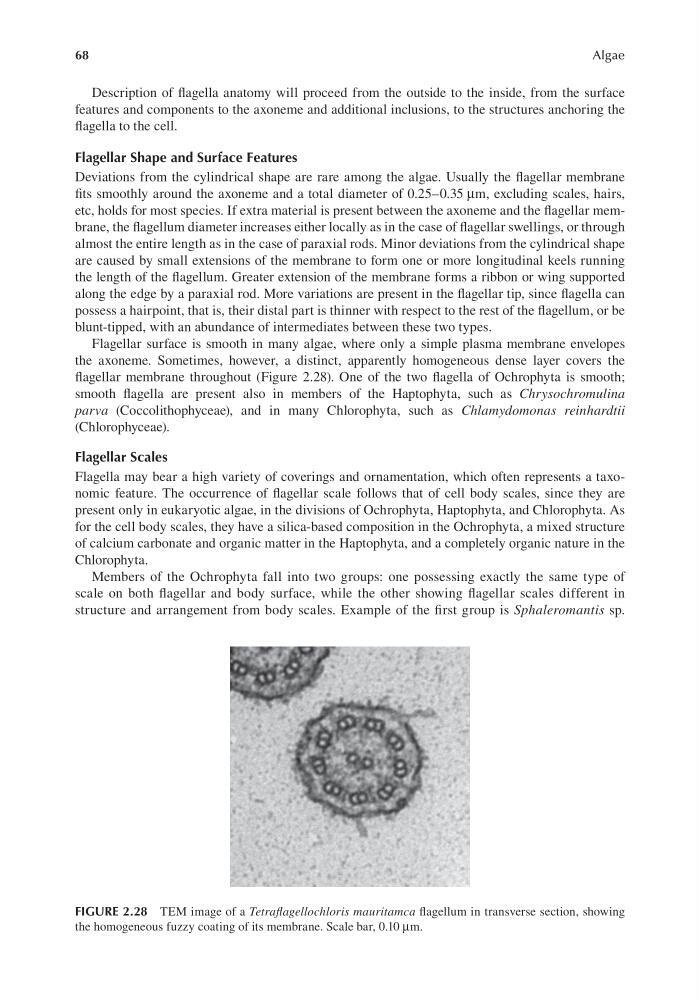
the axoneme. Sometimes, however, a distinct, apparently homogeneous dense layer covers the
flagellar membrane throughout (Figure 2.28). One of the two flagella of Ochrophyta is smooth;
smooth flagella are present also in members of the Haptophyta, such as Chrysochromulina
parva (Coccolithophyceae), and in many Chlorophyta, such as Chlamydomonas reinhardtii
(Chlorophyceae).
Flagellar Scales
Flagella may bear a high variety of coverings and ornamentation, which often represents a taxonomic feature. The occurrence of flagellar scale follows that of cell body scales, since they are
present only in eukaryotic algae, in the divisions of Ochrophyta, Haptophyta, and Chlorophyta. As
for the cell body scales, they have a silica-based composition in the Ochrophyta, a mixed structure
of calcium carbonate and organic matter in the Haptophyta, and a completely organic nature in the
Chlorophyta.
Members of the Ochrophyta fall into two groups: one possessing exactly the same type of
scale on both flagellar and body surface, while the other showing flagellar scales different in
structure and arrangement from body scales. Example of the first group is Sphaleromantis sp.
FIGURE 2.28 TEM image of a Tetraflagellochloris mauritamca flagellum in transverse section, showing
the homogeneous fuzzy coating of its membrane. Scale bar, 0.10 μm.
Algae
Description of flagella anatomy will proceed from the outside to the inside, from the surface
features and components to the axoneme and additional inclusions, to the structures anchoring the
flagella to the cell.
Flagellar Shape and Surface Features
Deviations from the cylindrical shape are rare among the algae. Usually the flagellar membrane
fits smoothly around the axoneme and a total diameter of 0.25–0.35 μm, excluding scales, hairs,
etc, holds for most species. If extra material is present between the axoneme and the flagellar membrane, the flagellum diameter increases either locally as in the case of flagellar swellings, or through
almost the entire length as in the case of paraxial rods. Minor deviations from the cylindrical shape
are caused by small extensions of the membrane to form one or more longitudinal keels running
the length of the flagellum. Greater extension of the membrane forms a ribbon or wing supported
along the edge by a paraxial rod. More variations are present in the flagellar tip, since flagella can
possess a hairpoint, that is, their distal part is thinner with respect to the rest of the flagellum, or be
blunt-tipped, with an abundance of intermediates between these two types.
Flagellar surface is smooth in many algae, where only a simple plasma membrane envelopes
the axoneme. Sometimes, however, a distinct, apparently homogeneous dense layer covers the
flagellar membrane throughout (Figure 2.28). One of the two flagella of Ochrophyta is smooth;
smooth flagella are present also in members of the Haptophyta, such as Chrysochromulina
parva (Coccolithophyceae), and in many Chlorophyta, such as Chlamydomonas reinhardtii
(Chlorophyceae).
Flagellar Scales
Flagella may bear a high variety of coverings and ornamentation, which often represents a taxonomic feature. The occurrence of flagellar scale follows that of cell body scales, since they are
present only in eukaryotic algae, in the divisions of Ochrophyta, Haptophyta, and Chlorophyta. As
for the cell body scales, they have a silica-based composition in the Ochrophyta, a mixed structure
of calcium carbonate and organic matter in the Haptophyta, and a completely organic nature in the
Chlorophyta.
Members of the Ochrophyta fall into two groups: one possessing exactly the same type of
scale on both flagellar and body surface, while the other showing flagellar scales different in
structure and arrangement from body scales. Example of the first group is Sphaleromantis sp.
FIGURE 2.28 TEM image of a Tetraflagellochloris mauritamca flagellum in transverse section, showing
the homogeneous fuzzy coating of its membrane. Scale bar, 0.10 μm.