

67
Anatomy
convincing example of this derivation is Polytomella agilis (Chlorophyceae) from Chlamydomonas
sp. (Chlorophyceae). A triflagellate type of zoospore such as that of Acrochaete wittrockii
(Ulvophyceae) may have originated from a quadriflagellate ancestor by reduction, whereas the few
uniflagellate forms are most likely descendant of biflagellated cells. Intermediate cases exist which
carry a short second flagellum, as in Mantoniella squamata (Mamiellophyceae) or Euglena gracilis
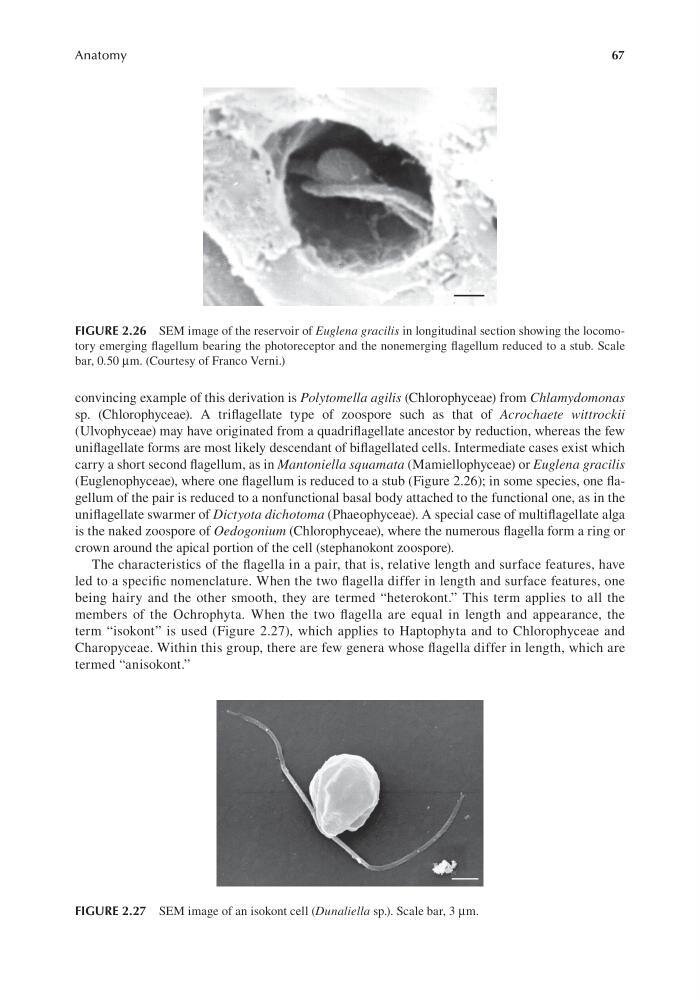
(Euglenophyceae), where one flagellum is reduced to a stub (Figure 2.26); in some species, one flagellum of the pair is reduced to a nonfunctional basal body attached to the functional one, as in the
uniflagellate swarmer of Dictyota dichotoma (Phaeophyceae). A special case of multiflagellate alga
is the naked zoospore of Oedogonium (Chlorophyceae), where the numerous flagella form a ring or
crown around the apical portion of the cell (stephanokont zoospore).
The characteristics of the flagella in a pair, that is, relative length and surface features, have
led to a specific nomenclature. When the two flagella differ in length and surface features, one
being hairy and the other smooth, they are termed “heterokont.” This term applies to all the
members of the Ochrophyta. When the two flagella are equal in length and appearance, the
term “isokont” is used (Figure 2.27), which applies to Haptophyta and to Chlorophyceae and
Charopyceae. Within this group, there are few genera whose flagella differ in length, which are
termed “anisokont.”
FIGURE 2.26 SEM image of the reservoir of Euglena gracilis in longitudinal section showing the locomotory emerging flagellum bearing the photoreceptor and the nonemerging flagellum reduced to a stub. Scale
bar, 0.50 μm. (Courtesy of Franco Verni.)
FIGURE 2.27 SEM image of an isokont cell (Dunaliella sp.). Scale bar, 3 μm.
Anatomy
convincing example of this derivation is Polytomella agilis (Chlorophyceae) from Chlamydomonas
sp. (Chlorophyceae). A triflagellate type of zoospore such as that of Acrochaete wittrockii
(Ulvophyceae) may have originated from a quadriflagellate ancestor by reduction, whereas the few
uniflagellate forms are most likely descendant of biflagellated cells. Intermediate cases exist which
carry a short second flagellum, as in Mantoniella squamata (Mamiellophyceae) or Euglena gracilis
(Euglenophyceae), where one flagellum is reduced to a stub (Figure 2.26); in some species, one flagellum of the pair is reduced to a nonfunctional basal body attached to the functional one, as in the
uniflagellate swarmer of Dictyota dichotoma (Phaeophyceae). A special case of multiflagellate alga
is the naked zoospore of Oedogonium (Chlorophyceae), where the numerous flagella form a ring or
crown around the apical portion of the cell (stephanokont zoospore).
The characteristics of the flagella in a pair, that is, relative length and surface features, have
led to a specific nomenclature. When the two flagella differ in length and surface features, one
being hairy and the other smooth, they are termed “heterokont.” This term applies to all the
members of the Ochrophyta. When the two flagella are equal in length and appearance, the
term “isokont” is used (Figure 2.27), which applies to Haptophyta and to Chlorophyceae and
Charopyceae. Within this group, there are few genera whose flagella differ in length, which are
termed “anisokont.”
FIGURE 2.26 SEM image of the reservoir of Euglena gracilis in longitudinal section showing the locomotory emerging flagellum bearing the photoreceptor and the nonemerging flagellum reduced to a stub. Scale
bar, 0.50 μm. (Courtesy of Franco Verni.)
FIGURE 2.27 SEM image of an isokont cell (Dunaliella sp.). Scale bar, 3 μm.