

61
Anatomy
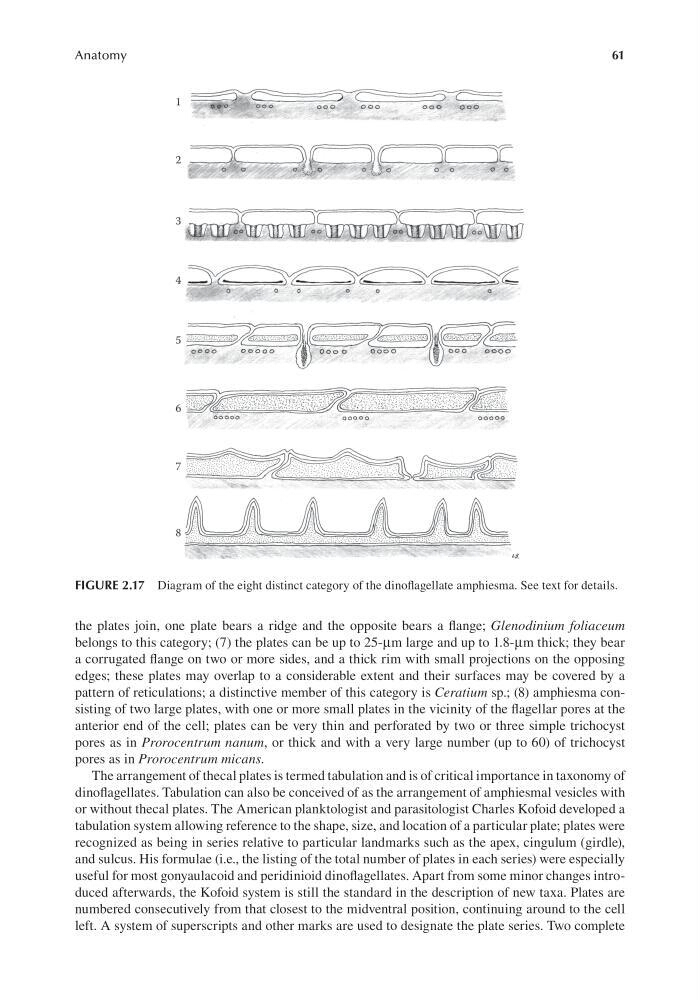
the plates join, one plate bears a ridge and the opposite bears a flange; Glenodinium foliaceum
belongs to this category; (7) the plates can be up to 25-μm large and up to 1.8-μm thick; they bear
a corrugated flange on two or more sides, and a thick rim with small projections on the opposing
edges; these plates may overlap to a considerable extent and their surfaces may be covered by a
pattern of reticulations; a distinctive member of this category is Ceratium sp.; (8) amphiesma consisting of two large plates, with one or more small plates in the vicinity of the flagellar pores at the
anterior end of the cell; plates can be very thin and perforated by two or three simple trichocyst
pores as in Prorocentrum nanum, or thick and with a very large number (up to 60) of trichocyst
pores as in Prorocentrum micans.
The arrangement of thecal plates is termed tabulation and is of critical importance in taxonomy of
dinoflagellates. Tabulation can also be conceived of as the arrangement of amphiesmal vesicles with
or without thecal plates. The American planktologist and parasitologist Charles Kofoid developed a
tabulation system allowing reference to the shape, size, and location of a particular plate; plates were
recognized as being in series relative to particular landmarks such as the apex, cingulum (girdle),
and sulcus. His formulae (i.e., the listing of the total number of plates in each series) were especially
useful for most gonyaulacoid and peridinioid dinoflagellates. Apart from some minor changes introduced afterwards, the Kofoid system is still the standard in the description of new taxa. Plates are
numbered consecutively from that closest to the midventral position, continuing around to the cell
left. A system of superscripts and other marks are used to designate the plate series. Two complete
FIGURE 2.17 Diagram of the eight distinct category of the dinoflagellate amphiesma. See text for details.
Anatomy
the plates join, one plate bears a ridge and the opposite bears a flange; Glenodinium foliaceum
belongs to this category; (7) the plates can be up to 25-μm large and up to 1.8-μm thick; they bear
a corrugated flange on two or more sides, and a thick rim with small projections on the opposing
edges; these plates may overlap to a considerable extent and their surfaces may be covered by a
pattern of reticulations; a distinctive member of this category is Ceratium sp.; (8) amphiesma consisting of two large plates, with one or more small plates in the vicinity of the flagellar pores at the
anterior end of the cell; plates can be very thin and perforated by two or three simple trichocyst
pores as in Prorocentrum nanum, or thick and with a very large number (up to 60) of trichocyst
pores as in Prorocentrum micans.
The arrangement of thecal plates is termed tabulation and is of critical importance in taxonomy of
dinoflagellates. Tabulation can also be conceived of as the arrangement of amphiesmal vesicles with
or without thecal plates. The American planktologist and parasitologist Charles Kofoid developed a
tabulation system allowing reference to the shape, size, and location of a particular plate; plates were
recognized as being in series relative to particular landmarks such as the apex, cingulum (girdle),
and sulcus. His formulae (i.e., the listing of the total number of plates in each series) were especially
useful for most gonyaulacoid and peridinioid dinoflagellates. Apart from some minor changes introduced afterwards, the Kofoid system is still the standard in the description of new taxa. Plates are
numbered consecutively from that closest to the midventral position, continuing around to the cell
left. A system of superscripts and other marks are used to designate the plate series. Two complete
FIGURE 2.17 Diagram of the eight distinct category of the dinoflagellate amphiesma. See text for details.