

17
General Overview
2. Obligate phototrophic algae: their primary mode of nutrition is phototrophy, but they
can supplement growth by phagotrophy and/or osmotrophy when light is limiting (e.g.,
Dinobryon divergens, Ochrophyta);
3. Facultative mixotrophic algae: they can grow equally well as photoautotrophs and as heterotrophs (e.g., Fragilidium subglobosum, Myzozoa);
4. Obligate mixotrophic algae: their primary mode of nutrition is phototrophy, but phagotrophy and/or osmotrophy provide substances essential for growth (in this group, we can
include photoautoxotrophic algae) (e.g., Euglena gracilis, Euglenozoa).
REPRODUCTION
Methods of reproduction in algae may be vegetative by division of a single cell or fragmentation of a
colony, asexual by production of motile spore, or sexual by union of gametes. Vegetative and asexual
mode allows stability of an adapted genotype within a species from a generation to the next. Both
modes provide a fast and economical means of increasing the number of individuals while restricting
genetic variability. Sexual mode involves plasmogamy (union of cells), karyogamy (union of nuclei),
chromosome/gene association, and meiosis, resulting in genetic recombination. Sexual reproduction
allows for variation but is more costly, because of the waste of gametes that fail to mate.
VegeTaTiVe and asexUal reprodUcTion
Binary Fission or Cellular Bisection
It is the simplest form of reproduction; the parent organism divides into two equal parts, each having
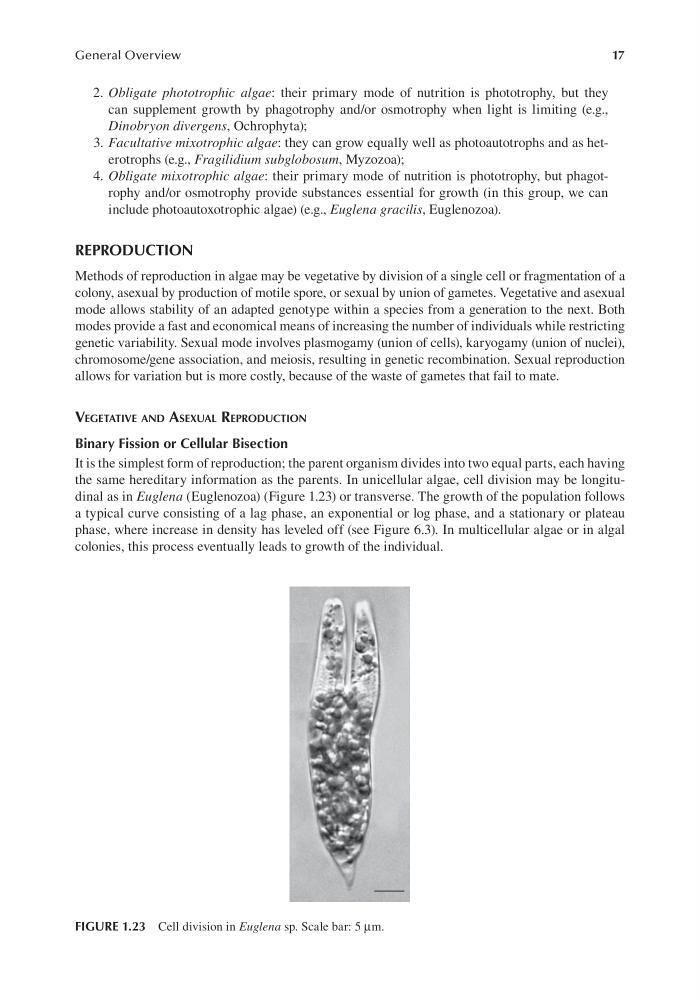
the same hereditary information as the parents. In unicellular algae, cell division may be longitudinal as in Euglena (Euglenozoa) (Figure 1.23) or transverse. The growth of the population follows
a typical curve consisting of a lag phase, an exponential or log phase, and a stationary or plateau
phase, where increase in density has leveled off (see Figure 6.3). In multicellular algae or in algal
colonies, this process eventually leads to growth of the individual.
FIGURE 1.23 Cell division in Euglena sp. Scale bar: 5 μm.
General Overview
2. Obligate phototrophic algae: their primary mode of nutrition is phototrophy, but they
can supplement growth by phagotrophy and/or osmotrophy when light is limiting (e.g.,
Dinobryon divergens, Ochrophyta);
3. Facultative mixotrophic algae: they can grow equally well as photoautotrophs and as heterotrophs (e.g., Fragilidium subglobosum, Myzozoa);
4. Obligate mixotrophic algae: their primary mode of nutrition is phototrophy, but phagotrophy and/or osmotrophy provide substances essential for growth (in this group, we can
include photoautoxotrophic algae) (e.g., Euglena gracilis, Euglenozoa).
REPRODUCTION
Methods of reproduction in algae may be vegetative by division of a single cell or fragmentation of a
colony, asexual by production of motile spore, or sexual by union of gametes. Vegetative and asexual
mode allows stability of an adapted genotype within a species from a generation to the next. Both
modes provide a fast and economical means of increasing the number of individuals while restricting
genetic variability. Sexual mode involves plasmogamy (union of cells), karyogamy (union of nuclei),
chromosome/gene association, and meiosis, resulting in genetic recombination. Sexual reproduction
allows for variation but is more costly, because of the waste of gametes that fail to mate.
VegeTaTiVe and asexUal reprodUcTion
Binary Fission or Cellular Bisection
It is the simplest form of reproduction; the parent organism divides into two equal parts, each having
the same hereditary information as the parents. In unicellular algae, cell division may be longitudinal as in Euglena (Euglenozoa) (Figure 1.23) or transverse. The growth of the population follows
a typical curve consisting of a lag phase, an exponential or log phase, and a stationary or plateau
phase, where increase in density has leveled off (see Figure 6.3). In multicellular algae or in algal
colonies, this process eventually leads to growth of the individual.
FIGURE 1.23 Cell division in Euglena sp. Scale bar: 5 μm.