

18
Algae
Zoospore, Aplanospore, and Autospore
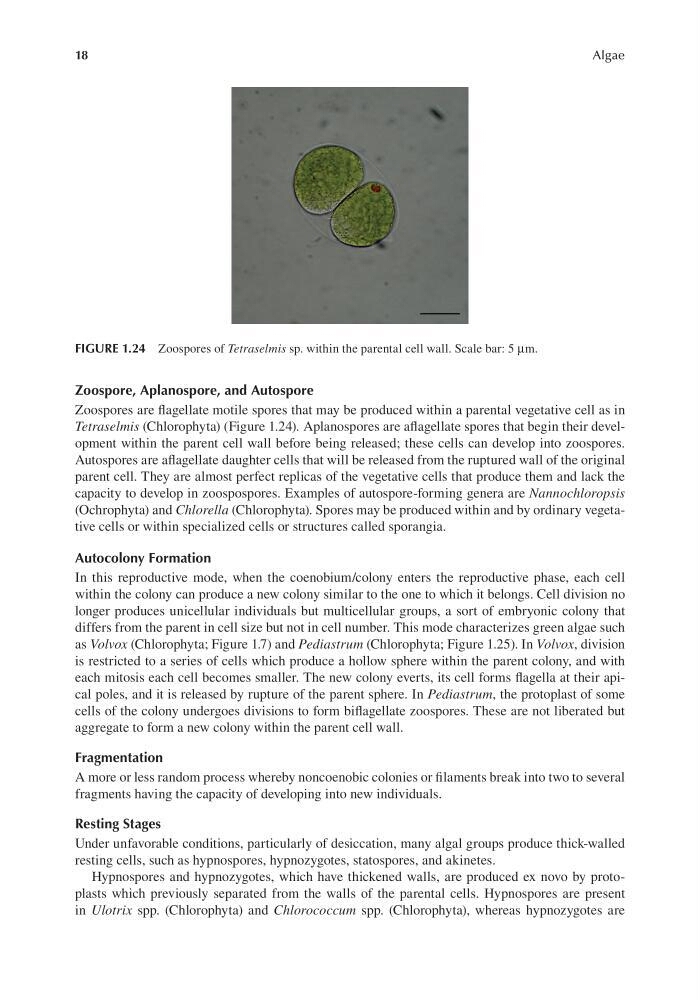
Zoospores are flagellate motile spores that may be produced within a parental vegetative cell as in
Tetraselmis (Chlorophyta) (Figure 1.24). Aplanospores are aflagellate spores that begin their development within the parent cell wall before being released; these cells can develop into zoospores.
Autospores are aflagellate daughter cells that will be released from the ruptured wall of the original
parent cell. They are almost perfect replicas of the vegetative cells that produce them and lack the
capacity to develop in zoospospores. Examples of autospore-forming genera are Nannochloropsis
(Ochrophyta) and Chlorella (Chlorophyta). Spores may be produced within and by ordinary vegetative cells or within specialized cells or structures called sporangia.
Autocolony Formation
In this reproductive mode, when the coenobium/colony enters the reproductive phase, each cell
within the colony can produce a new colony similar to the one to which it belongs. Cell division no
longer produces unicellular individuals but multicellular groups, a sort of embryonic colony that
differs from the parent in cell size but not in cell number. This mode characterizes green algae such
as Volvox (Chlorophyta; Figure 1.7) and Pediastrum (Chlorophyta; Figure 1.25). In Volvox, division
is restricted to a series of cells which produce a hollow sphere within the parent colony, and with
each mitosis each cell becomes smaller. The new colony everts, its cell forms flagella at their apical poles, and it is released by rupture of the parent sphere. In Pediastrum, the protoplast of some
cells of the colony undergoes divisions to form biflagellate zoospores. These are not liberated but
aggregate to form a new colony within the parent cell wall.
Fragmentation
A more or less random process whereby noncoenobic colonies or filaments break into two to several
fragments having the capacity of developing into new individuals.
Resting Stages
Under unfavorable conditions, particularly of desiccation, many algal groups produce thick-walled
resting cells, such as hypnospores, hypnozygotes, statospores, and akinetes.
Hypnospores and hypnozygotes, which have thickened walls, are produced ex novo by protoplasts which previously separated from the walls of the parental cells. Hypnospores are present
in Ulotrix spp. (Chlorophyta) and Chlorococcum spp. (Chlorophyta), whereas hypnozygotes are
FIGURE 1.24 Zoospores of Tetraselmis sp. within the parental cell wall. Scale bar: 5 μm.
Algae
Zoospore, Aplanospore, and Autospore
Zoospores are flagellate motile spores that may be produced within a parental vegetative cell as in
Tetraselmis (Chlorophyta) (Figure 1.24). Aplanospores are aflagellate spores that begin their development within the parent cell wall before being released; these cells can develop into zoospores.
Autospores are aflagellate daughter cells that will be released from the ruptured wall of the original
parent cell. They are almost perfect replicas of the vegetative cells that produce them and lack the
capacity to develop in zoospospores. Examples of autospore-forming genera are Nannochloropsis
(Ochrophyta) and Chlorella (Chlorophyta). Spores may be produced within and by ordinary vegetative cells or within specialized cells or structures called sporangia.
Autocolony Formation
In this reproductive mode, when the coenobium/colony enters the reproductive phase, each cell
within the colony can produce a new colony similar to the one to which it belongs. Cell division no
longer produces unicellular individuals but multicellular groups, a sort of embryonic colony that
differs from the parent in cell size but not in cell number. This mode characterizes green algae such
as Volvox (Chlorophyta; Figure 1.7) and Pediastrum (Chlorophyta; Figure 1.25). In Volvox, division
is restricted to a series of cells which produce a hollow sphere within the parent colony, and with
each mitosis each cell becomes smaller. The new colony everts, its cell forms flagella at their apical poles, and it is released by rupture of the parent sphere. In Pediastrum, the protoplast of some
cells of the colony undergoes divisions to form biflagellate zoospores. These are not liberated but
aggregate to form a new colony within the parent cell wall.
Fragmentation
A more or less random process whereby noncoenobic colonies or filaments break into two to several
fragments having the capacity of developing into new individuals.
Resting Stages
Under unfavorable conditions, particularly of desiccation, many algal groups produce thick-walled
resting cells, such as hypnospores, hypnozygotes, statospores, and akinetes.
Hypnospores and hypnozygotes, which have thickened walls, are produced ex novo by protoplasts which previously separated from the walls of the parental cells. Hypnospores are present
in Ulotrix spp. (Chlorophyta) and Chlorococcum spp. (Chlorophyta), whereas hypnozygotes are
FIGURE 1.24 Zoospores of Tetraselmis sp. within the parental cell wall. Scale bar: 5 μm.