

15
General Overview
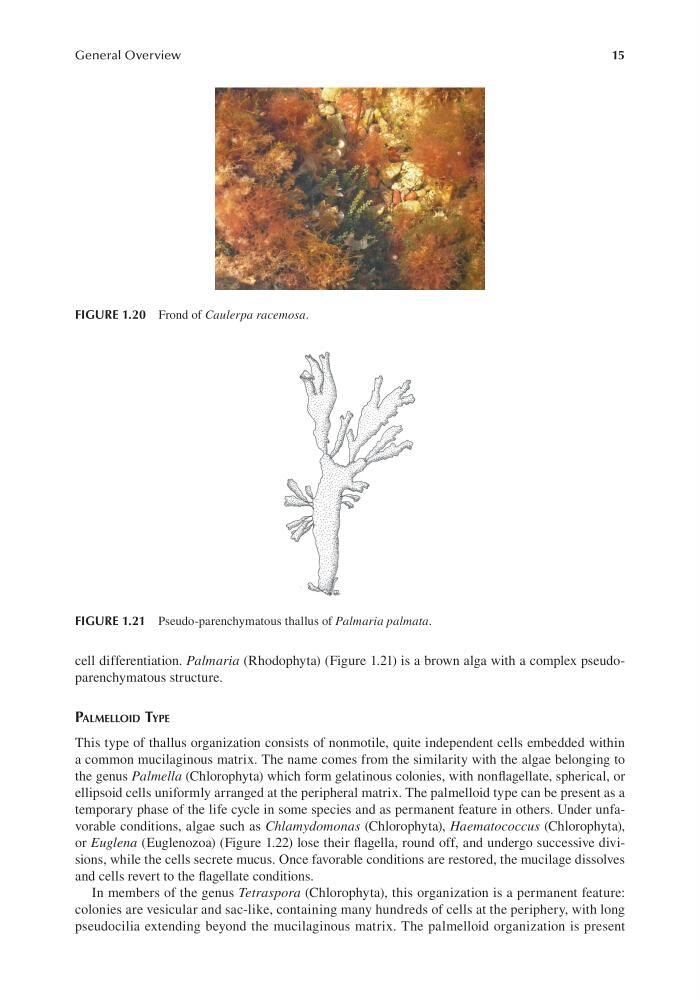
cell differentiation. Palmaria (Rhodophyta) (Figure 1.21) is a brown alga with a complex pseudoparenchymatous structure.
palmelloid Type
This type of thallus organization consists of nonmotile, quite independent cells embedded within
a common mucilaginous matrix. The name comes from the similarity with the algae belonging to
the genus Palmella (Chlorophyta) which form gelatinous colonies, with nonflagellate, spherical, or
ellipsoid cells uniformly arranged at the peripheral matrix. The palmelloid type can be present as a
temporary phase of the life cycle in some species and as permanent feature in others. Under unfavorable conditions, algae such as Chlamydomonas (Chlorophyta), Haematococcus (Chlorophyta),
or Euglena (Euglenozoa) (Figure 1.22) lose their flagella, round off, and undergo successive divisions, while the cells secrete mucus. Once favorable conditions are restored, the mucilage dissolves
and cells revert to the flagellate conditions.
In members of the genus Tetraspora (Chlorophyta), this organization is a permanent feature:
colonies are vesicular and sac-like, containing many hundreds of cells at the periphery, with long
pseudocilia extending beyond the mucilaginous matrix. The palmelloid organization is present
FIGURE 1.20 Frond of Caulerpa racemosa.
FIGURE 1.21 Pseudo-parenchymatous thallus of Palmaria palmata.
General Overview
cell differentiation. Palmaria (Rhodophyta) (Figure 1.21) is a brown alga with a complex pseudoparenchymatous structure.
palmelloid Type
This type of thallus organization consists of nonmotile, quite independent cells embedded within
a common mucilaginous matrix. The name comes from the similarity with the algae belonging to
the genus Palmella (Chlorophyta) which form gelatinous colonies, with nonflagellate, spherical, or
ellipsoid cells uniformly arranged at the peripheral matrix. The palmelloid type can be present as a
temporary phase of the life cycle in some species and as permanent feature in others. Under unfavorable conditions, algae such as Chlamydomonas (Chlorophyta), Haematococcus (Chlorophyta),
or Euglena (Euglenozoa) (Figure 1.22) lose their flagella, round off, and undergo successive divisions, while the cells secrete mucus. Once favorable conditions are restored, the mucilage dissolves
and cells revert to the flagellate conditions.
In members of the genus Tetraspora (Chlorophyta), this organization is a permanent feature:
colonies are vesicular and sac-like, containing many hundreds of cells at the periphery, with long
pseudocilia extending beyond the mucilaginous matrix. The palmelloid organization is present
FIGURE 1.20 Frond of Caulerpa racemosa.
FIGURE 1.21 Pseudo-parenchymatous thallus of Palmaria palmata.