

98
Algae
swimming, these cells also rotate. Speeds ranging from 100 to 200 μm s −1 can be reached by these
cells during forward swimming. Backward swimming is also possible, during which the flagella
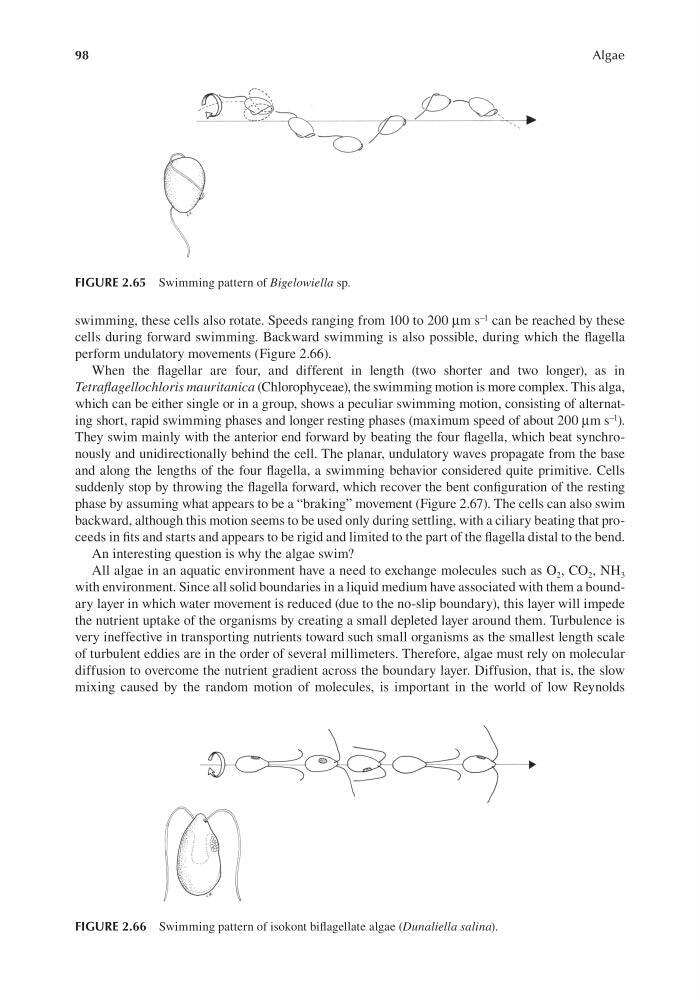
perform undulatory movements (Figure 2.66).
When the flagellar are four, and different in length (two shorter and two longer), as in
Tetraflagellochloris mauritanica (Chlorophyceae), the swimming motion is more complex. This alga,
which can be either single or in a group, shows a peculiar swimming motion, consisting of alternating short, rapid swimming phases and longer resting phases (maximum speed of about 200 μm s −1 ).
They swim mainly with the anterior end forward by beating the four flagella, which beat synchronously and unidirectionally behind the cell. The planar, undulatory waves propagate from the base
and along the lengths of the four flagella, a swimming behavior considered quite primitive. Cells
suddenly stop by throwing the flagella forward, which recover the bent configuration of the resting
phase by assuming what appears to be a “braking” movement (Figure 2.67). The cells can also swim
backward, although this motion seems to be used only during settling, with a ciliary beating that proceeds in fits and starts and appears to be rigid and limited to the part of the flagella distal to the bend.
An interesting question is why the algae swim?
All algae in an aquatic environment have a need to exchange molecules such as O 2 , CO 2 , NH 3
with environment. Since all solid boundaries in a liquid medium have associated with them a boundary layer in which water movement is reduced (due to the no-slip boundary), this layer will impede
the nutrient uptake of the organisms by creating a small depleted layer around them. Turbulence is
very ineffective in transporting nutrients toward such small organisms as the smallest length scale
of turbulent eddies are in the order of several millimeters. Therefore, algae must rely on molecular
diffusion to overcome the nutrient gradient across the boundary layer. Diffusion, that is, the slow
mixing caused by the random motion of molecules, is important in the world of low Reynolds
FIGURE 2.65 Swimming pattern of Bigelowiella sp.
FIGURE 2.66 Swimming pattern of isokont biflagellate algae (Dunaliella salina).
Algae
swimming, these cells also rotate. Speeds ranging from 100 to 200 μm s −1 can be reached by these
cells during forward swimming. Backward swimming is also possible, during which the flagella
perform undulatory movements (Figure 2.66).
When the flagellar are four, and different in length (two shorter and two longer), as in
Tetraflagellochloris mauritanica (Chlorophyceae), the swimming motion is more complex. This alga,
which can be either single or in a group, shows a peculiar swimming motion, consisting of alternating short, rapid swimming phases and longer resting phases (maximum speed of about 200 μm s −1 ).
They swim mainly with the anterior end forward by beating the four flagella, which beat synchronously and unidirectionally behind the cell. The planar, undulatory waves propagate from the base
and along the lengths of the four flagella, a swimming behavior considered quite primitive. Cells
suddenly stop by throwing the flagella forward, which recover the bent configuration of the resting
phase by assuming what appears to be a “braking” movement (Figure 2.67). The cells can also swim
backward, although this motion seems to be used only during settling, with a ciliary beating that proceeds in fits and starts and appears to be rigid and limited to the part of the flagella distal to the bend.
An interesting question is why the algae swim?
All algae in an aquatic environment have a need to exchange molecules such as O 2 , CO 2 , NH 3
with environment. Since all solid boundaries in a liquid medium have associated with them a boundary layer in which water movement is reduced (due to the no-slip boundary), this layer will impede
the nutrient uptake of the organisms by creating a small depleted layer around them. Turbulence is
very ineffective in transporting nutrients toward such small organisms as the smallest length scale
of turbulent eddies are in the order of several millimeters. Therefore, algae must rely on molecular
diffusion to overcome the nutrient gradient across the boundary layer. Diffusion, that is, the slow
mixing caused by the random motion of molecules, is important in the world of low Reynolds
FIGURE 2.65 Swimming pattern of Bigelowiella sp.
FIGURE 2.66 Swimming pattern of isokont biflagellate algae (Dunaliella salina).