

97
Anatomy
brings about rotation. The longitudinal flagellum beats with a planar waveform, which contributes
to forward movement. The longitudinal flagellum can also reverse the swimming direction: it stops
beating, points in a different direction by bending, and then resumes beating. This steering ability
is related to change in orientation of basal bodies and contraction of the structures associated to the
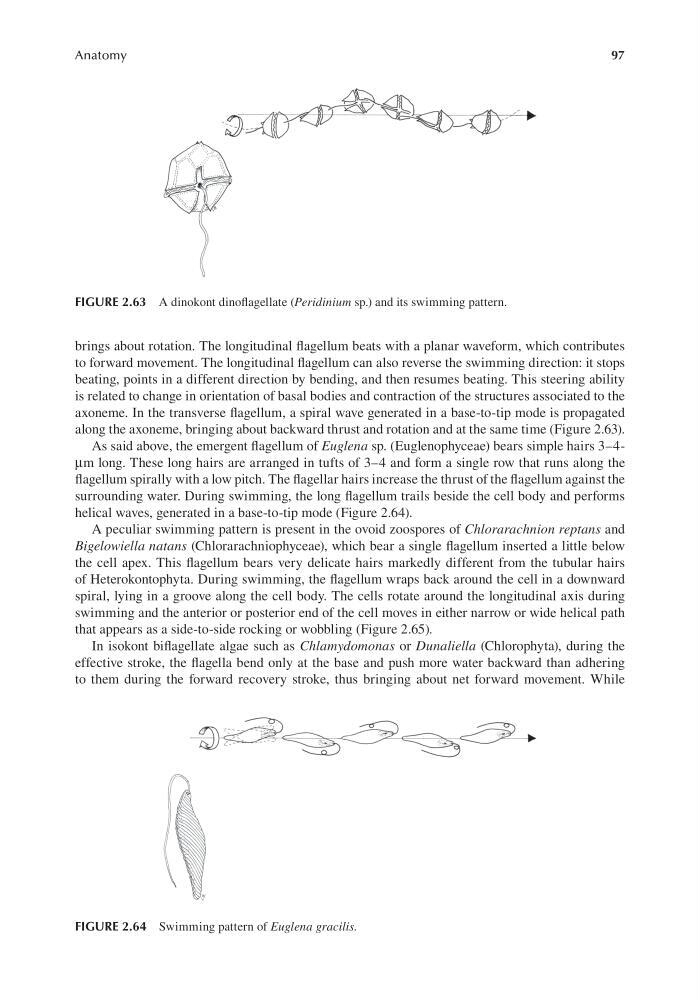
axoneme. In the transverse flagellum, a spiral wave generated in a base-to-tip mode is propagated
along the axoneme, bringing about backward thrust and rotation and at the same time (Figure 2.63).
As said above, the emergent flagellum of Euglena sp. (Euglenophyceae) bears simple hairs 3–4μm long. These long hairs are arranged in tufts of 3–4 and form a single row that runs along the
flagellum spirally with a low pitch. The flagellar hairs increase the thrust of the flagellum against the
surrounding water. During swimming, the long flagellum trails beside the cell body and performs
helical waves, generated in a base-to-tip mode (Figure 2.64).
A peculiar swimming pattern is present in the ovoid zoospores of Chlorarachnion reptans and
Bigelowiella natans (Chlorarachniophyceae), which bear a single flagellum inserted a little below
the cell apex. This flagellum bears very delicate hairs markedly different from the tubular hairs
of Heterokontophyta. During swimming, the flagellum wraps back around the cell in a downward
spiral, lying in a groove along the cell body. The cells rotate around the longitudinal axis during
swimming and the anterior or posterior end of the cell moves in either narrow or wide helical path
that appears as a side-to-side rocking or wobbling (Figure 2.65).
In isokont biflagellate algae such as Chlamydomonas or Dunaliella (Chlorophyta), during the
effective stroke, the flagella bend only at the base and push more water backward than adhering
to them during the forward recovery stroke, thus bringing about net forward movement. While
FIGURE 2.63 A dinokont dinoflagellate (Peridinium sp.) and its swimming pattern.
FIGURE 2.64 Swimming pattern of Euglena gracilis.
Anatomy
brings about rotation. The longitudinal flagellum beats with a planar waveform, which contributes
to forward movement. The longitudinal flagellum can also reverse the swimming direction: it stops
beating, points in a different direction by bending, and then resumes beating. This steering ability
is related to change in orientation of basal bodies and contraction of the structures associated to the
axoneme. In the transverse flagellum, a spiral wave generated in a base-to-tip mode is propagated
along the axoneme, bringing about backward thrust and rotation and at the same time (Figure 2.63).
As said above, the emergent flagellum of Euglena sp. (Euglenophyceae) bears simple hairs 3–4μm long. These long hairs are arranged in tufts of 3–4 and form a single row that runs along the
flagellum spirally with a low pitch. The flagellar hairs increase the thrust of the flagellum against the
surrounding water. During swimming, the long flagellum trails beside the cell body and performs
helical waves, generated in a base-to-tip mode (Figure 2.64).
A peculiar swimming pattern is present in the ovoid zoospores of Chlorarachnion reptans and
Bigelowiella natans (Chlorarachniophyceae), which bear a single flagellum inserted a little below
the cell apex. This flagellum bears very delicate hairs markedly different from the tubular hairs
of Heterokontophyta. During swimming, the flagellum wraps back around the cell in a downward
spiral, lying in a groove along the cell body. The cells rotate around the longitudinal axis during
swimming and the anterior or posterior end of the cell moves in either narrow or wide helical path
that appears as a side-to-side rocking or wobbling (Figure 2.65).
In isokont biflagellate algae such as Chlamydomonas or Dunaliella (Chlorophyta), during the
effective stroke, the flagella bend only at the base and push more water backward than adhering
to them during the forward recovery stroke, thus bringing about net forward movement. While
FIGURE 2.63 A dinokont dinoflagellate (Peridinium sp.) and its swimming pattern.
FIGURE 2.64 Swimming pattern of Euglena gracilis.