

99
Anatomy
number, because of this world stirring is not any good. The alga’s problem is not its energy supply;
its problem is its environment. At low Reynolds number, you cannot shake off your environment. If
you move, you take it along; it only gradually falls behind.
Algae use their motility (be it sinking or swimming) to generate movement relative to the water
and hence replenish the boundary layer with nutrients. Depending on the size of the organism, the
motive for swimming must differ; however, its effects differ significantly. For small algae in the
1–10-μm range, diffusion is about 100 times more effective in supplying nutrients than movement.
This is often expressed as the Sherwood number (S):
S = (
) (
time for transport by diffusion time for transport by movement) )
(
)(
)
( )
,
−
−
− −
−
=
=
1
2
1
1 1
1
L D Lu
Lu D
(2.3)
where L is the distance over which the nutrient is to be transported, u the water velocity, and D the
diffusion constant.
For scale in the order of 1 μm, the ratio is ≈10 −2 . Diffusion is about 100 times faster than movement. Hence, in this world of low Reynolds numbers, nothing is gained by trying to reduce the
diffusion barrier by generating turbulent advection. In this contest, the only possible advantage to
the alga of undertaking locomotion is that it might encounter nutrients in a higher concentration.
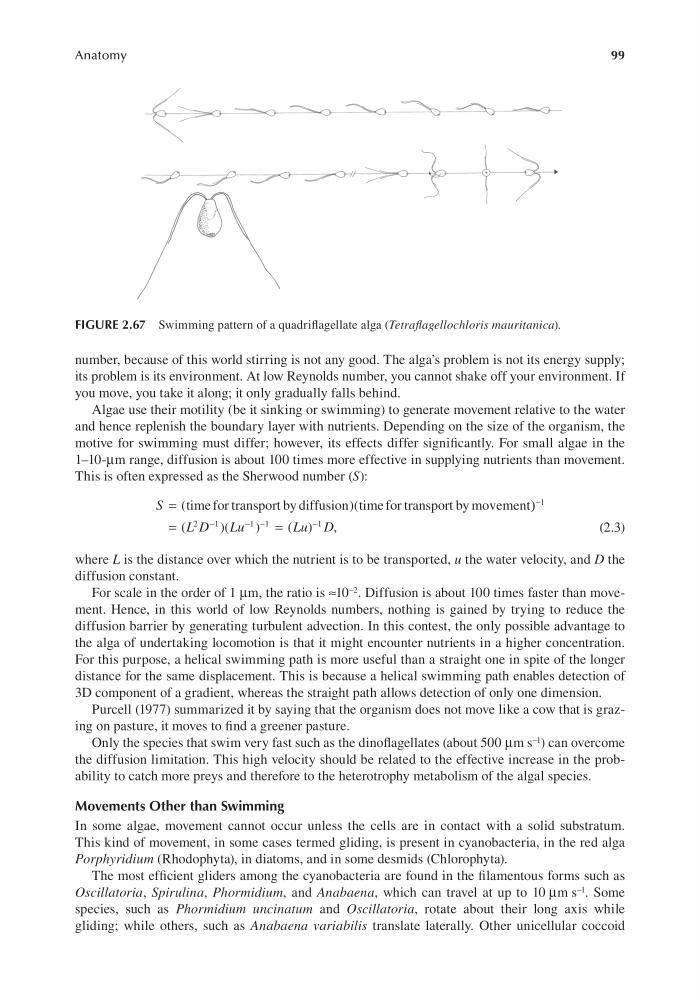
For this purpose, a helical swimming path is more useful than a straight one in spite of the longer
distance for the same displacement. This is because a helical swimming path enables detection of
3D component of a gradient, whereas the straight path allows detection of only one dimension.
Purcell (1977) summarized it by saying that the organism does not move like a cow that is grazing on pasture, it moves to find a greener pasture.
Only the species that swim very fast such as the dinoflagellates (about 500 μm s −1 ) can overcome
the diffusion limitation. This high velocity should be related to the effective increase in the probability to catch more preys and therefore to the heterotrophy metabolism of the algal species.
Movements Other than Swimming
In some algae, movement cannot occur unless the cells are in contact with a solid substratum.
This kind of movement, in some cases termed gliding, is present in cyanobacteria, in the red alga
Porphyridium (Rhodophyta), in diatoms, and in some desmids (Chlorophyta).
The most efficient gliders among the cyanobacteria are found in the filamentous forms such as
Oscillatoria, Spirulina, Phormidium, and Anabaena, which can travel at up to 10 μm s −1 . Some
species, such as Phormidium uncinatum and Oscillatoria, rotate about their long axis while
gliding; while others, such as Anabaena variabilis translate laterally. Other unicellular coccoid
FIGURE 2.67 Swimming pattern of a quadriflagellate alga (Tetraflagellochloris mauritanica).
Anatomy
number, because of this world stirring is not any good. The alga’s problem is not its energy supply;
its problem is its environment. At low Reynolds number, you cannot shake off your environment. If
you move, you take it along; it only gradually falls behind.
Algae use their motility (be it sinking or swimming) to generate movement relative to the water
and hence replenish the boundary layer with nutrients. Depending on the size of the organism, the
motive for swimming must differ; however, its effects differ significantly. For small algae in the
1–10-μm range, diffusion is about 100 times more effective in supplying nutrients than movement.
This is often expressed as the Sherwood number (S):
S = (
) (
time for transport by diffusion time for transport by movement) )
(
)(
)
( )
,
−
−
− −
−
=
=
1
2
1
1 1
1
L D Lu
Lu D
(2.3)
where L is the distance over which the nutrient is to be transported, u the water velocity, and D the
diffusion constant.
For scale in the order of 1 μm, the ratio is ≈10 −2 . Diffusion is about 100 times faster than movement. Hence, in this world of low Reynolds numbers, nothing is gained by trying to reduce the
diffusion barrier by generating turbulent advection. In this contest, the only possible advantage to
the alga of undertaking locomotion is that it might encounter nutrients in a higher concentration.
For this purpose, a helical swimming path is more useful than a straight one in spite of the longer
distance for the same displacement. This is because a helical swimming path enables detection of
3D component of a gradient, whereas the straight path allows detection of only one dimension.
Purcell (1977) summarized it by saying that the organism does not move like a cow that is grazing on pasture, it moves to find a greener pasture.
Only the species that swim very fast such as the dinoflagellates (about 500 μm s −1 ) can overcome
the diffusion limitation. This high velocity should be related to the effective increase in the probability to catch more preys and therefore to the heterotrophy metabolism of the algal species.
Movements Other than Swimming
In some algae, movement cannot occur unless the cells are in contact with a solid substratum.
This kind of movement, in some cases termed gliding, is present in cyanobacteria, in the red alga
Porphyridium (Rhodophyta), in diatoms, and in some desmids (Chlorophyta).
The most efficient gliders among the cyanobacteria are found in the filamentous forms such as
Oscillatoria, Spirulina, Phormidium, and Anabaena, which can travel at up to 10 μm s −1 . Some
species, such as Phormidium uncinatum and Oscillatoria, rotate about their long axis while
gliding; while others, such as Anabaena variabilis translate laterally. Other unicellular coccoid
FIGURE 2.67 Swimming pattern of a quadriflagellate alga (Tetraflagellochloris mauritanica).