

90
Algae
Only few data are available on the flagellar roots of Eustigmatophyceae. Both microtubular and
cross-banded fibrillar types are present. The microtubular structures, consisting of 2–5 microtubules, arise close to the basal bodies and pass anteriorly and posteriorly in the cell. The crossbanded roots are narrow and pass from the region of the flagellar bases along the anterior flattened
face of the nucleus.
The ultrastructure of the flagellar root system has been described only in one species of
Bacillariophyceae, Biddulphia laevis. In the spindle-shaped spermatoids of this centric diatom, a
system of microtubules radiates from the only basal body present into the cell, to form a cone on the
anterior part of the nucleus, and at least some of these microtubules extend throughout the length of
the cell. They appear to maintain the elongated shape of the nucleus and thus probably of the cell
itself.
An elaborate root system connects the basal bodies to the anterior surface of the nucleus in the
Raphidophyceae. In Chattonella, two or three roots have been described: one multilayered, associated with the pleuronematic flagellum, and one with the smooth flagellum. The latter is a band of
9–10 microtubules which extends from the anterior part of the cell, passing between the basal bodies, and joining with other microtubules before extending along the nucleus in a depression of its
surface. A large number of distinctly cross-banded fibrous roots are also present, extending from the
flagellar bases to ensheathe the anterior cone of the nucleus.
In the Phaeophyceae, the structure of the flagellar root system appears remarkably uniform.
The main characteristic of the system is the root supporting the flat, elastic proboscis in spermatozoids of brown algae. In Fucus, this root is very broad, contains usually seven microtubules (but
there can be up to 15 microtubules), which travel from the base of the anterior flagellum along the
plasmalemma to the anterior end of the cell, where the proboscis is located. Here, they bend back
and run along the cell membrane on the opposite side. A bypassing microtubular root, of about five
microtubules, originates in the anterior part of the cell, runs along the proboscis root, bypasses the
basal bodies, without contact, and continues toward the posterior part of the cell. Two other minor
microtubular roots, consisting of only one microtubule, are present, one extending anteriorly, and
the other posteriorly. The basal bodies are interlinked by three cross-banded connectives, the deltoid, the strap-shaped, and the button-shaped bands (Figure 2.56).
LF
SF
R4
R3
R2
R1
RHP
N
R3
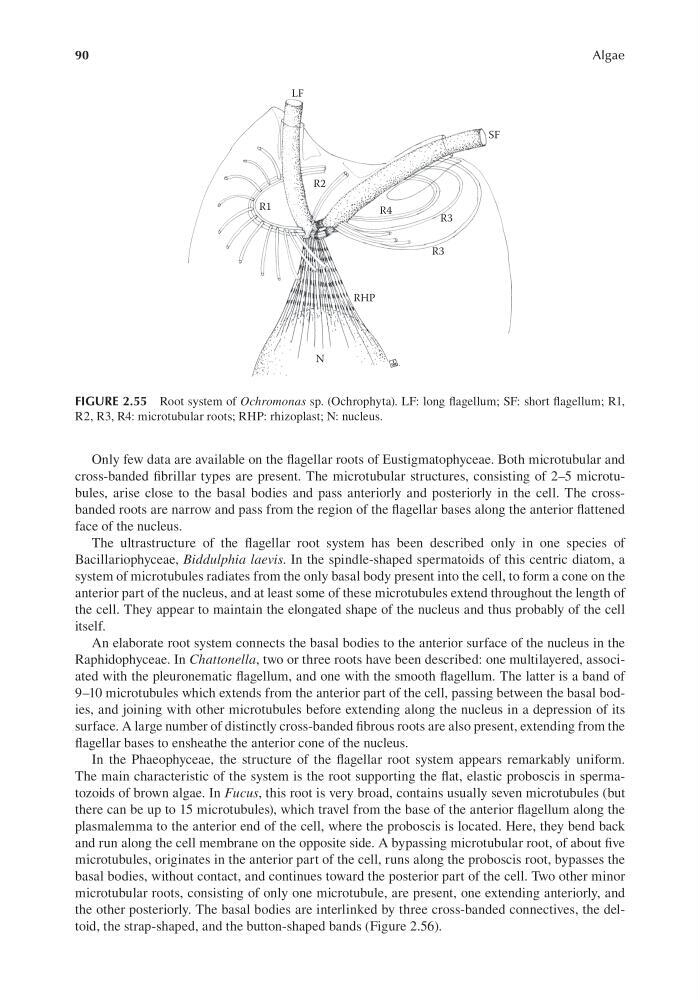
FIGURE 2.55 Root system of Ochromonas sp. (Ochrophyta). LF: long flagellum; SF: short flagellum; R1,
R2, R3, R4: microtubular roots; RHP: rhizoplast; N: nucleus.
Algae
Only few data are available on the flagellar roots of Eustigmatophyceae. Both microtubular and
cross-banded fibrillar types are present. The microtubular structures, consisting of 2–5 microtubules, arise close to the basal bodies and pass anteriorly and posteriorly in the cell. The crossbanded roots are narrow and pass from the region of the flagellar bases along the anterior flattened
face of the nucleus.
The ultrastructure of the flagellar root system has been described only in one species of
Bacillariophyceae, Biddulphia laevis. In the spindle-shaped spermatoids of this centric diatom, a
system of microtubules radiates from the only basal body present into the cell, to form a cone on the
anterior part of the nucleus, and at least some of these microtubules extend throughout the length of
the cell. They appear to maintain the elongated shape of the nucleus and thus probably of the cell
itself.
An elaborate root system connects the basal bodies to the anterior surface of the nucleus in the
Raphidophyceae. In Chattonella, two or three roots have been described: one multilayered, associated with the pleuronematic flagellum, and one with the smooth flagellum. The latter is a band of
9–10 microtubules which extends from the anterior part of the cell, passing between the basal bodies, and joining with other microtubules before extending along the nucleus in a depression of its
surface. A large number of distinctly cross-banded fibrous roots are also present, extending from the
flagellar bases to ensheathe the anterior cone of the nucleus.
In the Phaeophyceae, the structure of the flagellar root system appears remarkably uniform.
The main characteristic of the system is the root supporting the flat, elastic proboscis in spermatozoids of brown algae. In Fucus, this root is very broad, contains usually seven microtubules (but
there can be up to 15 microtubules), which travel from the base of the anterior flagellum along the
plasmalemma to the anterior end of the cell, where the proboscis is located. Here, they bend back
and run along the cell membrane on the opposite side. A bypassing microtubular root, of about five
microtubules, originates in the anterior part of the cell, runs along the proboscis root, bypasses the
basal bodies, without contact, and continues toward the posterior part of the cell. Two other minor
microtubular roots, consisting of only one microtubule, are present, one extending anteriorly, and
the other posteriorly. The basal bodies are interlinked by three cross-banded connectives, the deltoid, the strap-shaped, and the button-shaped bands (Figure 2.56).
LF
SF
R4
R3
R2
R1
RHP
N
R3
FIGURE 2.55 Root system of Ochromonas sp. (Ochrophyta). LF: long flagellum; SF: short flagellum; R1,
R2, R3, R4: microtubular roots; RHP: rhizoplast; N: nucleus.