

88
Algae
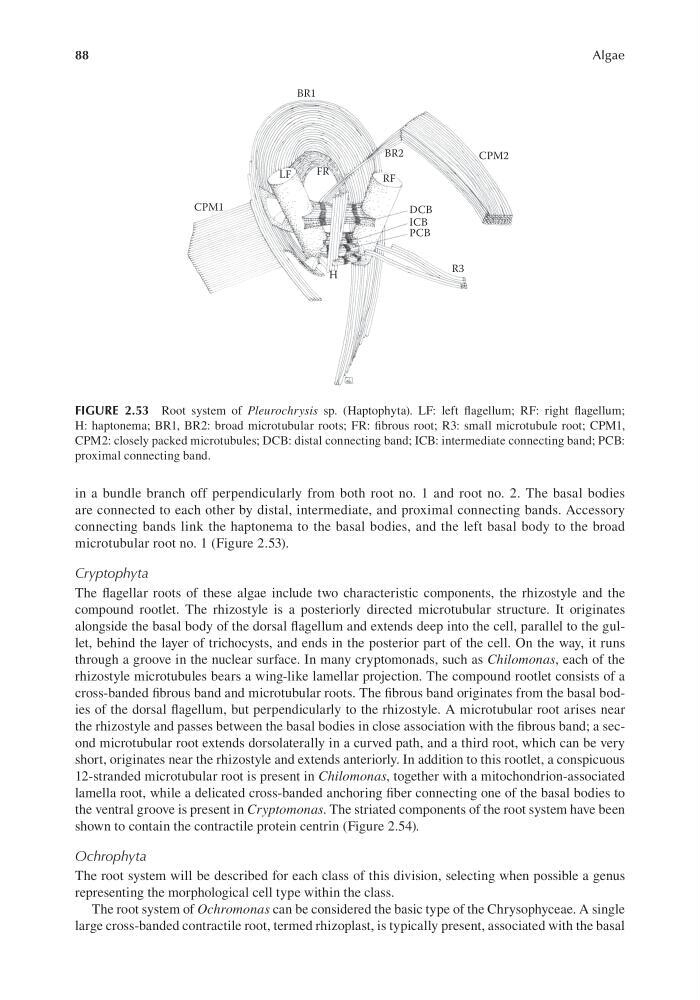
in a bundle branch off perpendicularly from both root no. 1 and root no. 2. The basal bodies
are connected to each other by distal, intermediate, and proximal connecting bands. Accessory
connecting bands link the haptonema to the basal bodies, and the left basal body to the broad
microtubular root no. 1 (Figure 2.53).
Cryptophyta
The flagellar roots of these algae include two characteristic components, the rhizostyle and the
compound rootlet. The rhizostyle is a posteriorly directed microtubular structure. It originates
alongside the basal body of the dorsal flagellum and extends deep into the cell, parallel to the gullet, behind the layer of trichocysts, and ends in the posterior part of the cell. On the way, it runs
through a groove in the nuclear surface. In many cryptomonads, such as Chilomonas, each of the
rhizostyle microtubules bears a wing-like lamellar projection. The compound rootlet consists of a
cross-banded fibrous band and microtubular roots. The fibrous band originates from the basal bodies of the dorsal flagellum, but perpendicularly to the rhizostyle. A microtubular root arises near
the rhizostyle and passes between the basal bodies in close association with the fibrous band; a second microtubular root extends dorsolaterally in a curved path, and a third root, which can be very
short, originates near the rhizostyle and extends anteriorly. In addition to this rootlet, a conspicuous
12-stranded microtubular root is present in Chilomonas, together with a mitochondrion-associated
lamella root, while a delicated cross-banded anchoring fiber connecting one of the basal bodies to
the ventral groove is present in Cryptomonas. The striated components of the root system have been
shown to contain the contractile protein centrin (Figure 2.54).
Ochrophyta
The root system will be described for each class of this division, selecting when possible a genus
representing the morphological cell type within the class.
The root system of Ochromonas can be considered the basic type of the Chrysophyceae. A single
large cross-banded contractile root, termed rhizoplast, is typically present, associated with the basal
BR1
BR2
CPM2
RF
FR
LF
CPM1
DCB
ICB
PCB
R3
H
FIGURE 2.53 Root system of Pleurochrysis sp. (Haptophyta). LF: left flagellum; RF: right flagellum;
H: haptonema; BR1, BR2: broad microtubular roots; FR: fibrous root; R3: small microtubule root; CPM1,
CPM2: closely packed microtubules; DCB: distal connecting band; ICB: intermediate connecting band; PCB:
proximal connecting band.
Algae
in a bundle branch off perpendicularly from both root no. 1 and root no. 2. The basal bodies
are connected to each other by distal, intermediate, and proximal connecting bands. Accessory
connecting bands link the haptonema to the basal bodies, and the left basal body to the broad
microtubular root no. 1 (Figure 2.53).
Cryptophyta
The flagellar roots of these algae include two characteristic components, the rhizostyle and the
compound rootlet. The rhizostyle is a posteriorly directed microtubular structure. It originates
alongside the basal body of the dorsal flagellum and extends deep into the cell, parallel to the gullet, behind the layer of trichocysts, and ends in the posterior part of the cell. On the way, it runs
through a groove in the nuclear surface. In many cryptomonads, such as Chilomonas, each of the
rhizostyle microtubules bears a wing-like lamellar projection. The compound rootlet consists of a
cross-banded fibrous band and microtubular roots. The fibrous band originates from the basal bodies of the dorsal flagellum, but perpendicularly to the rhizostyle. A microtubular root arises near
the rhizostyle and passes between the basal bodies in close association with the fibrous band; a second microtubular root extends dorsolaterally in a curved path, and a third root, which can be very
short, originates near the rhizostyle and extends anteriorly. In addition to this rootlet, a conspicuous
12-stranded microtubular root is present in Chilomonas, together with a mitochondrion-associated
lamella root, while a delicated cross-banded anchoring fiber connecting one of the basal bodies to
the ventral groove is present in Cryptomonas. The striated components of the root system have been
shown to contain the contractile protein centrin (Figure 2.54).
Ochrophyta
The root system will be described for each class of this division, selecting when possible a genus
representing the morphological cell type within the class.
The root system of Ochromonas can be considered the basic type of the Chrysophyceae. A single
large cross-banded contractile root, termed rhizoplast, is typically present, associated with the basal
BR1
BR2
CPM2
RF
FR
LF
CPM1
DCB
ICB
PCB
R3
H
FIGURE 2.53 Root system of Pleurochrysis sp. (Haptophyta). LF: left flagellum; RF: right flagellum;
H: haptonema; BR1, BR2: broad microtubular roots; FR: fibrous root; R3: small microtubule root; CPM1,
CPM2: closely packed microtubules; DCB: distal connecting band; ICB: intermediate connecting band; PCB:
proximal connecting band.