

87
Anatomy
system anchoring the flagella in the cell consists of a single lateral root of about 60 microtubules,
which extend from the basal bodies along the cell side down to the posterior. At the level of
the basal bodies, this broad root enters a multilayered structure in which the microtubules are
located between two laminate plates.
In the biflagellate male gametes of the Charophyceae, the basal bodies are connected to each
other by a conspicuous fibrous linkage; the root system consists of a main broad band of microtubules and a small secondary root.
A strongly suggested reading on this topic is the review by Moenstrup (1982).
Haptophyta
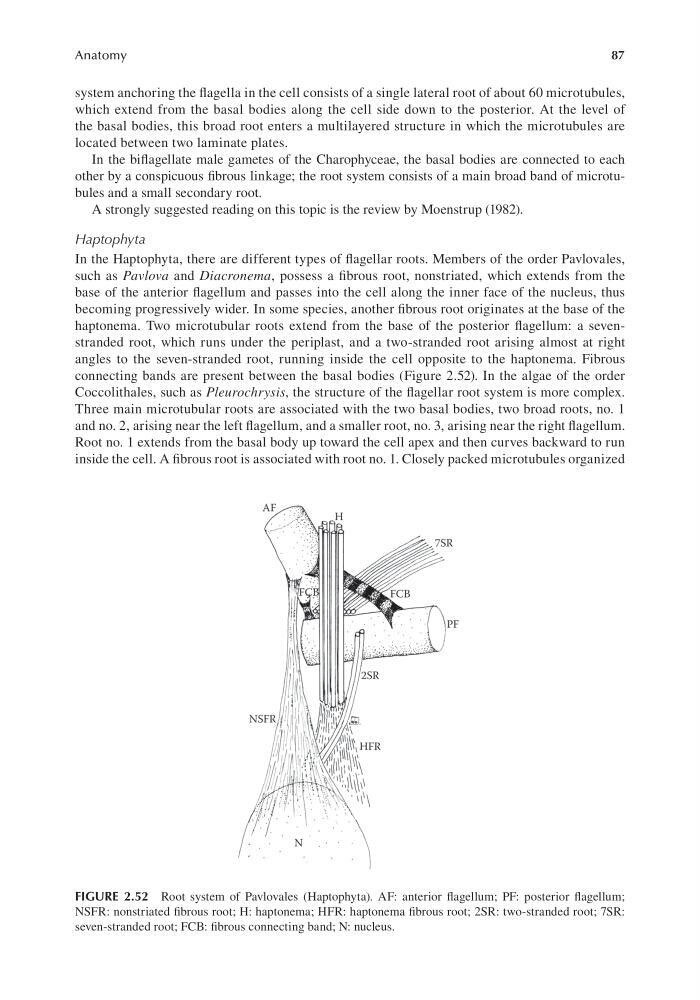
In the Haptophyta, there are different types of flagellar roots. Members of the order Pavlovales,
such as Pavlova and Diacronema, possess a fibrous root, nonstriated, which extends from the
base of the anterior flagellum and passes into the cell along the inner face of the nucleus, thus
becoming progressively wider. In some species, another fibrous root originates at the base of the
haptonema. Two microtubular roots extend from the base of the posterior flagellum: a sevenstranded root, which runs under the periplast, and a two-stranded root arising almost at right
angles to the seven-stranded root, running inside the cell opposite to the haptonema. Fibrous
connecting bands are present between the basal bodies (Figure 2.52). In the algae of the order
Coccolithales, such as Pleurochrysis, the structure of the flagellar root system is more complex.
Three main microtubular roots are associated with the two basal bodies, two broad roots, no. 1
and no. 2, arising near the left flagellum, and a smaller root, no. 3, arising near the right flagellum.
Root no. 1 extends from the basal body up toward the cell apex and then curves backward to run
inside the cell. A fibrous root is associated with root no. 1. Closely packed microtubules organized
FIGURE 2.52 Root system of Pavlovales (Haptophyta). AF: anterior flagellum; PF: posterior flagellum;
NSFR: nonstriated fibrous root; H: haptonema; HFR: haptonema fibrous root; 2SR: two-stranded root; 7SR:
seven-stranded root; FCB: fibrous connecting band; N: nucleus.
Anatomy
system anchoring the flagella in the cell consists of a single lateral root of about 60 microtubules,
which extend from the basal bodies along the cell side down to the posterior. At the level of
the basal bodies, this broad root enters a multilayered structure in which the microtubules are
located between two laminate plates.
In the biflagellate male gametes of the Charophyceae, the basal bodies are connected to each
other by a conspicuous fibrous linkage; the root system consists of a main broad band of microtubules and a small secondary root.
A strongly suggested reading on this topic is the review by Moenstrup (1982).
Haptophyta
In the Haptophyta, there are different types of flagellar roots. Members of the order Pavlovales,
such as Pavlova and Diacronema, possess a fibrous root, nonstriated, which extends from the
base of the anterior flagellum and passes into the cell along the inner face of the nucleus, thus
becoming progressively wider. In some species, another fibrous root originates at the base of the
haptonema. Two microtubular roots extend from the base of the posterior flagellum: a sevenstranded root, which runs under the periplast, and a two-stranded root arising almost at right
angles to the seven-stranded root, running inside the cell opposite to the haptonema. Fibrous
connecting bands are present between the basal bodies (Figure 2.52). In the algae of the order
Coccolithales, such as Pleurochrysis, the structure of the flagellar root system is more complex.
Three main microtubular roots are associated with the two basal bodies, two broad roots, no. 1
and no. 2, arising near the left flagellum, and a smaller root, no. 3, arising near the right flagellum.
Root no. 1 extends from the basal body up toward the cell apex and then curves backward to run
inside the cell. A fibrous root is associated with root no. 1. Closely packed microtubules organized
FIGURE 2.52 Root system of Pavlovales (Haptophyta). AF: anterior flagellum; PF: posterior flagellum;
NSFR: nonstriated fibrous root; H: haptonema; HFR: haptonema fibrous root; 2SR: two-stranded root; 7SR:
seven-stranded root; FCB: fibrous connecting band; N: nucleus.