

86
Algae
The root system and the associated structures of the biflagellate motile cells of Dasycladophyceae
are scarcely distinguishable from those of the Ulvophyceae. The X–2–X–2 pattern is present, with
the basal bodies and microtubular rootlets showing a flattened arrangement. A striated distal fiber
connects the proximal ends of the basal bodies, from which two prominent rhizoplasts depart.
No flagellate reproductive cells are present in the Zygnematophyceae.
Biflagellate cells of Klebsormidiophyceae such as Chaetosphaeridium sp. and Coleochaete
sp. are characterized by a unilateral construction, in which the two equal flagella emerge on one
side of the cell, below the apex. A transversely striated connective links the basal bodies. The
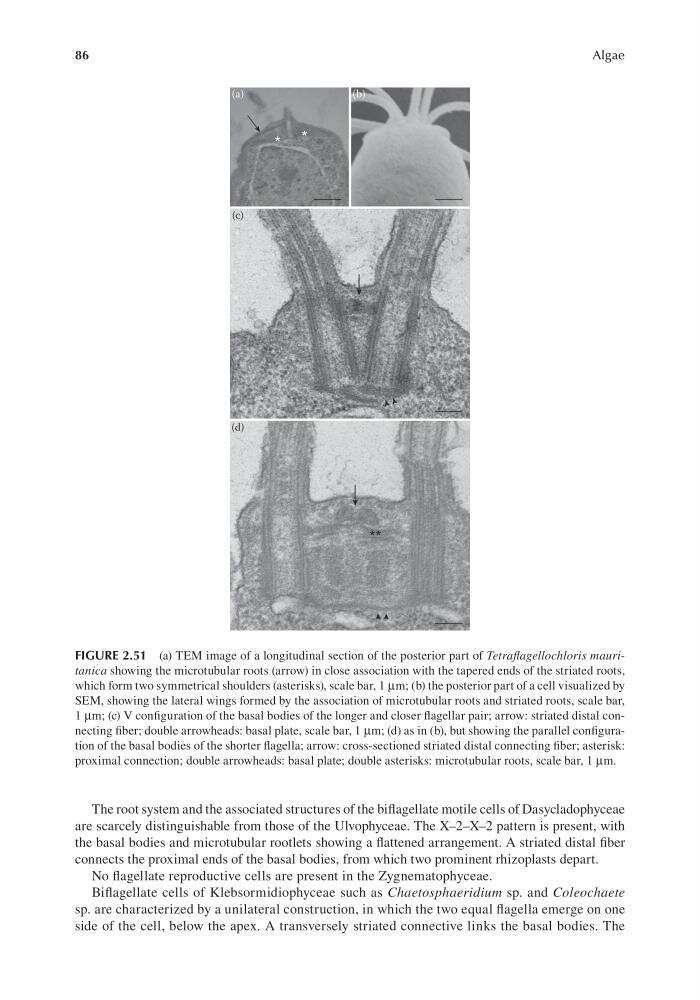
FIGURE 2.51 (a) TEM image of a longitudinal section of the posterior part of Tetraflagellochloris mauritanica showing the microtubular roots (arrow) in close association with the tapered ends of the striated roots,
which form two symmetrical shoulders (asterisks), scale bar, 1 μm; (b) the posterior part of a cell visualized by
SEM, showing the lateral wings formed by the association of microtubular roots and striated roots, scale bar,
1 μm; (c) V configuration of the basal bodies of the longer and closer flagellar pair; arrow: striated distal connecting fiber; double arrowheads: basal plate, scale bar, 1 μm; (d) as in (b), but showing the parallel configuration of the basal bodies of the shorter flagella; arrow: cross-sectioned striated distal connecting fiber; asterisk:
proximal connection; double arrowheads: basal plate; double asterisks: microtubular roots, scale bar, 1 μm.
Algae
The root system and the associated structures of the biflagellate motile cells of Dasycladophyceae
are scarcely distinguishable from those of the Ulvophyceae. The X–2–X–2 pattern is present, with
the basal bodies and microtubular rootlets showing a flattened arrangement. A striated distal fiber
connects the proximal ends of the basal bodies, from which two prominent rhizoplasts depart.
No flagellate reproductive cells are present in the Zygnematophyceae.
Biflagellate cells of Klebsormidiophyceae such as Chaetosphaeridium sp. and Coleochaete
sp. are characterized by a unilateral construction, in which the two equal flagella emerge on one
side of the cell, below the apex. A transversely striated connective links the basal bodies. The
FIGURE 2.51 (a) TEM image of a longitudinal section of the posterior part of Tetraflagellochloris mauritanica showing the microtubular roots (arrow) in close association with the tapered ends of the striated roots,
which form two symmetrical shoulders (asterisks), scale bar, 1 μm; (b) the posterior part of a cell visualized by
SEM, showing the lateral wings formed by the association of microtubular roots and striated roots, scale bar,
1 μm; (c) V configuration of the basal bodies of the longer and closer flagellar pair; arrow: striated distal connecting fiber; double arrowheads: basal plate, scale bar, 1 μm; (d) as in (b), but showing the parallel configuration of the basal bodies of the shorter flagella; arrow: cross-sectioned striated distal connecting fiber; asterisk:
proximal connection; double arrowheads: basal plate; double asterisks: microtubular roots, scale bar, 1 μm.