

where E CO 2 ,trec is the volume of CO 2 emissions in a specific period, region, and
sector; Q trec is the volume of energy consumption in a specific period, region, and
sector; and EF CO 2 ,rec is the CO 2 emission factor for a specific region and sector.
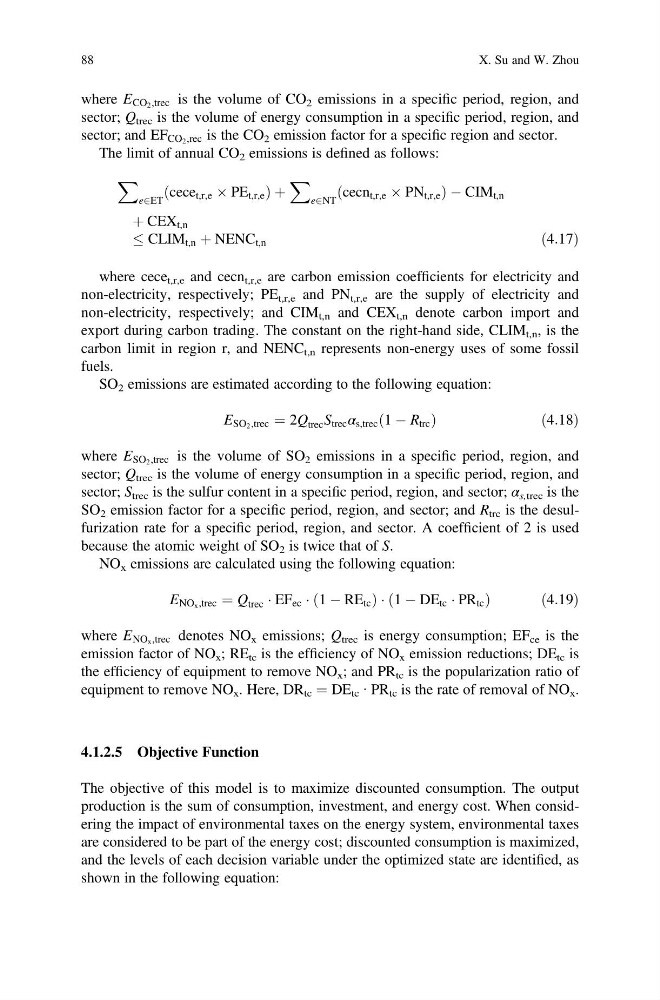
The limit of annual CO 2 emissions is defined as follows:
X
e2ET
cece t,r,e  PE t,r,e
ð
Þ þ
X
e2NT
cecn t,r,e  PN t,r,e
ð
Þ À CIM t,n
þ CEX t,n
CLIM t,n þ NENC t,n
ð4:17Þ
where cece t,r,e and cecn t,r,e are carbon emission coefficients for electricity and
non-electricity, respectively; PE t,r,e and PN t,r,e are the supply of electricity and
non-electricity, respectively; and CIM t,n and CEX t,n denote carbon import and
export during carbon trading. The constant on the right-hand side, CLIM t,n , is the
carbon limit in region r, and NENC t,n represents non-energy uses of some fossil
fuels.
SO 2 emissions are estimated according to the following equation:
E SO 2 ,trec ¼ 2Q trec S trec α s,trec 1 À R trc
ð
Þ
ð 4:18Þ
where E SO 2 ,trec is the volume of SO 2 emissions in a specific period, region, and
sector; Q trec is the volume of energy consumption in a specific period, region, and
sector; S trec is the sulfur content in a specific period, region, and sector; α s,trec is the
SO 2 emission factor for a specific period, region, and sector; and R trc is the desulfurization rate for a specific period, region, and sector. A coefficient of 2 is used
because the atomic weight of SO 2 is twice that of S.
NO x emissions are calculated using the following equation:
E NO x ,trec ¼ Q trec Á EF ec Á 1 À RE tc
ð
ÞÁ 1 À DE tc Á PR tc
ð
Þ
ð 4:19Þ
where E NO x ,trec denotes NO x emissions; Q trec is energy consumption; EF ce is the
emission factor of NO x ; RE tc is the efficiency of NO x emission reductions; DE tc is
the efficiency of equipment to remove NO x ; and PR tc is the popularization ratio of
equipment to remove NO x . Here, DR tc ¼ DE tc ∙ PR tc is the rate of removal of NO x .
4.1.2.5 Objective Function
The objective of this model is to maximize discounted consumption. The output
production is the sum of consumption, investment, and energy cost. When considering the impact of environmental taxes on the energy system, environmental taxes
are considered to be part of the energy cost; discounted consumption is maximized,
and the levels of each decision variable under the optimized state are identified, as
shown in the following equation:
88
X. Su and W. Zhou
sector; Q trec is the volume of energy consumption in a specific period, region, and
sector; and EF CO 2 ,rec is the CO 2 emission factor for a specific region and sector.
The limit of annual CO 2 emissions is defined as follows:
X
e2ET
cece t,r,e  PE t,r,e
ð
Þ þ
X
e2NT
cecn t,r,e  PN t,r,e
ð
Þ À CIM t,n
þ CEX t,n
CLIM t,n þ NENC t,n
ð4:17Þ
where cece t,r,e and cecn t,r,e are carbon emission coefficients for electricity and
non-electricity, respectively; PE t,r,e and PN t,r,e are the supply of electricity and
non-electricity, respectively; and CIM t,n and CEX t,n denote carbon import and
export during carbon trading. The constant on the right-hand side, CLIM t,n , is the
carbon limit in region r, and NENC t,n represents non-energy uses of some fossil
fuels.
SO 2 emissions are estimated according to the following equation:
E SO 2 ,trec ¼ 2Q trec S trec α s,trec 1 À R trc
ð
Þ
ð 4:18Þ
where E SO 2 ,trec is the volume of SO 2 emissions in a specific period, region, and
sector; Q trec is the volume of energy consumption in a specific period, region, and
sector; S trec is the sulfur content in a specific period, region, and sector; α s,trec is the
SO 2 emission factor for a specific period, region, and sector; and R trc is the desulfurization rate for a specific period, region, and sector. A coefficient of 2 is used
because the atomic weight of SO 2 is twice that of S.
NO x emissions are calculated using the following equation:
E NO x ,trec ¼ Q trec Á EF ec Á 1 À RE tc
ð
ÞÁ 1 À DE tc Á PR tc
ð
Þ
ð 4:19Þ
where E NO x ,trec denotes NO x emissions; Q trec is energy consumption; EF ce is the
emission factor of NO x ; RE tc is the efficiency of NO x emission reductions; DE tc is
the efficiency of equipment to remove NO x ; and PR tc is the popularization ratio of
equipment to remove NO x . Here, DR tc ¼ DE tc ∙ PR tc is the rate of removal of NO x .
4.1.2.5 Objective Function
The objective of this model is to maximize discounted consumption. The output
production is the sum of consumption, investment, and energy cost. When considering the impact of environmental taxes on the energy system, environmental taxes
are considered to be part of the energy cost; discounted consumption is maximized,
and the levels of each decision variable under the optimized state are identified, as
shown in the following equation:
88
X. Su and W. Zhou