

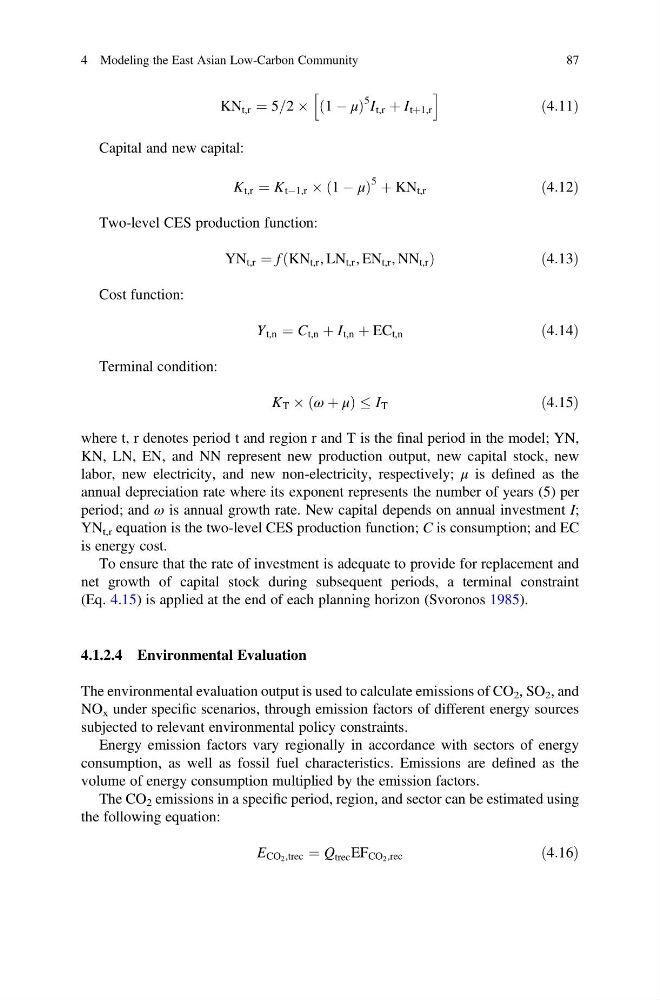
KN t,r ¼ 5=2 Â 1 À μ
ð
Þ
5 I t,r þ I tþ1,r
h
i
ð4:11Þ
Capital and new capital:
K t,r ¼ K tÀ1,r  1 À μ
ð
Þ
5 þ KN t,r
ð4:12Þ
Two-level CES production function:
YN t,r ¼ f KN t,r , LN t,r , EN t,r , NN t,r
ð
Þ
ð 4:13Þ
Cost function:
Y t,n ¼ C t,n þ I t,n þ EC t,n
ð4:14Þ
Terminal condition:
K T Â ω þ μ
ð
Þ I T
ð4:15Þ
where t, r denotes period t and region r and T is the final period in the model; YN,
KN, LN, EN, and NN represent new production output, new capital stock, new
labor, new electricity, and new non-electricity, respectively; μ is defined as the
annual depreciation rate where its exponent represents the number of years (5) per
period; and ω is annual growth rate. New capital depends on annual investment I;
YN t,r equation is the two-level CES production function; C is consumption; and EC
is energy cost.
To ensure that the rate of investment is adequate to provide for replacement and
net growth of capital stock during subsequent periods, a terminal constraint
(Eq. 4.15) is applied at the end of each planning horizon (Svoronos 1985).
4.1.2.4 Environmental Evaluation
The environmental evaluation output is used to calculate emissions of CO 2 , SO 2 , and
NO x under specific scenarios, through emission factors of different energy sources
subjected to relevant environmental policy constraints.
Energy emission factors vary regionally in accordance with sectors of energy
consumption, as well as fossil fuel characteristics. Emissions are defined as the
volume of energy consumption multiplied by the emission factors.
The CO 2 emissions in a specific period, region, and sector can be estimated using
the following equation:
E CO 2 ,trec ¼ Q trec EF CO 2 ,rec
ð4:16Þ
4 Modeling the East Asian Low-Carbon Community
87
ð
Þ
5 I t,r þ I tþ1,r
h
i
ð4:11Þ
Capital and new capital:
K t,r ¼ K tÀ1,r  1 À μ
ð
Þ
5 þ KN t,r
ð4:12Þ
Two-level CES production function:
YN t,r ¼ f KN t,r , LN t,r , EN t,r , NN t,r
ð
Þ
ð 4:13Þ
Cost function:
Y t,n ¼ C t,n þ I t,n þ EC t,n
ð4:14Þ
Terminal condition:
K T Â ω þ μ
ð
Þ I T
ð4:15Þ
where t, r denotes period t and region r and T is the final period in the model; YN,
KN, LN, EN, and NN represent new production output, new capital stock, new
labor, new electricity, and new non-electricity, respectively; μ is defined as the
annual depreciation rate where its exponent represents the number of years (5) per
period; and ω is annual growth rate. New capital depends on annual investment I;
YN t,r equation is the two-level CES production function; C is consumption; and EC
is energy cost.
To ensure that the rate of investment is adequate to provide for replacement and
net growth of capital stock during subsequent periods, a terminal constraint
(Eq. 4.15) is applied at the end of each planning horizon (Svoronos 1985).
4.1.2.4 Environmental Evaluation
The environmental evaluation output is used to calculate emissions of CO 2 , SO 2 , and
NO x under specific scenarios, through emission factors of different energy sources
subjected to relevant environmental policy constraints.
Energy emission factors vary regionally in accordance with sectors of energy
consumption, as well as fossil fuel characteristics. Emissions are defined as the
volume of energy consumption multiplied by the emission factors.
The CO 2 emissions in a specific period, region, and sector can be estimated using
the following equation:
E CO 2 ,trec ¼ Q trec EF CO 2 ,rec
ð4:16Þ
4 Modeling the East Asian Low-Carbon Community
87