

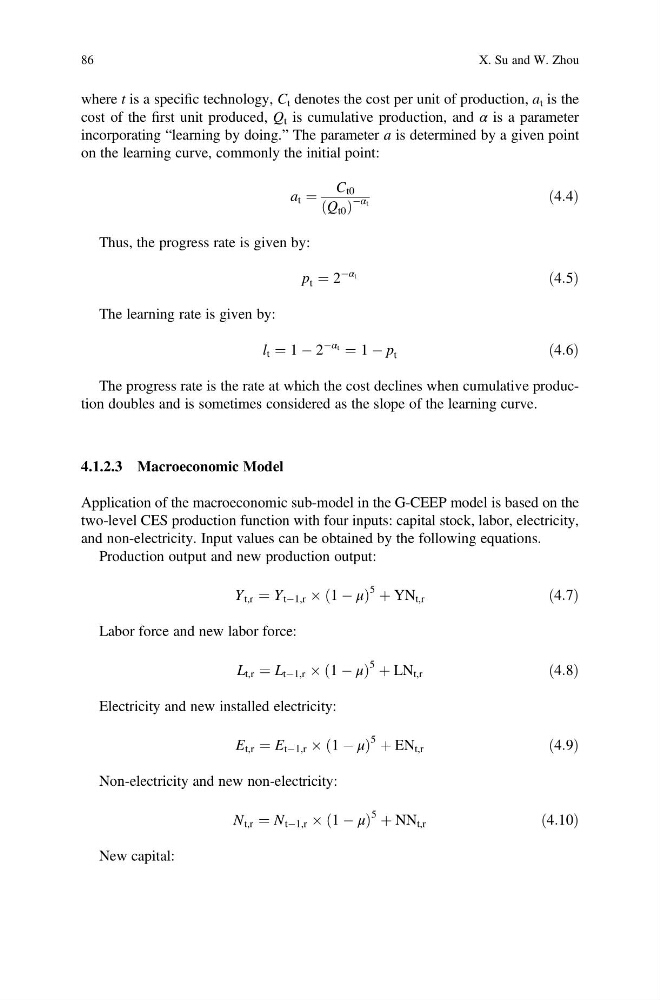
where t is a specific technology, C t denotes the cost per unit of production, a t is the
cost of the first unit produced, Q t is cumulative production, and α is a parameter
incorporating “learning by doing.” The parameter a is determined by a given point
on the learning curve, commonly the initial point:
a t ¼
C t0
Q t0
ð Þ
Àα t
ð4:4Þ
Thus, the progress rate is given by:
p t ¼ 2
Àα t
ð4:5Þ
The learning rate is given by:
l t ¼ 1 À 2
Àα t ¼ 1 À p t
ð4:6Þ
The progress rate is the rate at which the cost declines when cumulative production doubles and is sometimes considered as the slope of the learning curve.
4.1.2.3 Macroeconomic Model
Application of the macroeconomic sub-model in the G-CEEP model is based on the
two-level CES production function with four inputs: capital stock, labor, electricity,
and non-electricity. Input values can be obtained by the following equations.
Production output and new production output:
Y t,r ¼ Y tÀ1,r  1 À μ
ð
Þ
5 þ YN t,r
ð4:7Þ
Labor force and new labor force:
L t,r ¼ L tÀ1,r  1 À μ
ð
Þ
5 þ LN t,r
ð4:8Þ
Electricity and new installed electricity:
E t,r ¼ E tÀ1,r  1 À μ
ð
Þ
5 þ EN t,r
ð4:9Þ
Non-electricity and new non-electricity:
N t,r ¼ N tÀ1,r  1 À μ
ð
Þ
5 þ NN t,r
ð4:10Þ
New capital:
86
X. Su and W. Zhou
cost of the first unit produced, Q t is cumulative production, and α is a parameter
incorporating “learning by doing.” The parameter a is determined by a given point
on the learning curve, commonly the initial point:
a t ¼
C t0
Q t0
ð Þ
Àα t
ð4:4Þ
Thus, the progress rate is given by:
p t ¼ 2
Àα t
ð4:5Þ
The learning rate is given by:
l t ¼ 1 À 2
Àα t ¼ 1 À p t
ð4:6Þ
The progress rate is the rate at which the cost declines when cumulative production doubles and is sometimes considered as the slope of the learning curve.
4.1.2.3 Macroeconomic Model
Application of the macroeconomic sub-model in the G-CEEP model is based on the
two-level CES production function with four inputs: capital stock, labor, electricity,
and non-electricity. Input values can be obtained by the following equations.
Production output and new production output:
Y t,r ¼ Y tÀ1,r  1 À μ
ð
Þ
5 þ YN t,r
ð4:7Þ
Labor force and new labor force:
L t,r ¼ L tÀ1,r  1 À μ
ð
Þ
5 þ LN t,r
ð4:8Þ
Electricity and new installed electricity:
E t,r ¼ E tÀ1,r  1 À μ
ð
Þ
5 þ EN t,r
ð4:9Þ
Non-electricity and new non-electricity:
N t,r ¼ N tÀ1,r  1 À μ
ð
Þ
5 þ NN t,r
ð4:10Þ
New capital:
86
X. Su and W. Zhou