

and social development of various countries, which makes it difficult to accurately predict the concentration of greenhouse gases in the atmosphere in the
future. At the same time, the relationship between temperature rise and the
impact is far from clear, which significantly affects the accuracy of the assessment results.
(b) The deficiencies of the climate model and the prediction technology itself
To predict global and regional climate changes in the next 50–100 years, it
must rely on complex global land-air-sea coupling models and high-resolution
regional climate models. However, the current climate models’ descriptions of
clouds, oceans, and polar ice caps are still incomplete, and the models cannot
handle the effects of clouds and ocean circulation, as well as regional precipitation changes.
Significant variability can occur in climate prediction due to the parameter
uncertainties of the equations solved by the physics-based climate model and the
structural uncertainties of the climate model. As a result, there is a great deal of
uncertainty in decision-making.
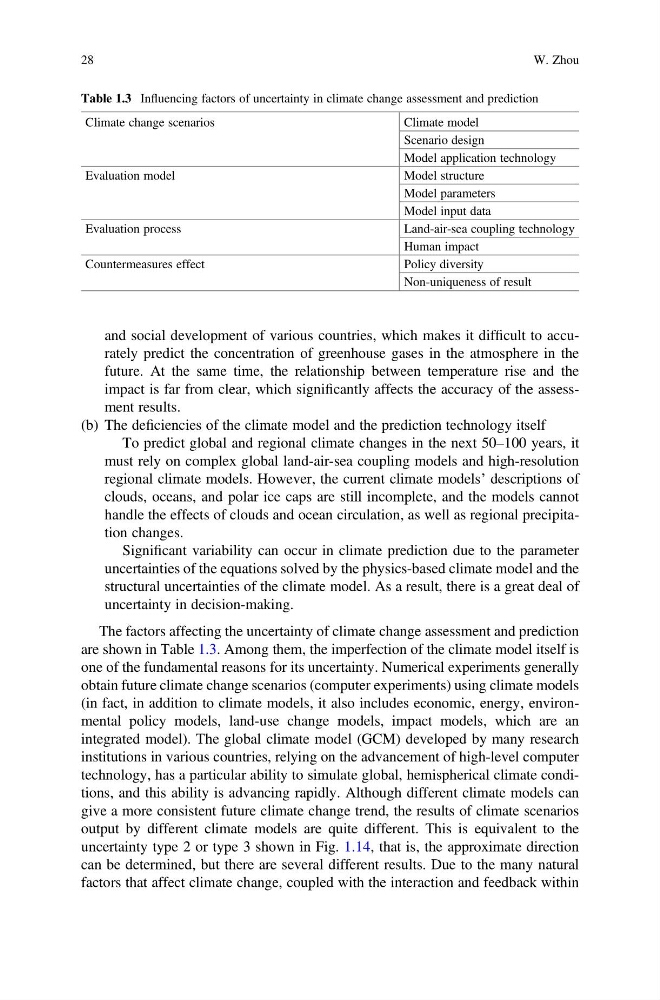
The factors affecting the uncertainty of climate change assessment and prediction
are shown in Table 1.3. Among them, the imperfection of the climate model itself is
one of the fundamental reasons for its uncertainty. Numerical experiments generally
obtain future climate change scenarios (computer experiments) using climate models
(in fact, in addition to climate models, it also includes economic, energy, environmental policy models, land-use change models, impact models, which are an
integrated model). The global climate model (GCM) developed by many research
institutions in various countries, relying on the advancement of high-level computer
technology, has a particular ability to simulate global, hemispherical climate conditions, and this ability is advancing rapidly. Although different climate models can
give a more consistent future climate change trend, the results of climate scenarios
output by different climate models are quite different. This is equivalent to the
uncertainty type 2 or type 3 shown in Fig. 1.14, that is, the approximate direction
can be determined, but there are several different results. Due to the many natural
factors that affect climate change, coupled with the interaction and feedback within
Table 1.3 Influencing factors of uncertainty in climate change assessment and prediction
Climate change scenarios
Climate model
Scenario design
Model application technology
Evaluation model
Model structure
Model parameters
Model input data
Evaluation process
Land-air-sea coupling technology
Human impact
Countermeasures effect
Policy diversity
Non-uniqueness of result
28
W. Zhou
future. At the same time, the relationship between temperature rise and the
impact is far from clear, which significantly affects the accuracy of the assessment results.
(b) The deficiencies of the climate model and the prediction technology itself
To predict global and regional climate changes in the next 50–100 years, it
must rely on complex global land-air-sea coupling models and high-resolution
regional climate models. However, the current climate models’ descriptions of
clouds, oceans, and polar ice caps are still incomplete, and the models cannot
handle the effects of clouds and ocean circulation, as well as regional precipitation changes.
Significant variability can occur in climate prediction due to the parameter
uncertainties of the equations solved by the physics-based climate model and the
structural uncertainties of the climate model. As a result, there is a great deal of
uncertainty in decision-making.
The factors affecting the uncertainty of climate change assessment and prediction
are shown in Table 1.3. Among them, the imperfection of the climate model itself is
one of the fundamental reasons for its uncertainty. Numerical experiments generally
obtain future climate change scenarios (computer experiments) using climate models
(in fact, in addition to climate models, it also includes economic, energy, environmental policy models, land-use change models, impact models, which are an
integrated model). The global climate model (GCM) developed by many research
institutions in various countries, relying on the advancement of high-level computer
technology, has a particular ability to simulate global, hemispherical climate conditions, and this ability is advancing rapidly. Although different climate models can
give a more consistent future climate change trend, the results of climate scenarios
output by different climate models are quite different. This is equivalent to the
uncertainty type 2 or type 3 shown in Fig. 1.14, that is, the approximate direction
can be determined, but there are several different results. Due to the many natural
factors that affect climate change, coupled with the interaction and feedback within
Table 1.3 Influencing factors of uncertainty in climate change assessment and prediction
Climate change scenarios
Climate model
Scenario design
Model application technology
Evaluation model
Model structure
Model parameters
Model input data
Evaluation process
Land-air-sea coupling technology
Human impact
Countermeasures effect
Policy diversity
Non-uniqueness of result
28
W. Zhou