

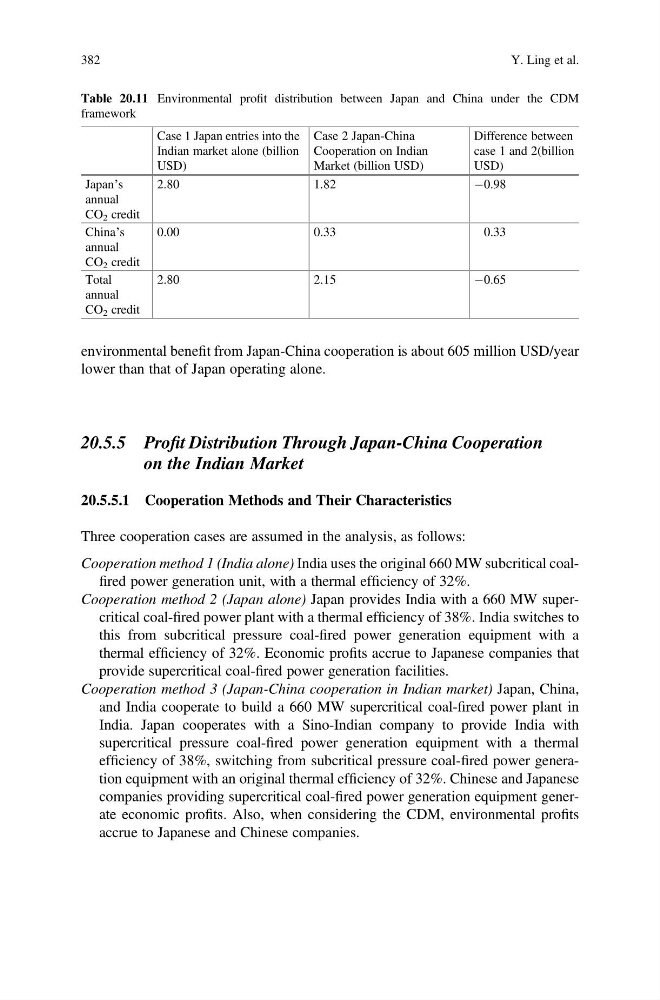
environmental benefit from Japan-China cooperation is about 605 million USD/year
lower than that of Japan operating alone.
20.5.5 Profit Distribution Through Japan-China Cooperation
on the Indian Market
20.5.5.1 Cooperation Methods and Their Characteristics
Three cooperation cases are assumed in the analysis, as follows:
Cooperation method 1 (India alone) India uses the original 660 MW subcritical coalfired power generation unit, with a thermal efficiency of 32%.
Cooperation method 2 (Japan alone) Japan provides India with a 660 MW supercritical coal-fired power plant with a thermal efficiency of 38%. India switches to
this from subcritical pressure coal-fired power generation equipment with a
thermal efficiency of 32%. Economic profits accrue to Japanese companies that
provide supercritical coal-fired power generation facilities.
Cooperation method 3 (Japan-China cooperation in Indian market) Japan, China,
and India cooperate to build a 660 MW supercritical coal-fired power plant in
India. Japan cooperates with a Sino-Indian company to provide India with
supercritical pressure coal-fired power generation equipment with a thermal
efficiency of 38%, switching from subcritical pressure coal-fired power generation equipment with an original thermal efficiency of 32%. Chinese and Japanese
companies providing supercritical coal-fired power generation equipment generate economic profits. Also, when considering the CDM, environmental profits
accrue to Japanese and Chinese companies.
Table 20.11 Environmental profit distribution between Japan and China under the CDM
framework
Case 1 Japan entries into the
Indian market alone (billion
USD)
Case 2 Japan-China
Cooperation on Indian
Market (billion USD)
Difference between
case 1 and 2(billion
USD)
Japan’s
annual
CO 2 credit
2.80
1.82
À0.98
China’s
annual
CO 2 credit
0.00
0.33
0.33
Total
annual
CO 2 credit
2.80
2.15
À0.65
382
Y. Ling et al.
lower than that of Japan operating alone.
20.5.5 Profit Distribution Through Japan-China Cooperation
on the Indian Market
20.5.5.1 Cooperation Methods and Their Characteristics
Three cooperation cases are assumed in the analysis, as follows:
Cooperation method 1 (India alone) India uses the original 660 MW subcritical coalfired power generation unit, with a thermal efficiency of 32%.
Cooperation method 2 (Japan alone) Japan provides India with a 660 MW supercritical coal-fired power plant with a thermal efficiency of 38%. India switches to
this from subcritical pressure coal-fired power generation equipment with a
thermal efficiency of 32%. Economic profits accrue to Japanese companies that
provide supercritical coal-fired power generation facilities.
Cooperation method 3 (Japan-China cooperation in Indian market) Japan, China,
and India cooperate to build a 660 MW supercritical coal-fired power plant in
India. Japan cooperates with a Sino-Indian company to provide India with
supercritical pressure coal-fired power generation equipment with a thermal
efficiency of 38%, switching from subcritical pressure coal-fired power generation equipment with an original thermal efficiency of 32%. Chinese and Japanese
companies providing supercritical coal-fired power generation equipment generate economic profits. Also, when considering the CDM, environmental profits
accrue to Japanese and Chinese companies.
Table 20.11 Environmental profit distribution between Japan and China under the CDM
framework
Case 1 Japan entries into the
Indian market alone (billion
USD)
Case 2 Japan-China
Cooperation on Indian
Market (billion USD)
Difference between
case 1 and 2(billion
USD)
Japan’s
annual
CO 2 credit
2.80
1.82
À0.98
China’s
annual
CO 2 credit
0.00
0.33
0.33
Total
annual
CO 2 credit
2.80
2.15
À0.65
382
Y. Ling et al.