

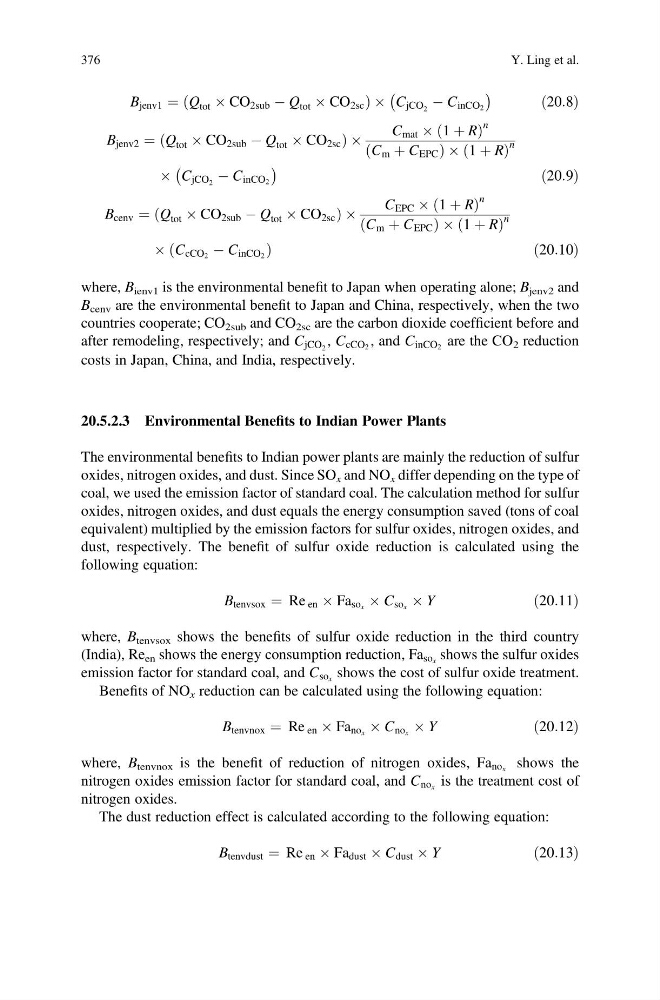
B jenv1 ¼ Q tot  CO 2sub À Q tot  CO 2sc
ð
Þ Â C jCO 2 À C inCO 2
À
Á
ð20:8Þ
B jenv2 ¼ Q tot  CO 2sub À Q tot  CO 2sc
ð
Þ Â
C mat  1 þ R
ð
Þ
n
C m þ C EPC
ð
ÞÂ 1 þ R
ð
Þ
n
 C jCO 2 À C inCO 2
À
Á
ð20:9Þ
B cenv ¼ Q tot  CO 2sub À Q tot  CO 2sc
ð
Þ Â
C EPC Â 1 þ R
ð
Þ
n
C m þ C EPC
ð
ÞÂ 1 þ R
ð
Þ
n
 C cCO 2 À C inCO 2
ð
Þ
ð 20:10Þ
where, B ienv1 is the environmental benefit to Japan when operating alone; B jenv2 and
B cenv are the environmental benefit to Japan and China, respectively, when the two
countries cooperate; CO 2sub and CO 2sc are the carbon dioxide coefficient before and
after remodeling, respectively; and C jCO 2 , C cCO 2 , and C inCO 2 are the CO 2 reduction
costs in Japan, China, and India, respectively.
20.5.2.3 Environmental Benefits to Indian Power Plants
The environmental benefits to Indian power plants are mainly the reduction of sulfur
oxides, nitrogen oxides, and dust. Since SO x and NO x differ depending on the type of
coal, we used the emission factor of standard coal. The calculation method for sulfur
oxides, nitrogen oxides, and dust equals the energy consumption saved (tons of coal
equivalent) multiplied by the emission factors for sulfur oxides, nitrogen oxides, and
dust, respectively. The benefit of sulfur oxide reduction is calculated using the
following equation:
B tenvsox ¼ Re en  Fa so x  C so x  Y
ð20:11Þ
where, B tenvsox shows the benefits of sulfur oxide reduction in the third country
(India), Re en shows the energy consumption reduction, Fa so x shows the sulfur oxides
emission factor for standard coal, and C so x shows the cost of sulfur oxide treatment.
Benefits of NO x reduction can be calculated using the following equation:
B tenvnox ¼ Re en  Fa no x  C no x  Y
ð20:12Þ
where, B tenvnox is the benefit of reduction of nitrogen oxides, Fa no x shows the
nitrogen oxides emission factor for standard coal, and C no x is the treatment cost of
nitrogen oxides.
The dust reduction effect is calculated according to the following equation:
B tenvdust ¼ Re en  Fa dust  C dust  Y
ð20:13Þ
376
Y. Ling et al.
ð
Þ Â C jCO 2 À C inCO 2
À
Á
ð20:8Þ
B jenv2 ¼ Q tot  CO 2sub À Q tot  CO 2sc
ð
Þ Â
C mat  1 þ R
ð
Þ
n
C m þ C EPC
ð
ÞÂ 1 þ R
ð
Þ
n
 C jCO 2 À C inCO 2
À
Á
ð20:9Þ
B cenv ¼ Q tot  CO 2sub À Q tot  CO 2sc
ð
Þ Â
C EPC Â 1 þ R
ð
Þ
n
C m þ C EPC
ð
ÞÂ 1 þ R
ð
Þ
n
 C cCO 2 À C inCO 2
ð
Þ
ð 20:10Þ
where, B ienv1 is the environmental benefit to Japan when operating alone; B jenv2 and
B cenv are the environmental benefit to Japan and China, respectively, when the two
countries cooperate; CO 2sub and CO 2sc are the carbon dioxide coefficient before and
after remodeling, respectively; and C jCO 2 , C cCO 2 , and C inCO 2 are the CO 2 reduction
costs in Japan, China, and India, respectively.
20.5.2.3 Environmental Benefits to Indian Power Plants
The environmental benefits to Indian power plants are mainly the reduction of sulfur
oxides, nitrogen oxides, and dust. Since SO x and NO x differ depending on the type of
coal, we used the emission factor of standard coal. The calculation method for sulfur
oxides, nitrogen oxides, and dust equals the energy consumption saved (tons of coal
equivalent) multiplied by the emission factors for sulfur oxides, nitrogen oxides, and
dust, respectively. The benefit of sulfur oxide reduction is calculated using the
following equation:
B tenvsox ¼ Re en  Fa so x  C so x  Y
ð20:11Þ
where, B tenvsox shows the benefits of sulfur oxide reduction in the third country
(India), Re en shows the energy consumption reduction, Fa so x shows the sulfur oxides
emission factor for standard coal, and C so x shows the cost of sulfur oxide treatment.
Benefits of NO x reduction can be calculated using the following equation:
B tenvnox ¼ Re en  Fa no x  C no x  Y
ð20:12Þ
where, B tenvnox is the benefit of reduction of nitrogen oxides, Fa no x shows the
nitrogen oxides emission factor for standard coal, and C no x is the treatment cost of
nitrogen oxides.
The dust reduction effect is calculated according to the following equation:
B tenvdust ¼ Re en  Fa dust  C dust  Y
ð20:13Þ
376
Y. Ling et al.