

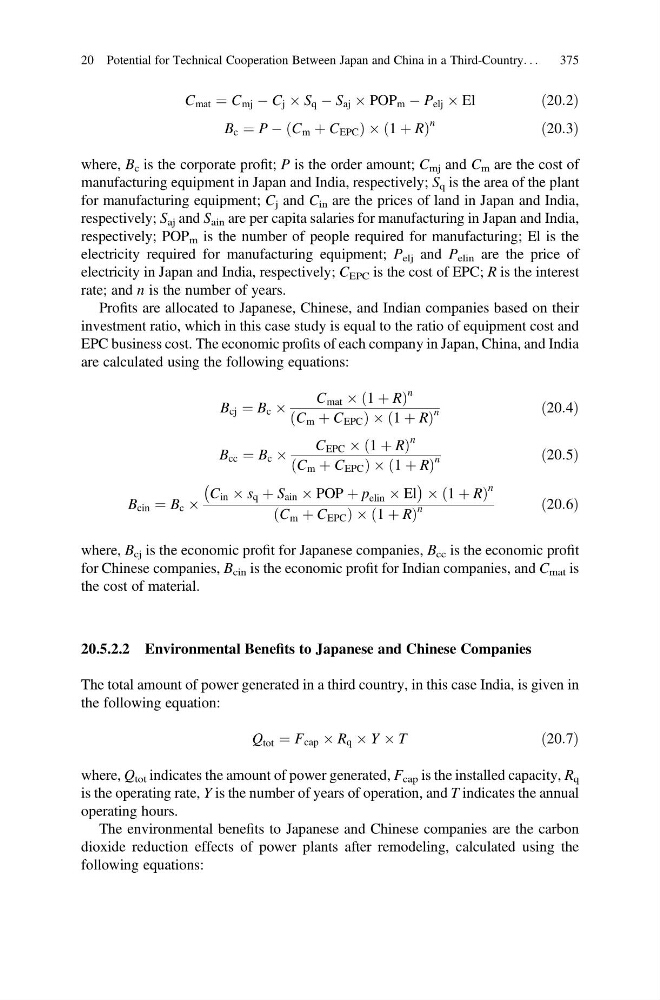
C mat ¼ C mj À C j  S q À S aj  POP m À P elj  El
ð20:2Þ
B c ¼ P À C m þ C EPC
ð
ÞÂ 1 þ R
ð
Þ
n
ð20:3Þ
where, B c is the corporate profit; P is the order amount; C mj and C m are the cost of
manufacturing equipment in Japan and India, respectively; S q is the area of the plant
for manufacturing equipment; C j and C in are the prices of land in Japan and India,
respectively; S aj and S ain are per capita salaries for manufacturing in Japan and India,
respectively; POP m is the number of people required for manufacturing; El is the
electricity required for manufacturing equipment; P elj and P elin are the price of
electricity in Japan and India, respectively; C EPC is the cost of EPC; R is the interest
rate; and n is the number of years.
Profits are allocated to Japanese, Chinese, and Indian companies based on their
investment ratio, which in this case study is equal to the ratio of equipment cost and
EPC business cost. The economic profits of each company in Japan, China, and India
are calculated using the following equations:
B cj ¼ B c Â
C mat  1 þ R
ð
Þ
n
C m þ C EPC
ð
ÞÂ 1 þ R
ð
Þ
n
ð20:4Þ
B cc ¼ B c Â
C EPC Â 1 þ R
ð
Þ
n
C m þ C EPC
ð
ÞÂ 1 þ R
ð
Þ
n
ð20:5Þ
B cin ¼ B c Â
C in  s q þ S ain  POP þ p elin  El
À
Á Â 1 þ R
ð
Þ
n
C m þ C EPC
ð
ÞÂ 1 þ R
ð
Þ
n
ð20:6Þ
where, B cj is the economic profit for Japanese companies, B cc is the economic profit
for Chinese companies, B cin is the economic profit for Indian companies, and C mat is
the cost of material.
20.5.2.2 Environmental Benefits to Japanese and Chinese Companies
The total amount of power generated in a third country, in this case India, is given in
the following equation:
Q tot ¼ F cap  R q  Y  T
ð20:7Þ
where, Q tot indicates the amount of power generated, F cap is the installed capacity, R q
is the operating rate, Y is the number of years of operation, and T indicates the annual
operating hours.
The environmental benefits to Japanese and Chinese companies are the carbon
dioxide reduction effects of power plants after remodeling, calculated using the
following equations:
20 Potential for Technical Cooperation Between Japan and China in a Third-Country. . .
375
ð20:2Þ
B c ¼ P À C m þ C EPC
ð
ÞÂ 1 þ R
ð
Þ
n
ð20:3Þ
where, B c is the corporate profit; P is the order amount; C mj and C m are the cost of
manufacturing equipment in Japan and India, respectively; S q is the area of the plant
for manufacturing equipment; C j and C in are the prices of land in Japan and India,
respectively; S aj and S ain are per capita salaries for manufacturing in Japan and India,
respectively; POP m is the number of people required for manufacturing; El is the
electricity required for manufacturing equipment; P elj and P elin are the price of
electricity in Japan and India, respectively; C EPC is the cost of EPC; R is the interest
rate; and n is the number of years.
Profits are allocated to Japanese, Chinese, and Indian companies based on their
investment ratio, which in this case study is equal to the ratio of equipment cost and
EPC business cost. The economic profits of each company in Japan, China, and India
are calculated using the following equations:
B cj ¼ B c Â
C mat  1 þ R
ð
Þ
n
C m þ C EPC
ð
ÞÂ 1 þ R
ð
Þ
n
ð20:4Þ
B cc ¼ B c Â
C EPC Â 1 þ R
ð
Þ
n
C m þ C EPC
ð
ÞÂ 1 þ R
ð
Þ
n
ð20:5Þ
B cin ¼ B c Â
C in  s q þ S ain  POP þ p elin  El
À
Á Â 1 þ R
ð
Þ
n
C m þ C EPC
ð
ÞÂ 1 þ R
ð
Þ
n
ð20:6Þ
where, B cj is the economic profit for Japanese companies, B cc is the economic profit
for Chinese companies, B cin is the economic profit for Indian companies, and C mat is
the cost of material.
20.5.2.2 Environmental Benefits to Japanese and Chinese Companies
The total amount of power generated in a third country, in this case India, is given in
the following equation:
Q tot ¼ F cap  R q  Y  T
ð20:7Þ
where, Q tot indicates the amount of power generated, F cap is the installed capacity, R q
is the operating rate, Y is the number of years of operation, and T indicates the annual
operating hours.
The environmental benefits to Japanese and Chinese companies are the carbon
dioxide reduction effects of power plants after remodeling, calculated using the
following equations:
20 Potential for Technical Cooperation Between Japan and China in a Third-Country. . .
375