

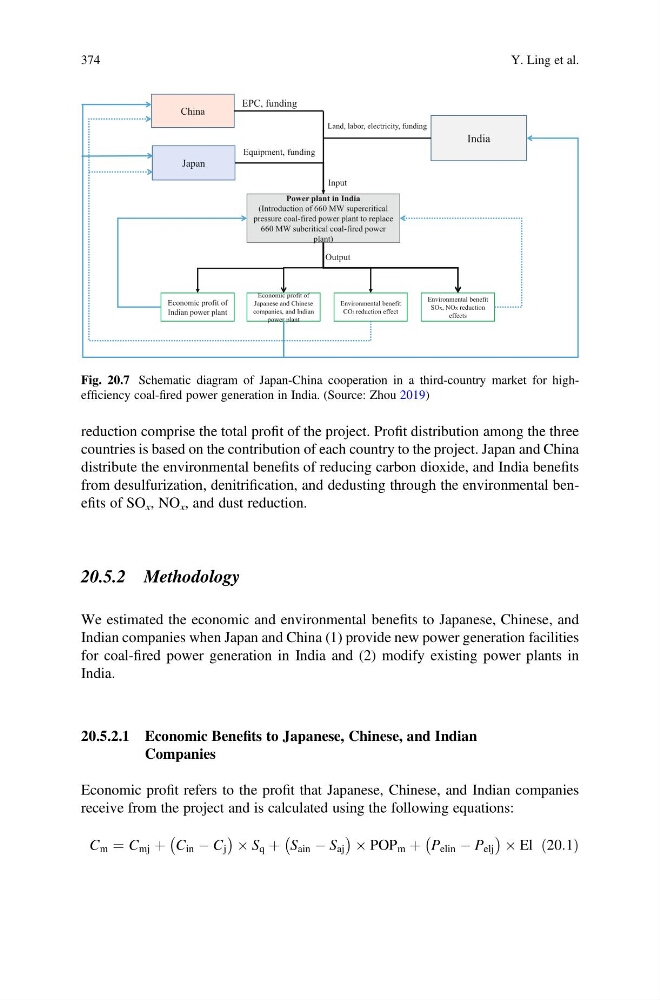
reduction comprise the total profit of the project. Profit distribution among the three
countries is based on the contribution of each country to the project. Japan and China
distribute the environmental benefits of reducing carbon dioxide, and India benefits
from desulfurization, denitrification, and dedusting through the environmental benefits of SO x , NO x , and dust reduction.
20.5.2 Methodology
We estimated the economic and environmental benefits to Japanese, Chinese, and
Indian companies when Japan and China (1) provide new power generation facilities
for coal-fired power generation in India and (2) modify existing power plants in
India.
20.5.2.1 Economic Benefits to Japanese, Chinese, and Indian
Companies
Economic profit refers to the profit that Japanese, Chinese, and Indian companies
receive from the project and is calculated using the following equations:
C m ¼ C mj þ C in À C j
À
Á Â S q þ S ain À S aj
À
Á Â POP m þ P elin À P elj
À
Á Â El ð20:1Þ
China
Japan
Power plant in India
(Introduction of 660 MW supercritical
pressure coal-fired power plant to replace
660 MW subcritical coal-fired power
plant)
Economic profit of
Indian power plant
Economic profit of
Japanese and Chinese
companies, and Indian
power plant
Environmental benefit
CO2 reduction effect
Environmental benefit
SOx, NOx reduction
effects
India
EPC, funding
Equipment, funding
Land, labor, electricity, funding
Input
Output
Fig. 20.7 Schematic diagram of Japan-China cooperation in a third-country market for highefficiency coal-fired power generation in India. (Source: Zhou 2019)
374
Y. Ling et al.
countries is based on the contribution of each country to the project. Japan and China
distribute the environmental benefits of reducing carbon dioxide, and India benefits
from desulfurization, denitrification, and dedusting through the environmental benefits of SO x , NO x , and dust reduction.
20.5.2 Methodology
We estimated the economic and environmental benefits to Japanese, Chinese, and
Indian companies when Japan and China (1) provide new power generation facilities
for coal-fired power generation in India and (2) modify existing power plants in
India.
20.5.2.1 Economic Benefits to Japanese, Chinese, and Indian
Companies
Economic profit refers to the profit that Japanese, Chinese, and Indian companies
receive from the project and is calculated using the following equations:
C m ¼ C mj þ C in À C j
À
Á Â S q þ S ain À S aj
À
Á Â POP m þ P elin À P elj
À
Á Â El ð20:1Þ
China
Japan
Power plant in India
(Introduction of 660 MW supercritical
pressure coal-fired power plant to replace
660 MW subcritical coal-fired power
plant)
Economic profit of
Indian power plant
Economic profit of
Japanese and Chinese
companies, and Indian
power plant
Environmental benefit
CO2 reduction effect
Environmental benefit
SOx, NOx reduction
effects
India
EPC, funding
Equipment, funding
Land, labor, electricity, funding
Input
Output
Fig. 20.7 Schematic diagram of Japan-China cooperation in a third-country market for highefficiency coal-fired power generation in India. (Source: Zhou 2019)
374
Y. Ling et al.