

20.3.3.2 Potential Reductions If India and Russia Match Power
Generation Efficiency of Japan
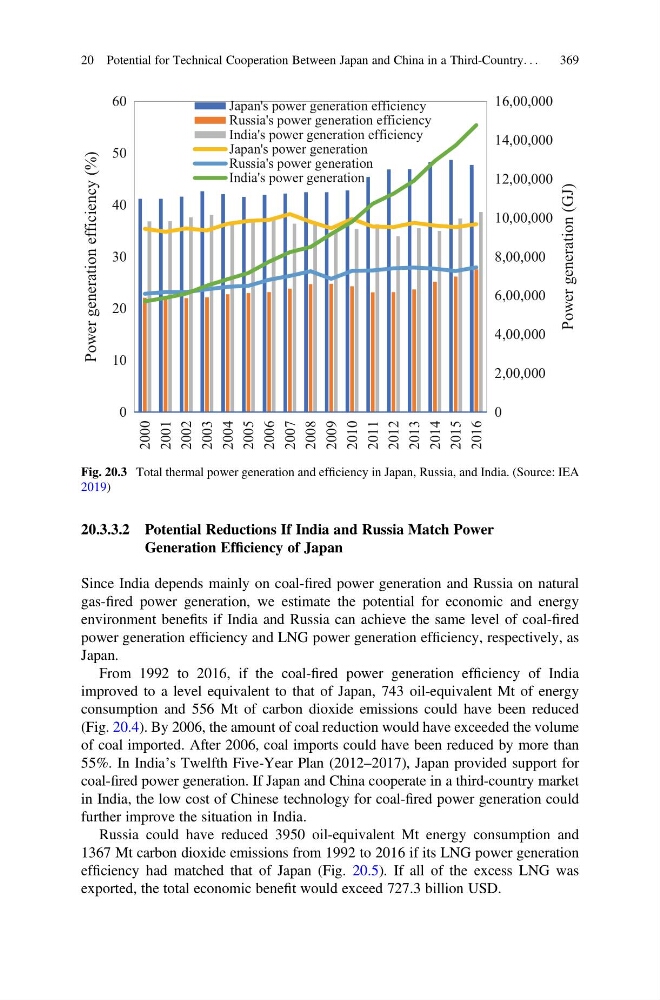
Since India depends mainly on coal-fired power generation and Russia on natural
gas-fired power generation, we estimate the potential for economic and energy
environment benefits if India and Russia can achieve the same level of coal-fired
power generation efficiency and LNG power generation efficiency, respectively, as
Japan.
From 1992 to 2016, if the coal-fired power generation efficiency of India
improved to a level equivalent to that of Japan, 743 oil-equivalent Mt of energy
consumption and 556 Mt of carbon dioxide emissions could have been reduced
(Fig. 20.4). By 2006, the amount of coal reduction would have exceeded the volume
of coal imported. After 2006, coal imports could have been reduced by more than
55%. In India’s Twelfth Five-Year Plan (2012–2017), Japan provided support for
coal-fired power generation. If Japan and China cooperate in a third-country market
in India, the low cost of Chinese technology for coal-fired power generation could
further improve the situation in India.
Russia could have reduced 3950 oil-equivalent Mt energy consumption and
1367 Mt carbon dioxide emissions from 1992 to 2016 if its LNG power generation
efficiency had matched that of Japan (Fig. 20.5). If all of the excess LNG was
exported, the total economic benefit would exceed 727.3 billion USD.
0
2,00,000
4,00,000
6,00,000
8,00,000
10,00,000
12,00,000
14,00,000
16,00,000
0
10
20
30
40
50
60
2000
2001
2002
2003
2004
2005
2006
2007
2008
2009
2010
2011
2012
2013
2014
2015
2016
Power generation (GJ)
Power generation efficiency (%)
Japan's power generation efficiency
Russia's power generation efficiency
India's power generation efficiency
Japan's power generation
Russia's power generation
India's power generation
Fig. 20.3 Total thermal power generation and efficiency in Japan, Russia, and India. (Source: IEA
2019)
20 Potential for Technical Cooperation Between Japan and China in a Third-Country. . .
369
Generation Efficiency of Japan
Since India depends mainly on coal-fired power generation and Russia on natural
gas-fired power generation, we estimate the potential for economic and energy
environment benefits if India and Russia can achieve the same level of coal-fired
power generation efficiency and LNG power generation efficiency, respectively, as
Japan.
From 1992 to 2016, if the coal-fired power generation efficiency of India
improved to a level equivalent to that of Japan, 743 oil-equivalent Mt of energy
consumption and 556 Mt of carbon dioxide emissions could have been reduced
(Fig. 20.4). By 2006, the amount of coal reduction would have exceeded the volume
of coal imported. After 2006, coal imports could have been reduced by more than
55%. In India’s Twelfth Five-Year Plan (2012–2017), Japan provided support for
coal-fired power generation. If Japan and China cooperate in a third-country market
in India, the low cost of Chinese technology for coal-fired power generation could
further improve the situation in India.
Russia could have reduced 3950 oil-equivalent Mt energy consumption and
1367 Mt carbon dioxide emissions from 1992 to 2016 if its LNG power generation
efficiency had matched that of Japan (Fig. 20.5). If all of the excess LNG was
exported, the total economic benefit would exceed 727.3 billion USD.
0
2,00,000
4,00,000
6,00,000
8,00,000
10,00,000
12,00,000
14,00,000
16,00,000
0
10
20
30
40
50
60
2000
2001
2002
2003
2004
2005
2006
2007
2008
2009
2010
2011
2012
2013
2014
2015
2016
Power generation (GJ)
Power generation efficiency (%)
Japan's power generation efficiency
Russia's power generation efficiency
India's power generation efficiency
Japan's power generation
Russia's power generation
India's power generation
Fig. 20.3 Total thermal power generation and efficiency in Japan, Russia, and India. (Source: IEA
2019)
20 Potential for Technical Cooperation Between Japan and China in a Third-Country. . .
369