

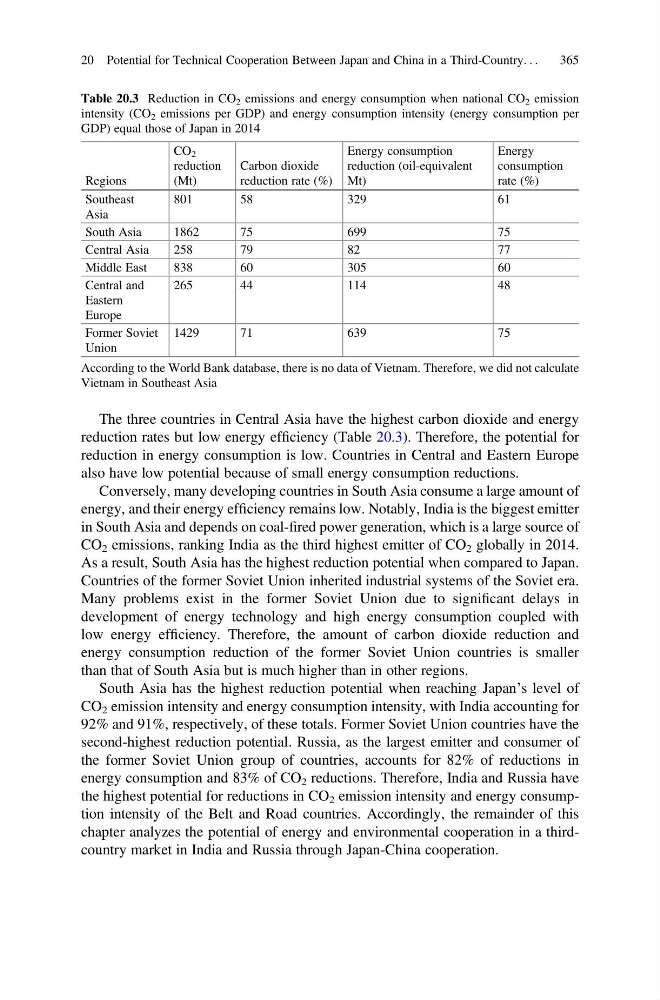
The three countries in Central Asia have the highest carbon dioxide and energy
reduction rates but low energy efficiency (Table 20.3). Therefore, the potential for
reduction in energy consumption is low. Countries in Central and Eastern Europe
also have low potential because of small energy consumption reductions.
Conversely, many developing countries in South Asia consume a large amount of
energy, and their energy efficiency remains low. Notably, India is the biggest emitter
in South Asia and depends on coal-fired power generation, which is a large source of
CO 2 emissions, ranking India as the third highest emitter of CO 2 globally in 2014.
As a result, South Asia has the highest reduction potential when compared to Japan.
Countries of the former Soviet Union inherited industrial systems of the Soviet era.
Many problems exist in the former Soviet Union due to significant delays in
development of energy technology and high energy consumption coupled with
low energy efficiency. Therefore, the amount of carbon dioxide reduction and
energy consumption reduction of the former Soviet Union countries is smaller
than that of South Asia but is much higher than in other regions.
South Asia has the highest reduction potential when reaching Japan’s level of
CO 2 emission intensity and energy consumption intensity, with India accounting for
92% and 91%, respectively, of these totals. Former Soviet Union countries have the
second-highest reduction potential. Russia, as the largest emitter and consumer of
the former Soviet Union group of countries, accounts for 82% of reductions in
energy consumption and 83% of CO 2 reductions. Therefore, India and Russia have
the highest potential for reductions in CO 2 emission intensity and energy consumption intensity of the Belt and Road countries. Accordingly, the remainder of this
chapter analyzes the potential of energy and environmental cooperation in a thirdcountry market in India and Russia through Japan-China cooperation.
Table 20.3 Reduction in CO 2 emissions and energy consumption when national CO 2 emission
intensity (CO 2 emissions per GDP) and energy consumption intensity (energy consumption per
GDP) equal those of Japan in 2014
Regions
CO 2
reduction
(Mt)
Carbon dioxide
reduction rate (%)
Energy consumption
reduction (oil-equivalent
Mt)
Energy
consumption
rate (%)
Southeast
Asia
801
58
329
61
South Asia
1862
75
699
75
Central Asia
258
79
82
77
Middle East
838
60
305
60
Central and
Eastern
Europe
265
44
114
48
Former Soviet
Union
1429
71
639
75
According to the World Bank database, there is no data of Vietnam. Therefore, we did not calculate
Vietnam in Southeast Asia
20 Potential for Technical Cooperation Between Japan and China in a Third-Country. . .
365
reduction rates but low energy efficiency (Table 20.3). Therefore, the potential for
reduction in energy consumption is low. Countries in Central and Eastern Europe
also have low potential because of small energy consumption reductions.
Conversely, many developing countries in South Asia consume a large amount of
energy, and their energy efficiency remains low. Notably, India is the biggest emitter
in South Asia and depends on coal-fired power generation, which is a large source of
CO 2 emissions, ranking India as the third highest emitter of CO 2 globally in 2014.
As a result, South Asia has the highest reduction potential when compared to Japan.
Countries of the former Soviet Union inherited industrial systems of the Soviet era.
Many problems exist in the former Soviet Union due to significant delays in
development of energy technology and high energy consumption coupled with
low energy efficiency. Therefore, the amount of carbon dioxide reduction and
energy consumption reduction of the former Soviet Union countries is smaller
than that of South Asia but is much higher than in other regions.
South Asia has the highest reduction potential when reaching Japan’s level of
CO 2 emission intensity and energy consumption intensity, with India accounting for
92% and 91%, respectively, of these totals. Former Soviet Union countries have the
second-highest reduction potential. Russia, as the largest emitter and consumer of
the former Soviet Union group of countries, accounts for 82% of reductions in
energy consumption and 83% of CO 2 reductions. Therefore, India and Russia have
the highest potential for reductions in CO 2 emission intensity and energy consumption intensity of the Belt and Road countries. Accordingly, the remainder of this
chapter analyzes the potential of energy and environmental cooperation in a thirdcountry market in India and Russia through Japan-China cooperation.
Table 20.3 Reduction in CO 2 emissions and energy consumption when national CO 2 emission
intensity (CO 2 emissions per GDP) and energy consumption intensity (energy consumption per
GDP) equal those of Japan in 2014
Regions
CO 2
reduction
(Mt)
Carbon dioxide
reduction rate (%)
Energy consumption
reduction (oil-equivalent
Mt)
Energy
consumption
rate (%)
Southeast
Asia
801
58
329
61
South Asia
1862
75
699
75
Central Asia
258
79
82
77
Middle East
838
60
305
60
Central and
Eastern
Europe
265
44
114
48
Former Soviet
Union
1429
71
639
75
According to the World Bank database, there is no data of Vietnam. Therefore, we did not calculate
Vietnam in Southeast Asia
20 Potential for Technical Cooperation Between Japan and China in a Third-Country. . .
365