

and calculate the CO 2 reduction effect and economics of third-country market
cooperation.
20.2 Potential Energy and Environment Reductions in Belt
and Road Countries
To calculate the reduction potential of each country of the Belt and Road in the field
of energy and environment, we divided the countries into six regions: Southeast
Asia, South Asia, Central Asia, the Middle East, the former Soviet Union, and
Central and Eastern Europe. Then, we calculated the CO 2 reduction and energysaving potential when the six regions reach carbon dioxide emissions per gross
domestic product (GDP) and energy consumption per GDP equivalent to those in
Japan in the same year.
Factors that influence CO 2 emissions per GDP (which is a measure of CO 2
emission intensity) are energy consumption structure, industrial structure, and
energy use efficiency. Factors that influence energy consumption per GDP (which
is a measure of energy consumption intensity) are industrial structure and energy
efficiency. Therefore, a third country that could cooperate with Japan and China in
this field would need an industrial structure similar to Japan. In this study, industrial
structure is judged mainly by the ratio of increased industry value to GDP. Since
2000, the ratio of the increased value of the Japanese manufacturing industry to GDP
has increased by approximately 19–22%. Japan is the third largest economy globally; it is impossible to choose a third country with the same ratio of increased value
in the manufacturing industry to GDP as Japan. Therefore, it is reasonable to classify
a country as having a similar industrial structure to Japan if its ratio of manufacturing
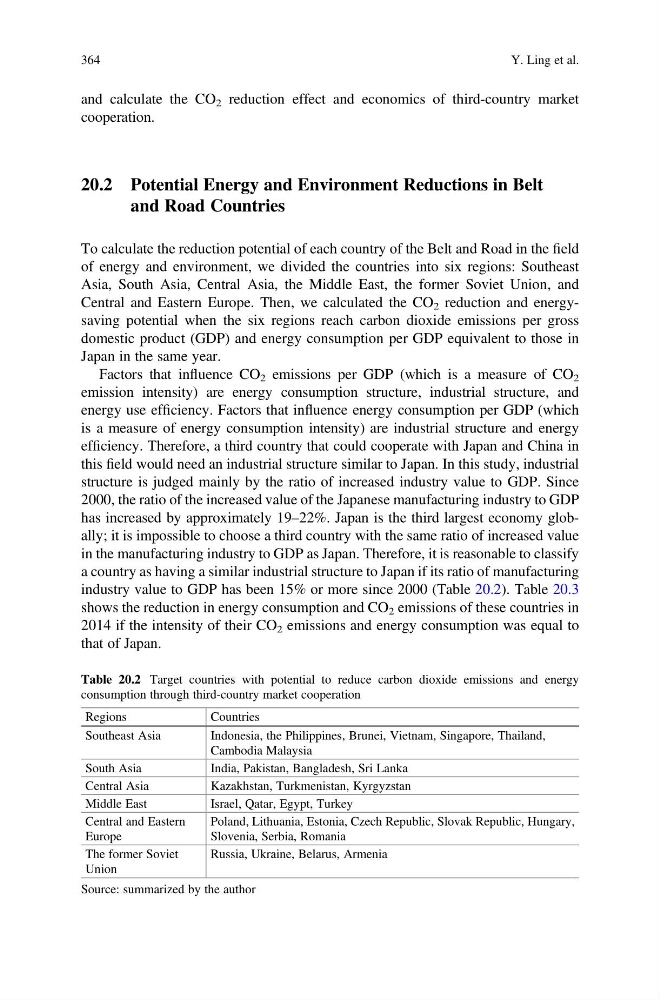
industry value to GDP has been 15% or more since 2000 (Table 20.2). Table 20.3
shows the reduction in energy consumption and CO 2 emissions of these countries in
2014 if the intensity of their CO 2 emissions and energy consumption was equal to
that of Japan.
Table 20.2 Target countries with potential to reduce carbon dioxide emissions and energy
consumption through third-country market cooperation
Regions
Countries
Southeast Asia
Indonesia, the Philippines, Brunei, Vietnam, Singapore, Thailand,
Cambodia Malaysia
South Asia
India, Pakistan, Bangladesh, Sri Lanka
Central Asia
Kazakhstan, Turkmenistan, Kyrgyzstan
Middle East
Israel, Qatar, Egypt, Turkey
Central and Eastern
Europe
Poland, Lithuania, Estonia, Czech Republic, Slovak Republic, Hungary,
Slovenia, Serbia, Romania
The former Soviet
Union
Russia, Ukraine, Belarus, Armenia
Source: summarized by the author
364
Y. Ling et al.
cooperation.
20.2 Potential Energy and Environment Reductions in Belt
and Road Countries
To calculate the reduction potential of each country of the Belt and Road in the field
of energy and environment, we divided the countries into six regions: Southeast
Asia, South Asia, Central Asia, the Middle East, the former Soviet Union, and
Central and Eastern Europe. Then, we calculated the CO 2 reduction and energysaving potential when the six regions reach carbon dioxide emissions per gross
domestic product (GDP) and energy consumption per GDP equivalent to those in
Japan in the same year.
Factors that influence CO 2 emissions per GDP (which is a measure of CO 2
emission intensity) are energy consumption structure, industrial structure, and
energy use efficiency. Factors that influence energy consumption per GDP (which
is a measure of energy consumption intensity) are industrial structure and energy
efficiency. Therefore, a third country that could cooperate with Japan and China in
this field would need an industrial structure similar to Japan. In this study, industrial
structure is judged mainly by the ratio of increased industry value to GDP. Since
2000, the ratio of the increased value of the Japanese manufacturing industry to GDP
has increased by approximately 19–22%. Japan is the third largest economy globally; it is impossible to choose a third country with the same ratio of increased value
in the manufacturing industry to GDP as Japan. Therefore, it is reasonable to classify
a country as having a similar industrial structure to Japan if its ratio of manufacturing
industry value to GDP has been 15% or more since 2000 (Table 20.2). Table 20.3
shows the reduction in energy consumption and CO 2 emissions of these countries in
2014 if the intensity of their CO 2 emissions and energy consumption was equal to
that of Japan.
Table 20.2 Target countries with potential to reduce carbon dioxide emissions and energy
consumption through third-country market cooperation
Regions
Countries
Southeast Asia
Indonesia, the Philippines, Brunei, Vietnam, Singapore, Thailand,
Cambodia Malaysia
South Asia
India, Pakistan, Bangladesh, Sri Lanka
Central Asia
Kazakhstan, Turkmenistan, Kyrgyzstan
Middle East
Israel, Qatar, Egypt, Turkey
Central and Eastern
Europe
Poland, Lithuania, Estonia, Czech Republic, Slovak Republic, Hungary,
Slovenia, Serbia, Romania
The former Soviet
Union
Russia, Ukraine, Belarus, Armenia
Source: summarized by the author
364
Y. Ling et al.