

variables. Uncertainty limits our predictions and observations. Put merely, and
uncertainty refers to the inability to accurately know the outcome of a particular
event or a confident decision in advance. In other words, as long as there is more than
one possible outcome of an event or decision, uncertainty will arise. For example, in
economics, uncertainty means that the distribution range and states of economic
conditions, such as future gains and losses, cannot be known with certainty. As
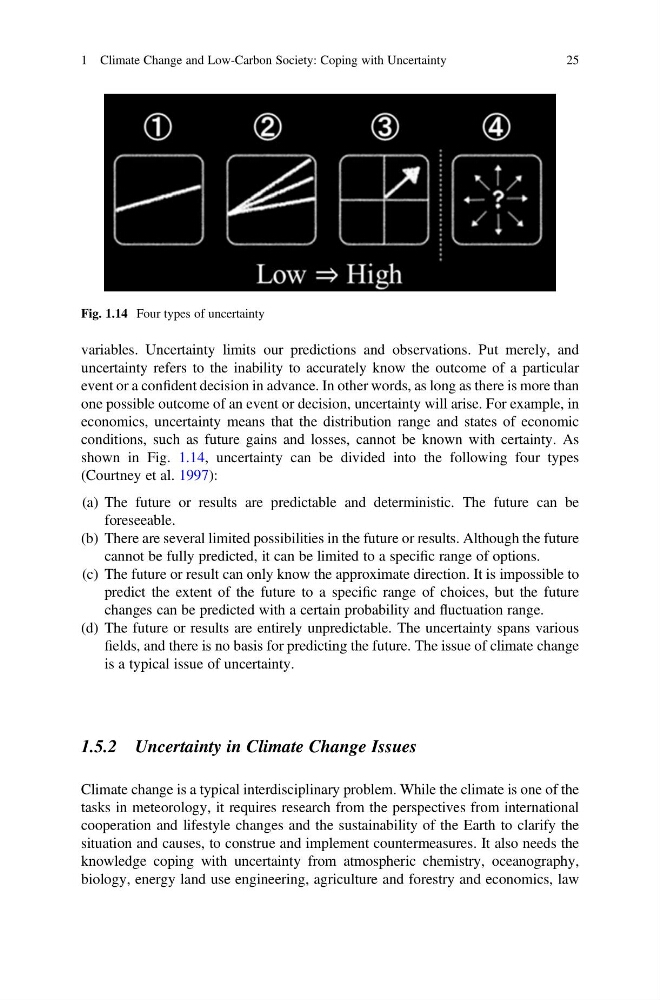
shown in Fig. 1.14, uncertainty can be divided into the following four types
(Courtney et al. 1997):
(a) The future or results are predictable and deterministic. The future can be
foreseeable.
(b) There are several limited possibilities in the future or results. Although the future
cannot be fully predicted, it can be limited to a specific range of options.
(c) The future or result can only know the approximate direction. It is impossible to
predict the extent of the future to a specific range of choices, but the future
changes can be predicted with a certain probability and fluctuation range.
(d) The future or results are entirely unpredictable. The uncertainty spans various
fields, and there is no basis for predicting the future. The issue of climate change
is a typical issue of uncertainty.
1.5.2 Uncertainty in Climate Change Issues
Climate change is a typical interdisciplinary problem. While the climate is one of the
tasks in meteorology, it requires research from the perspectives from international
cooperation and lifestyle changes and the sustainability of the Earth to clarify the
situation and causes, to construe and implement countermeasures. It also needs the
knowledge coping with uncertainty from atmospheric chemistry, oceanography,
biology, energy land use engineering, agriculture and forestry and economics, law
Fig. 1.14 Four types of uncertainty
1 Climate Change and Low-Carbon Society: Coping with Uncertainty
25
uncertainty refers to the inability to accurately know the outcome of a particular
event or a confident decision in advance. In other words, as long as there is more than
one possible outcome of an event or decision, uncertainty will arise. For example, in
economics, uncertainty means that the distribution range and states of economic
conditions, such as future gains and losses, cannot be known with certainty. As
shown in Fig. 1.14, uncertainty can be divided into the following four types
(Courtney et al. 1997):
(a) The future or results are predictable and deterministic. The future can be
foreseeable.
(b) There are several limited possibilities in the future or results. Although the future
cannot be fully predicted, it can be limited to a specific range of options.
(c) The future or result can only know the approximate direction. It is impossible to
predict the extent of the future to a specific range of choices, but the future
changes can be predicted with a certain probability and fluctuation range.
(d) The future or results are entirely unpredictable. The uncertainty spans various
fields, and there is no basis for predicting the future. The issue of climate change
is a typical issue of uncertainty.
1.5.2 Uncertainty in Climate Change Issues
Climate change is a typical interdisciplinary problem. While the climate is one of the
tasks in meteorology, it requires research from the perspectives from international
cooperation and lifestyle changes and the sustainability of the Earth to clarify the
situation and causes, to construe and implement countermeasures. It also needs the
knowledge coping with uncertainty from atmospheric chemistry, oceanography,
biology, energy land use engineering, agriculture and forestry and economics, law
Fig. 1.14 Four types of uncertainty
1 Climate Change and Low-Carbon Society: Coping with Uncertainty
25