

In recent years, a dramatic decline in the cost of wind and solar power has affected
policy-making decisions (UNEP Centre/BNEF 2020). These technologies have
always been low-carbon and are relatively fast to build. In many countries, wind
and solar are currently the cheapest power generation options. China has achieved a
relative price advantage in multi-module prices, which has also helped to contribute
to expanding PV utilization and reducing costs.
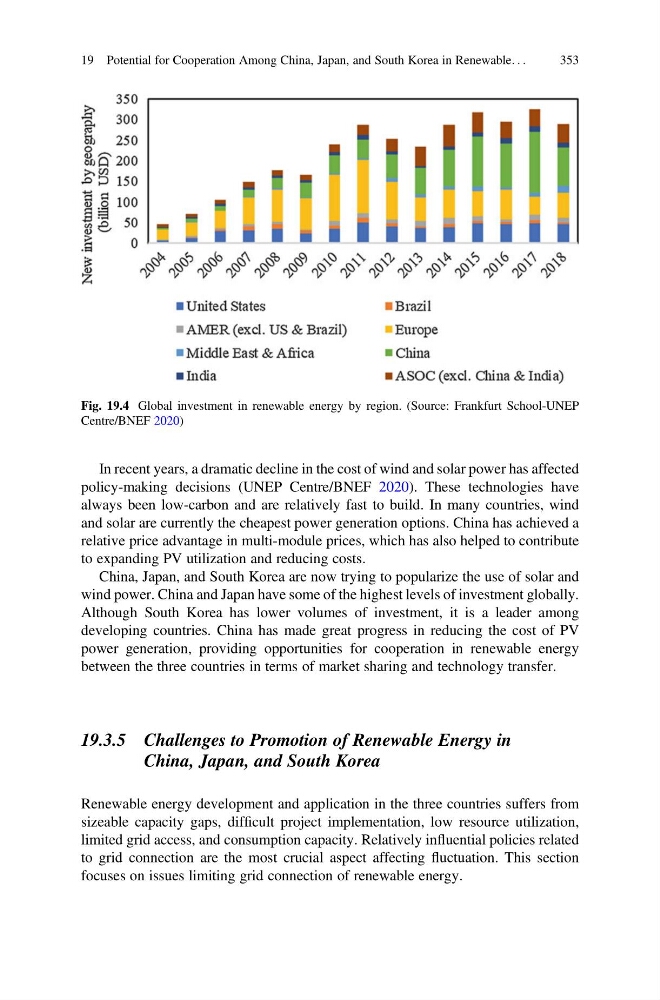
China, Japan, and South Korea are now trying to popularize the use of solar and
wind power. China and Japan have some of the highest levels of investment globally.
Although South Korea has lower volumes of investment, it is a leader among
developing countries. China has made great progress in reducing the cost of PV
power generation, providing opportunities for cooperation in renewable energy
between the three countries in terms of market sharing and technology transfer.
19.3.5 Challenges to Promotion of Renewable Energy in
China, Japan, and South Korea
Renewable energy development and application in the three countries suffers from
sizeable capacity gaps, difficult project implementation, low resource utilization,
limited grid access, and consumption capacity. Relatively influential policies related
to grid connection are the most crucial aspect affecting fluctuation. This section
focuses on issues limiting grid connection of renewable energy.
Fig. 19.4 Global investment in renewable energy by region. (Source: Frankfurt School-UNEP
Centre/BNEF 2020)
19 Potential for Cooperation Among China, Japan, and South Korea in Renewable. . .
353
policy-making decisions (UNEP Centre/BNEF 2020). These technologies have
always been low-carbon and are relatively fast to build. In many countries, wind
and solar are currently the cheapest power generation options. China has achieved a
relative price advantage in multi-module prices, which has also helped to contribute
to expanding PV utilization and reducing costs.
China, Japan, and South Korea are now trying to popularize the use of solar and
wind power. China and Japan have some of the highest levels of investment globally.
Although South Korea has lower volumes of investment, it is a leader among
developing countries. China has made great progress in reducing the cost of PV
power generation, providing opportunities for cooperation in renewable energy
between the three countries in terms of market sharing and technology transfer.
19.3.5 Challenges to Promotion of Renewable Energy in
China, Japan, and South Korea
Renewable energy development and application in the three countries suffers from
sizeable capacity gaps, difficult project implementation, low resource utilization,
limited grid access, and consumption capacity. Relatively influential policies related
to grid connection are the most crucial aspect affecting fluctuation. This section
focuses on issues limiting grid connection of renewable energy.
Fig. 19.4 Global investment in renewable energy by region. (Source: Frankfurt School-UNEP
Centre/BNEF 2020)
19 Potential for Cooperation Among China, Japan, and South Korea in Renewable. . .
353