

focused on refining production processes to reduce costs. The third and fourth stages
will run from 2020 to 2030, with a parity of 14 JPY/kWh. During this period,
technology development will focus on low-cost next-generation solar cells and longlife storage batteries. The fifth period from 2030 to 2050 will have a parity of 7 JPY/
kWh. During this period, technology development will focus on improving the
efficiency of solar panels to 40%.
In South Korea, the Ministry of Trade, Industry, and Energy (MOTIE) planned to
help the PV industry reduce the costs of solar module technology to 0.10 USD/cell
by 2030 and to increase production efficiency to 24% by the end of the next decade.
The government expects PV cell producers to increase the average efficiency of
multi-junction devices from 23 to 35%.
Wind Energy Generation
China has been promoting the development of both offshore and onshore wind
(Fig. 19.2). The historical focus has been on onshore wind, especially in the northern
and western regions of China, where wind resources are abundant. However,
insufficient system capacity became apparent. Since offshore wind can be located
close to areas with high power demand and is easy to connect to the grid, development of offshore wind has become more important. In 2007, the Donghai Daqiao
Offshore Wind Power Generation Project launched. The project installed 34 Sinovel
3 MW units with a total power generation capacity of 102 MW. Several offshore
wind farms have been constructed along the coast in water of 5 m depth or less, such
as at Rudong (30 MW), Jiangsu Xiangshui (6 MW), and Shandong Rongcheng
(6 MW).
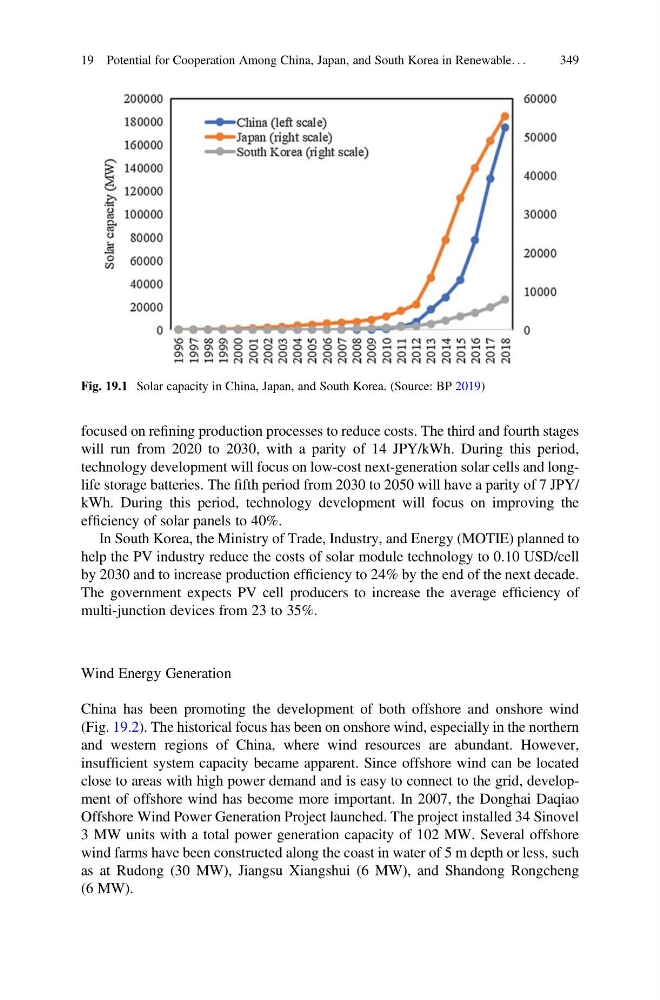
Fig. 19.1 Solar capacity in China, Japan, and South Korea. (Source: BP 2019)
19 Potential for Cooperation Among China, Japan, and South Korea in Renewable. . .
349
will run from 2020 to 2030, with a parity of 14 JPY/kWh. During this period,
technology development will focus on low-cost next-generation solar cells and longlife storage batteries. The fifth period from 2030 to 2050 will have a parity of 7 JPY/
kWh. During this period, technology development will focus on improving the
efficiency of solar panels to 40%.
In South Korea, the Ministry of Trade, Industry, and Energy (MOTIE) planned to
help the PV industry reduce the costs of solar module technology to 0.10 USD/cell
by 2030 and to increase production efficiency to 24% by the end of the next decade.
The government expects PV cell producers to increase the average efficiency of
multi-junction devices from 23 to 35%.
Wind Energy Generation
China has been promoting the development of both offshore and onshore wind
(Fig. 19.2). The historical focus has been on onshore wind, especially in the northern
and western regions of China, where wind resources are abundant. However,
insufficient system capacity became apparent. Since offshore wind can be located
close to areas with high power demand and is easy to connect to the grid, development of offshore wind has become more important. In 2007, the Donghai Daqiao
Offshore Wind Power Generation Project launched. The project installed 34 Sinovel
3 MW units with a total power generation capacity of 102 MW. Several offshore
wind farms have been constructed along the coast in water of 5 m depth or less, such
as at Rudong (30 MW), Jiangsu Xiangshui (6 MW), and Shandong Rongcheng
(6 MW).
Fig. 19.1 Solar capacity in China, Japan, and South Korea. (Source: BP 2019)
19 Potential for Cooperation Among China, Japan, and South Korea in Renewable. . .
349