

perspectives. The second is countermeasures against fluctuation, which is assessed
in Sect. 19.3.5.
19.3.3.1 Renewable Energy Introduction Potential and Technology
Development
China, Japan, and South Korea have abundant renewable energy resources. Due to
regional differences in conditions, the focus of renewable energy and the direction of
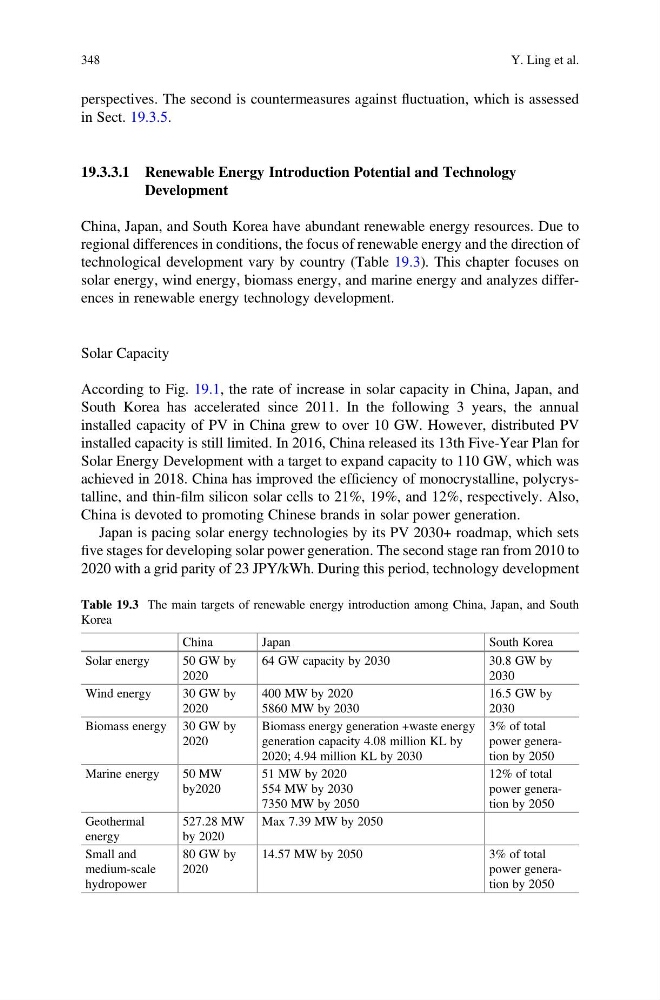
technological development vary by country (Table 19.3). This chapter focuses on
solar energy, wind energy, biomass energy, and marine energy and analyzes differences in renewable energy technology development.
Solar Capacity
According to Fig. 19.1, the rate of increase in solar capacity in China, Japan, and
South Korea has accelerated since 2011. In the following 3 years, the annual
installed capacity of PV in China grew to over 10 GW. However, distributed PV
installed capacity is still limited. In 2016, China released its 13th Five-Year Plan for
Solar Energy Development with a target to expand capacity to 110 GW, which was
achieved in 2018. China has improved the efficiency of monocrystalline, polycrystalline, and thin-film silicon solar cells to 21%, 19%, and 12%, respectively. Also,
China is devoted to promoting Chinese brands in solar power generation.
Japan is pacing solar energy technologies by its PV 2030+ roadmap, which sets
five stages for developing solar power generation. The second stage ran from 2010 to
2020 with a grid parity of 23 JPY/kWh. During this period, technology development
Table 19.3 The main targets of renewable energy introduction among China, Japan, and South
Korea
China
Japan
South Korea
Solar energy
50 GW by
2020
64 GW capacity by 2030
30.8 GW by
2030
Wind energy
30 GW by
2020
400 MW by 2020
5860 MW by 2030
16.5 GW by
2030
Biomass energy 30 GW by
2020
Biomass energy generation +waste energy
generation capacity 4.08 million KL by
2020; 4.94 million KL by 2030
3% of total
power generation by 2050
Marine energy
50 MW
by2020
51 MW by 2020
554 MW by 2030
7350 MW by 2050
12% of total
power generation by 2050
Geothermal
energy
527.28 MW
by 2020
Max 7.39 MW by 2050
Small and
medium-scale
hydropower
80 GW by
2020
14.57 MW by 2050
3% of total
power generation by 2050
348
Y. Ling et al.
in Sect. 19.3.5.
19.3.3.1 Renewable Energy Introduction Potential and Technology
Development
China, Japan, and South Korea have abundant renewable energy resources. Due to
regional differences in conditions, the focus of renewable energy and the direction of
technological development vary by country (Table 19.3). This chapter focuses on
solar energy, wind energy, biomass energy, and marine energy and analyzes differences in renewable energy technology development.
Solar Capacity
According to Fig. 19.1, the rate of increase in solar capacity in China, Japan, and
South Korea has accelerated since 2011. In the following 3 years, the annual
installed capacity of PV in China grew to over 10 GW. However, distributed PV
installed capacity is still limited. In 2016, China released its 13th Five-Year Plan for
Solar Energy Development with a target to expand capacity to 110 GW, which was
achieved in 2018. China has improved the efficiency of monocrystalline, polycrystalline, and thin-film silicon solar cells to 21%, 19%, and 12%, respectively. Also,
China is devoted to promoting Chinese brands in solar power generation.
Japan is pacing solar energy technologies by its PV 2030+ roadmap, which sets
five stages for developing solar power generation. The second stage ran from 2010 to
2020 with a grid parity of 23 JPY/kWh. During this period, technology development
Table 19.3 The main targets of renewable energy introduction among China, Japan, and South
Korea
China
Japan
South Korea
Solar energy
50 GW by
2020
64 GW capacity by 2030
30.8 GW by
2030
Wind energy
30 GW by
2020
400 MW by 2020
5860 MW by 2030
16.5 GW by
2030
Biomass energy 30 GW by
2020
Biomass energy generation +waste energy
generation capacity 4.08 million KL by
2020; 4.94 million KL by 2030
3% of total
power generation by 2050
Marine energy
50 MW
by2020
51 MW by 2020
554 MW by 2030
7350 MW by 2050
12% of total
power generation by 2050
Geothermal
energy
527.28 MW
by 2020
Max 7.39 MW by 2050
Small and
medium-scale
hydropower
80 GW by
2020
14.57 MW by 2050
3% of total
power generation by 2050
348
Y. Ling et al.