

1.4.3 Sea Level
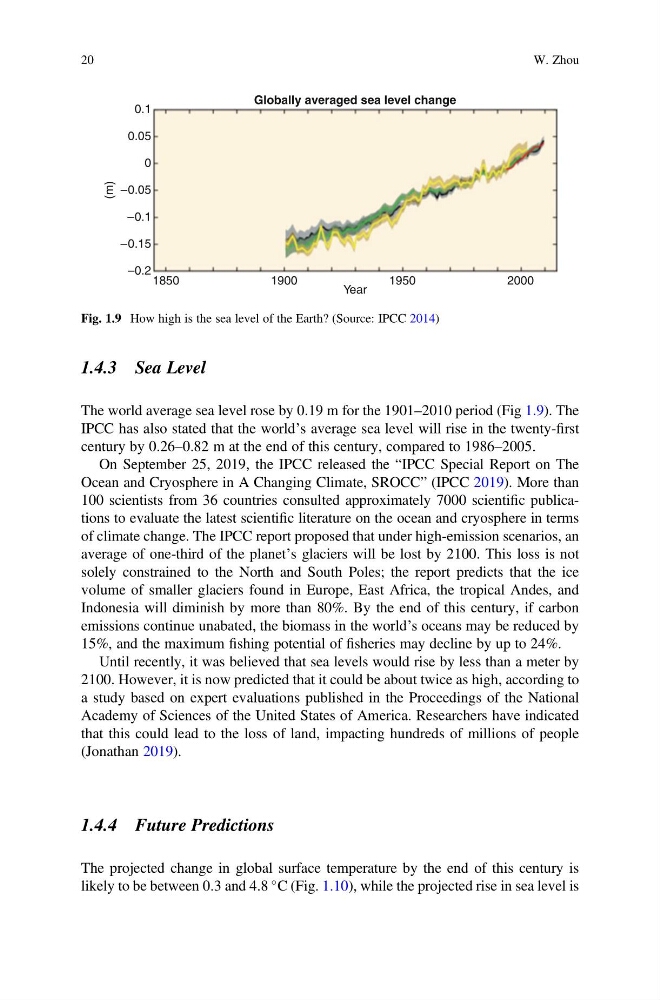
The world average sea level rose by 0.19 m for the 1901–2010 period (Fig 1.9). The
IPCC has also stated that the world’s average sea level will rise in the twenty-first
century by 0.26–0.82 m at the end of this century, compared to 1986–2005.
On September 25, 2019, the IPCC released the “IPCC Special Report on The
Ocean and Cryosphere in A Changing Climate, SROCC” (IPCC 2019). More than
100 scientists from 36 countries consulted approximately 7000 scientific publications to evaluate the latest scientific literature on the ocean and cryosphere in terms
of climate change. The IPCC report proposed that under high-emission scenarios, an
average of one-third of the planet’s glaciers will be lost by 2100. This loss is not
solely constrained to the North and South Poles; the report predicts that the ice
volume of smaller glaciers found in Europe, East Africa, the tropical Andes, and
Indonesia will diminish by more than 80%. By the end of this century, if carbon
emissions continue unabated, the biomass in the world’s oceans may be reduced by
15%, and the maximum fishing potential of fisheries may decline by up to 24%.
Until recently, it was believed that sea levels would rise by less than a meter by
2100. However, it is now predicted that it could be about twice as high, according to
a study based on expert evaluations published in the Proceedings of the National
Academy of Sciences of the United States of America. Researchers have indicated
that this could lead to the loss of land, impacting hundreds of millions of people
(Jonathan 2019).
1.4.4 Future Predictions
The projected change in global surface temperature by the end of this century is
likely to be between 0.3 and 4.8
C (Fig. 1.10), while the projected rise in sea level is
Globally averaged sea level change
(m)
1850
1900
1950
Year
2000
0.1
0.05
–0.05
–0.15
–0.2
–0.1
0
Fig. 1.9 How high is the sea level of the Earth? (Source: IPCC 2014)
20
W. Zhou
The world average sea level rose by 0.19 m for the 1901–2010 period (Fig 1.9). The
IPCC has also stated that the world’s average sea level will rise in the twenty-first
century by 0.26–0.82 m at the end of this century, compared to 1986–2005.
On September 25, 2019, the IPCC released the “IPCC Special Report on The
Ocean and Cryosphere in A Changing Climate, SROCC” (IPCC 2019). More than
100 scientists from 36 countries consulted approximately 7000 scientific publications to evaluate the latest scientific literature on the ocean and cryosphere in terms
of climate change. The IPCC report proposed that under high-emission scenarios, an
average of one-third of the planet’s glaciers will be lost by 2100. This loss is not
solely constrained to the North and South Poles; the report predicts that the ice
volume of smaller glaciers found in Europe, East Africa, the tropical Andes, and
Indonesia will diminish by more than 80%. By the end of this century, if carbon
emissions continue unabated, the biomass in the world’s oceans may be reduced by
15%, and the maximum fishing potential of fisheries may decline by up to 24%.
Until recently, it was believed that sea levels would rise by less than a meter by
2100. However, it is now predicted that it could be about twice as high, according to
a study based on expert evaluations published in the Proceedings of the National
Academy of Sciences of the United States of America. Researchers have indicated
that this could lead to the loss of land, impacting hundreds of millions of people
(Jonathan 2019).
1.4.4 Future Predictions
The projected change in global surface temperature by the end of this century is
likely to be between 0.3 and 4.8
C (Fig. 1.10), while the projected rise in sea level is
Globally averaged sea level change
(m)
1850
1900
1950
Year
2000
0.1
0.05
–0.05
–0.15
–0.2
–0.1
0
Fig. 1.9 How high is the sea level of the Earth? (Source: IPCC 2014)
20
W. Zhou