

1.4.1 Causes of Global Warming
Human activity is likely to be the dominant factor in the warming observed since the
mid-twentieth century (>95% likely). Atmospheric CO 2 , methane (CH 4 ), and
nitrous oxide (N 2 O) concentrations have increased to unprecedented levels over
the last 800,000 years. In terms of the causes of climate change, a few changes were
made compared with previous reports. It was announced that anthropogenic activities are very likely (95%) to be the cause of the warming observed since the
mid-twentieth century. It also states that atmospheric CO 2 , CH 4 , and N 2 O have
increased to unprecedented levels over the last 800,000 years. It is stated that the
changes in total CO 2 emissions and global mean surface temperatures are roughly
linear. In other words, the upper limit of temperature rise is determined by the upper
limit of total accumulated emissions. For lower temperature increases, a lower
cumulative emission is required.
It is stated that the upper limit of cumulative CO 2 emissions with the highest
probability (over 66%) is 790 GtC. This is the level that has maintained the global
average temperature rise pre-industrialization within 2
C. By 2011, approximately
515 GtC have already been emitted.
1.4.2 Current State of Global Warming (Observed Facts)
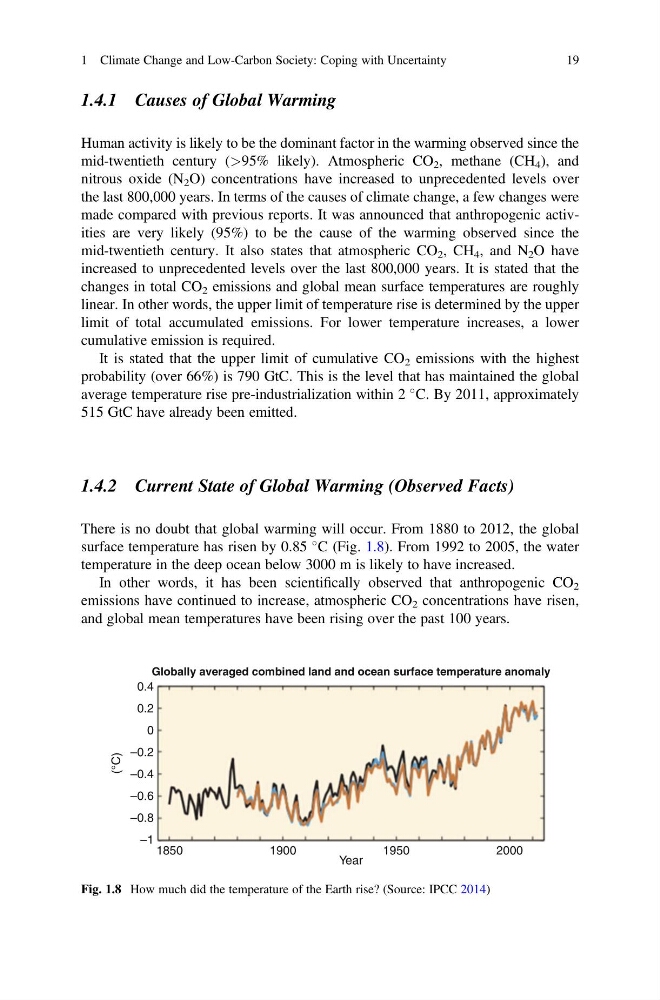
There is no doubt that global warming will occur. From 1880 to 2012, the global
surface temperature has risen by 0.85
C (Fig. 1.8). From 1992 to 2005, the water
temperature in the deep ocean below 3000 m is likely to have increased.
In other words, it has been scientifically observed that anthropogenic CO 2
emissions have continued to increase, atmospheric CO 2 concentrations have risen,
and global mean temperatures have been rising over the past 100 years.
Globally averaged combined land and ocean surface temperature anomaly
(°C)
1850
1900
1950
2000
Year
0.4
0.2
–0.2
–0.4
–0.6
–0.8
–1
0
Fig. 1.8 How much did the temperature of the Earth rise? (Source: IPCC 2014)
1 Climate Change and Low-Carbon Society: Coping with Uncertainty
19
Human activity is likely to be the dominant factor in the warming observed since the
mid-twentieth century (>95% likely). Atmospheric CO 2 , methane (CH 4 ), and
nitrous oxide (N 2 O) concentrations have increased to unprecedented levels over
the last 800,000 years. In terms of the causes of climate change, a few changes were
made compared with previous reports. It was announced that anthropogenic activities are very likely (95%) to be the cause of the warming observed since the
mid-twentieth century. It also states that atmospheric CO 2 , CH 4 , and N 2 O have
increased to unprecedented levels over the last 800,000 years. It is stated that the
changes in total CO 2 emissions and global mean surface temperatures are roughly
linear. In other words, the upper limit of temperature rise is determined by the upper
limit of total accumulated emissions. For lower temperature increases, a lower
cumulative emission is required.
It is stated that the upper limit of cumulative CO 2 emissions with the highest
probability (over 66%) is 790 GtC. This is the level that has maintained the global
average temperature rise pre-industrialization within 2
C. By 2011, approximately
515 GtC have already been emitted.
1.4.2 Current State of Global Warming (Observed Facts)
There is no doubt that global warming will occur. From 1880 to 2012, the global
surface temperature has risen by 0.85
C (Fig. 1.8). From 1992 to 2005, the water
temperature in the deep ocean below 3000 m is likely to have increased.
In other words, it has been scientifically observed that anthropogenic CO 2
emissions have continued to increase, atmospheric CO 2 concentrations have risen,
and global mean temperatures have been rising over the past 100 years.
Globally averaged combined land and ocean surface temperature anomaly
(°C)
1850
1900
1950
2000
Year
0.4
0.2
–0.2
–0.4
–0.6
–0.8
–1
0
Fig. 1.8 How much did the temperature of the Earth rise? (Source: IPCC 2014)
1 Climate Change and Low-Carbon Society: Coping with Uncertainty
19