

manufacturing, or supply-side, countries were wholly responsible. The latter were
considered as wholly the responsibility of the countries demanding the product. The
production of transportation equipment in various sectors was selected as a case
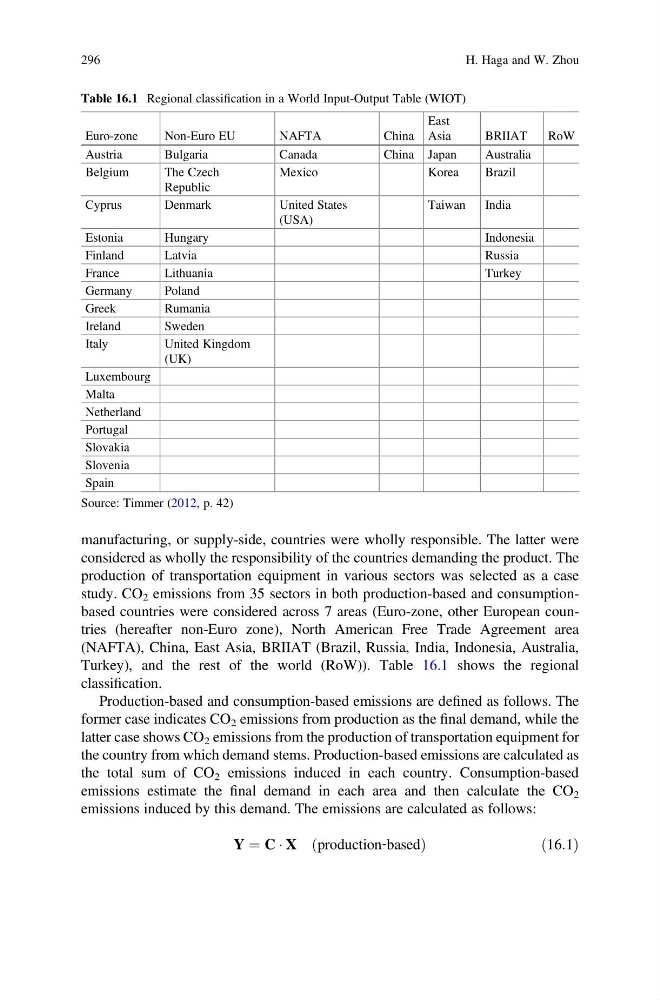
study. CO 2 emissions from 35 sectors in both production-based and consumptionbased countries were considered across 7 areas (Euro-zone, other European countries (hereafter non-Euro zone), North American Free Trade Agreement area
(NAFTA), China, East Asia, BRIIAT (Brazil, Russia, India, Indonesia, Australia,
Turkey), and the rest of the world (RoW)). Table 16.1 shows the regional
classification.
Production-based and consumption-based emissions are defined as follows. The
former case indicates CO 2 emissions from production as the final demand, while the
latter case shows CO 2 emissions from the production of transportation equipment for
the country from which demand stems. Production-based emissions are calculated as
the total sum of CO 2 emissions induced in each country. Consumption-based
emissions estimate the final demand in each area and then calculate the CO 2
emissions induced by this demand. The emissions are calculated as follows:
Y ¼ C Á X production‐based
ð
Þ
ð 16:1Þ
Table 16.1 Regional classification in a World Input-Output Table (WIOT)
Euro-zone
Non-Euro EU
NAFTA
China
East
Asia
BRIIAT
RoW
Austria
Bulgaria
Canada
China Japan
Australia
Belgium
The Czech
Republic
Mexico
Korea
Brazil
Cyprus
Denmark
United States
(USA)
Taiwan
India
Estonia
Hungary
Indonesia
Finland
Latvia
Russia
France
Lithuania
Turkey
Germany
Poland
Greek
Rumania
Ireland
Sweden
Italy
United Kingdom
(UK)
Luxembourg
Malta
Netherland
Portugal
Slovakia
Slovenia
Spain
Source: Timmer (2012, p. 42)
296
H. Haga and W. Zhou
considered as wholly the responsibility of the countries demanding the product. The
production of transportation equipment in various sectors was selected as a case
study. CO 2 emissions from 35 sectors in both production-based and consumptionbased countries were considered across 7 areas (Euro-zone, other European countries (hereafter non-Euro zone), North American Free Trade Agreement area
(NAFTA), China, East Asia, BRIIAT (Brazil, Russia, India, Indonesia, Australia,
Turkey), and the rest of the world (RoW)). Table 16.1 shows the regional
classification.
Production-based and consumption-based emissions are defined as follows. The
former case indicates CO 2 emissions from production as the final demand, while the
latter case shows CO 2 emissions from the production of transportation equipment for
the country from which demand stems. Production-based emissions are calculated as
the total sum of CO 2 emissions induced in each country. Consumption-based
emissions estimate the final demand in each area and then calculate the CO 2
emissions induced by this demand. The emissions are calculated as follows:
Y ¼ C Á X production‐based
ð
Þ
ð 16:1Þ
Table 16.1 Regional classification in a World Input-Output Table (WIOT)
Euro-zone
Non-Euro EU
NAFTA
China
East
Asia
BRIIAT
RoW
Austria
Bulgaria
Canada
China Japan
Australia
Belgium
The Czech
Republic
Mexico
Korea
Brazil
Cyprus
Denmark
United States
(USA)
Taiwan
India
Estonia
Hungary
Indonesia
Finland
Latvia
Russia
France
Lithuania
Turkey
Germany
Poland
Greek
Rumania
Ireland
Sweden
Italy
United Kingdom
(UK)
Luxembourg
Malta
Netherland
Portugal
Slovakia
Slovenia
Spain
Source: Timmer (2012, p. 42)
296
H. Haga and W. Zhou