

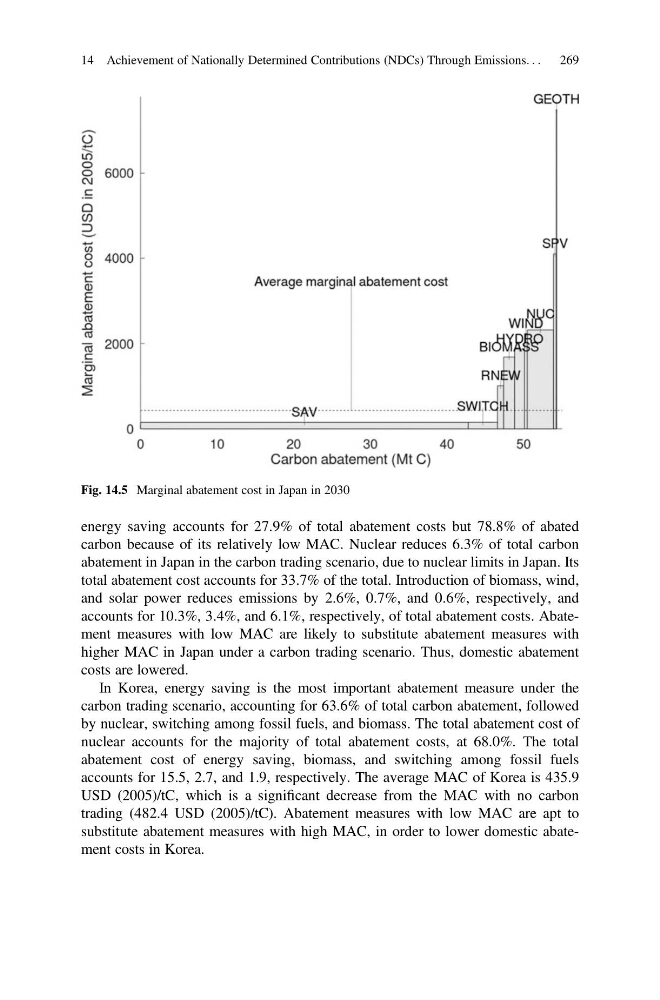
energy saving accounts for 27.9% of total abatement costs but 78.8% of abated
carbon because of its relatively low MAC. Nuclear reduces 6.3% of total carbon
abatement in Japan in the carbon trading scenario, due to nuclear limits in Japan. Its
total abatement cost accounts for 33.7% of the total. Introduction of biomass, wind,
and solar power reduces emissions by 2.6%, 0.7%, and 0.6%, respectively, and
accounts for 10.3%, 3.4%, and 6.1%, respectively, of total abatement costs. Abatement measures with low MAC are likely to substitute abatement measures with
higher MAC in Japan under a carbon trading scenario. Thus, domestic abatement
costs are lowered.
In Korea, energy saving is the most important abatement measure under the
carbon trading scenario, accounting for 63.6% of total carbon abatement, followed
by nuclear, switching among fossil fuels, and biomass. The total abatement cost of
nuclear accounts for the majority of total abatement costs, at 68.0%. The total
abatement cost of energy saving, biomass, and switching among fossil fuels
accounts for 15.5, 2.7, and 1.9, respectively. The average MAC of Korea is 435.9
USD (2005)/tC, which is a significant decrease from the MAC with no carbon
trading (482.4 USD (2005)/tC). Abatement measures with low MAC are apt to
substitute abatement measures with high MAC, in order to lower domestic abatement costs in Korea.
Fig. 14.5 Marginal abatement cost in Japan in 2030
14 Achievement of Nationally Determined Contributions (NDCs) Through Emissions. . .
269
carbon because of its relatively low MAC. Nuclear reduces 6.3% of total carbon
abatement in Japan in the carbon trading scenario, due to nuclear limits in Japan. Its
total abatement cost accounts for 33.7% of the total. Introduction of biomass, wind,
and solar power reduces emissions by 2.6%, 0.7%, and 0.6%, respectively, and
accounts for 10.3%, 3.4%, and 6.1%, respectively, of total abatement costs. Abatement measures with low MAC are likely to substitute abatement measures with
higher MAC in Japan under a carbon trading scenario. Thus, domestic abatement
costs are lowered.
In Korea, energy saving is the most important abatement measure under the
carbon trading scenario, accounting for 63.6% of total carbon abatement, followed
by nuclear, switching among fossil fuels, and biomass. The total abatement cost of
nuclear accounts for the majority of total abatement costs, at 68.0%. The total
abatement cost of energy saving, biomass, and switching among fossil fuels
accounts for 15.5, 2.7, and 1.9, respectively. The average MAC of Korea is 435.9
USD (2005)/tC, which is a significant decrease from the MAC with no carbon
trading (482.4 USD (2005)/tC). Abatement measures with low MAC are apt to
substitute abatement measures with high MAC, in order to lower domestic abatement costs in Korea.
Fig. 14.5 Marginal abatement cost in Japan in 2030
14 Achievement of Nationally Determined Contributions (NDCs) Through Emissions. . .
269