

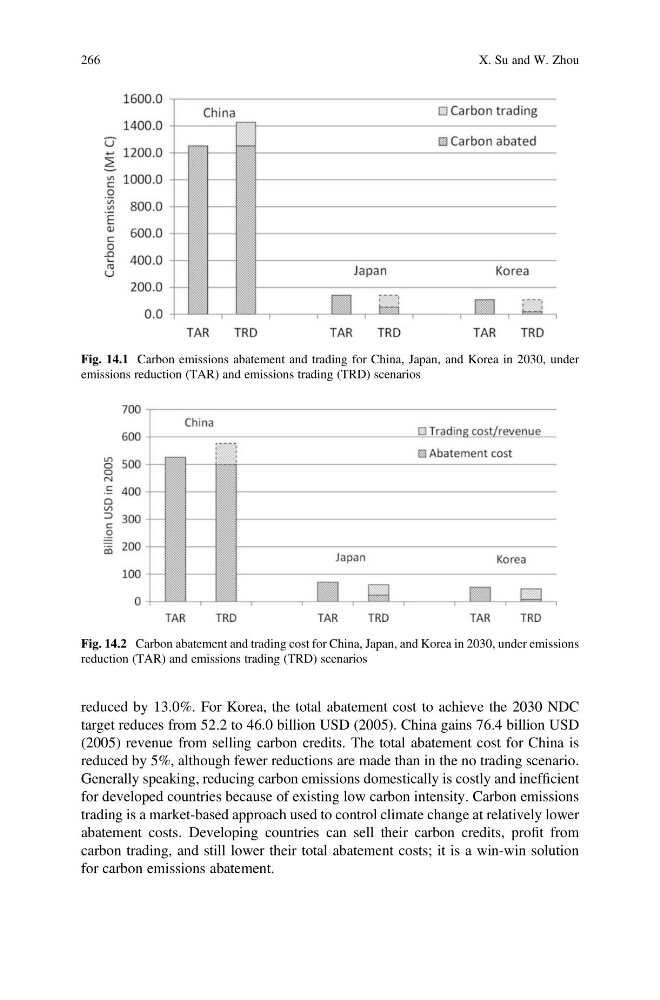
reduced by 13.0%. For Korea, the total abatement cost to achieve the 2030 NDC
target reduces from 52.2 to 46.0 billion USD (2005). China gains 76.4 billion USD
(2005) revenue from selling carbon credits. The total abatement cost for China is
reduced by 5%, although fewer reductions are made than in the no trading scenario.
Generally speaking, reducing carbon emissions domestically is costly and inefficient
for developed countries because of existing low carbon intensity. Carbon emissions
trading is a market-based approach used to control climate change at relatively lower
abatement costs. Developing countries can sell their carbon credits, profit from
carbon trading, and still lower their total abatement costs; it is a win-win solution
for carbon emissions abatement.
Fig. 14.1 Carbon emissions abatement and trading for China, Japan, and Korea in 2030, under
emissions reduction (TAR) and emissions trading (TRD) scenarios
Fig. 14.2 Carbon abatement and trading cost for China, Japan, and Korea in 2030, under emissions
reduction (TAR) and emissions trading (TRD) scenarios
266
X. Su and W. Zhou
target reduces from 52.2 to 46.0 billion USD (2005). China gains 76.4 billion USD
(2005) revenue from selling carbon credits. The total abatement cost for China is
reduced by 5%, although fewer reductions are made than in the no trading scenario.
Generally speaking, reducing carbon emissions domestically is costly and inefficient
for developed countries because of existing low carbon intensity. Carbon emissions
trading is a market-based approach used to control climate change at relatively lower
abatement costs. Developing countries can sell their carbon credits, profit from
carbon trading, and still lower their total abatement costs; it is a win-win solution
for carbon emissions abatement.
Fig. 14.1 Carbon emissions abatement and trading for China, Japan, and Korea in 2030, under
emissions reduction (TAR) and emissions trading (TRD) scenarios
Fig. 14.2 Carbon abatement and trading cost for China, Japan, and Korea in 2030, under emissions
reduction (TAR) and emissions trading (TRD) scenarios
266
X. Su and W. Zhou