

13.3.1.2 Rental Procedures
To rent a bicycle, a Hangzhou public transportation IC (integrated circuit) card or
citizen IC card with a balance of more than 200 CNY is necessary. People who do
not own such a card, e.g., tourists, can obtain a public bicycle IC card called a Z-Card
at the cycle port. This costs 300 CNY, of which 200 CNY is a deposit and 100 CNY
is a temporary deposit.
13.3.1.3 Fee System
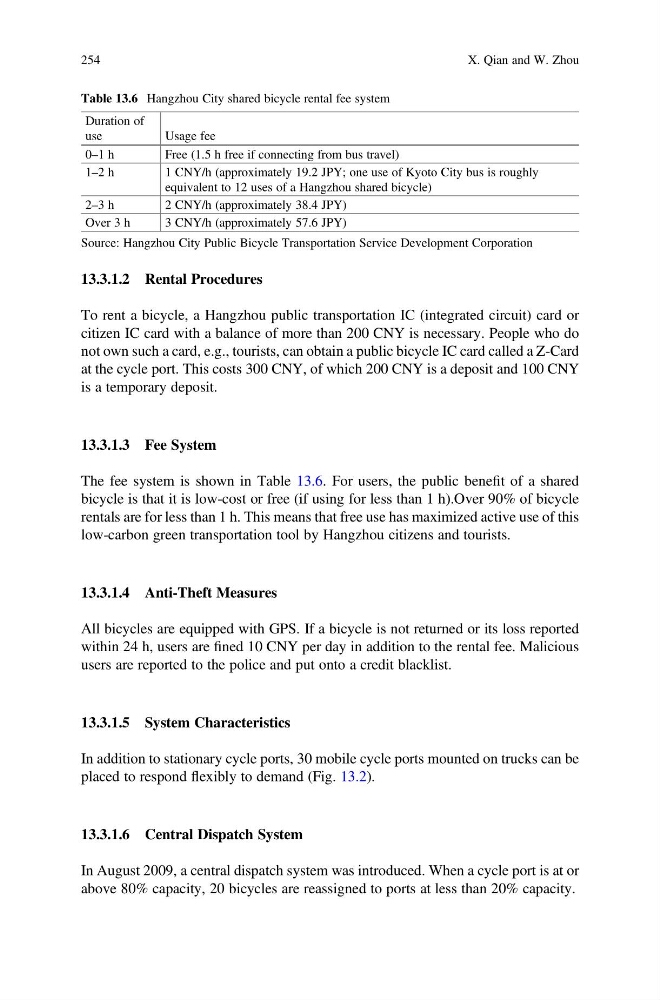
The fee system is shown in Table 13.6. For users, the public benefit of a shared
bicycle is that it is low-cost or free (if using for less than 1 h).Over 90% of bicycle
rentals are for less than 1 h. This means that free use has maximized active use of this
low-carbon green transportation tool by Hangzhou citizens and tourists.
13.3.1.4 Anti-Theft Measures
All bicycles are equipped with GPS. If a bicycle is not returned or its loss reported
within 24 h, users are fined 10 CNY per day in addition to the rental fee. Malicious
users are reported to the police and put onto a credit blacklist.
13.3.1.5 System Characteristics
In addition to stationary cycle ports, 30 mobile cycle ports mounted on trucks can be
placed to respond flexibly to demand (Fig. 13.2).
13.3.1.6 Central Dispatch System
In August 2009, a central dispatch system was introduced. When a cycle port is at or
above 80% capacity, 20 bicycles are reassigned to ports at less than 20% capacity.
Table 13.6 Hangzhou City shared bicycle rental fee system
Duration of
use
Usage fee
0–1 h
Free (1.5 h free if connecting from bus travel)
1–2 h
1 CNY/h (approximately 19.2 JPY; one use of Kyoto City bus is roughly
equivalent to 12 uses of a Hangzhou shared bicycle)
2–3 h
2 CNY/h (approximately 38.4 JPY)
Over 3 h
3 CNY/h (approximately 57.6 JPY)
Source: Hangzhou City Public Bicycle Transportation Service Development Corporation
254
X. Qian and W. Zhou
To rent a bicycle, a Hangzhou public transportation IC (integrated circuit) card or
citizen IC card with a balance of more than 200 CNY is necessary. People who do
not own such a card, e.g., tourists, can obtain a public bicycle IC card called a Z-Card
at the cycle port. This costs 300 CNY, of which 200 CNY is a deposit and 100 CNY
is a temporary deposit.
13.3.1.3 Fee System
The fee system is shown in Table 13.6. For users, the public benefit of a shared
bicycle is that it is low-cost or free (if using for less than 1 h).Over 90% of bicycle
rentals are for less than 1 h. This means that free use has maximized active use of this
low-carbon green transportation tool by Hangzhou citizens and tourists.
13.3.1.4 Anti-Theft Measures
All bicycles are equipped with GPS. If a bicycle is not returned or its loss reported
within 24 h, users are fined 10 CNY per day in addition to the rental fee. Malicious
users are reported to the police and put onto a credit blacklist.
13.3.1.5 System Characteristics
In addition to stationary cycle ports, 30 mobile cycle ports mounted on trucks can be
placed to respond flexibly to demand (Fig. 13.2).
13.3.1.6 Central Dispatch System
In August 2009, a central dispatch system was introduced. When a cycle port is at or
above 80% capacity, 20 bicycles are reassigned to ports at less than 20% capacity.
Table 13.6 Hangzhou City shared bicycle rental fee system
Duration of
use
Usage fee
0–1 h
Free (1.5 h free if connecting from bus travel)
1–2 h
1 CNY/h (approximately 19.2 JPY; one use of Kyoto City bus is roughly
equivalent to 12 uses of a Hangzhou shared bicycle)
2–3 h
2 CNY/h (approximately 38.4 JPY)
Over 3 h
3 CNY/h (approximately 57.6 JPY)
Source: Hangzhou City Public Bicycle Transportation Service Development Corporation
254
X. Qian and W. Zhou