

regions such as Taiwan, Hong Kong, and Japan. In this process, DiDi has exported
Chinese capital, technology, and models to the global market, as well as Chinese
experience and solutions to transportation problems to countries and regions
worldwide.
13.3 Shared Bicycles as Low-Carbon Mobility
13.3.1 Bicycle Sharing in Hangzhou City
From the launch of bicycle-sharing businesses on May 1, 2008, until October
23, 2019, 4253 cycle ports have been installed in Hangzhou City. Over 100,000
bicycles are available, and up to 470,000 journeys are made daily. Most bicycles are
rented more than four times each day, and total usage since the launch of the scheme
has exceeded one billion rentals, surpassing the volume of public bicycle rental in
developed countries. Hangzhou City has the largest community bicycle system in the
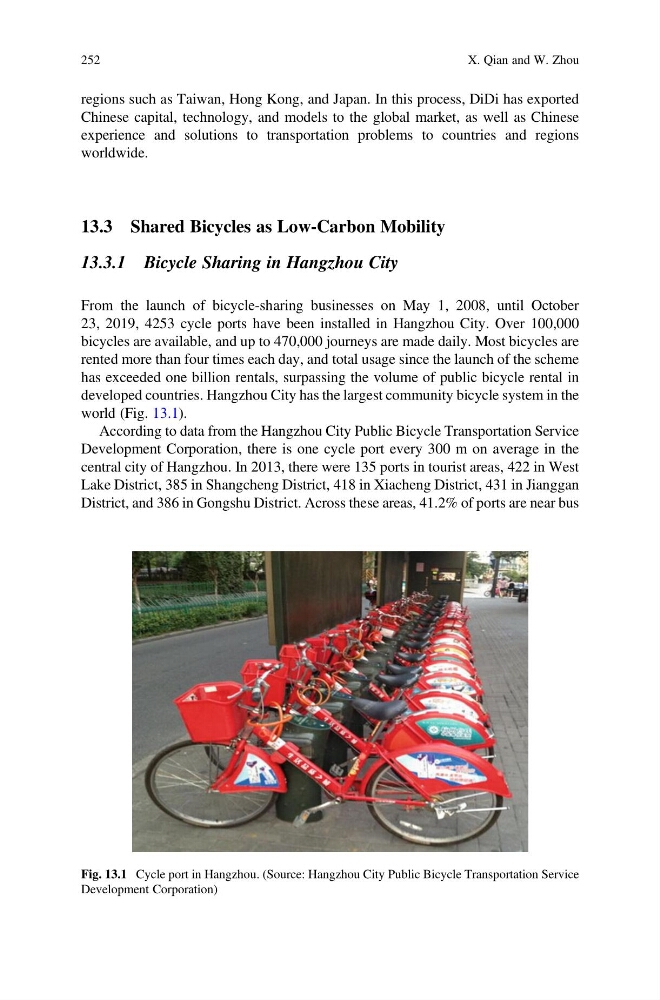
world (Fig. 13.1).
According to data from the Hangzhou City Public Bicycle Transportation Service
Development Corporation, there is one cycle port every 300 m on average in the
central city of Hangzhou. In 2013, there were 135 ports in tourist areas, 422 in West
Lake District, 385 in Shangcheng District, 418 in Xiacheng District, 431 in Jianggan
District, and 386 in Gongshu District. Across these areas, 41.2% of ports are near bus
Fig. 13.1 Cycle port in Hangzhou. (Source: Hangzhou City Public Bicycle Transportation Service
Development Corporation)
252
X. Qian and W. Zhou
Chinese capital, technology, and models to the global market, as well as Chinese
experience and solutions to transportation problems to countries and regions
worldwide.
13.3 Shared Bicycles as Low-Carbon Mobility
13.3.1 Bicycle Sharing in Hangzhou City
From the launch of bicycle-sharing businesses on May 1, 2008, until October
23, 2019, 4253 cycle ports have been installed in Hangzhou City. Over 100,000
bicycles are available, and up to 470,000 journeys are made daily. Most bicycles are
rented more than four times each day, and total usage since the launch of the scheme
has exceeded one billion rentals, surpassing the volume of public bicycle rental in
developed countries. Hangzhou City has the largest community bicycle system in the
world (Fig. 13.1).
According to data from the Hangzhou City Public Bicycle Transportation Service
Development Corporation, there is one cycle port every 300 m on average in the
central city of Hangzhou. In 2013, there were 135 ports in tourist areas, 422 in West
Lake District, 385 in Shangcheng District, 418 in Xiacheng District, 431 in Jianggan
District, and 386 in Gongshu District. Across these areas, 41.2% of ports are near bus
Fig. 13.1 Cycle port in Hangzhou. (Source: Hangzhou City Public Bicycle Transportation Service
Development Corporation)
252
X. Qian and W. Zhou