

1 m provides a volume of 100 m  10 m  1 m ¼ 1000 m
3 , allowing generation of
23 kW. This is enough to supply 10–20 houses or a small village. Alternatively, this
type of micro-hydraulic power generation system could be used to power port
facilities.
Although this micro-hydraulic power system was applied here to harness tidal
energy, it could equally be applied to extract clean energy from streams and small
rivers. In addition, if a certain volume of rainwater is stored in a tank, this water can
be transformed into electric power using the same system. This system can be
usefully applied to harness different energy sources when the medium is a fluid,
such as sea water and fresh water.
12.4.2 Hydropower Generation Using Drainage from Tall
Buildings
12.4.2.1 Fundamental Concept
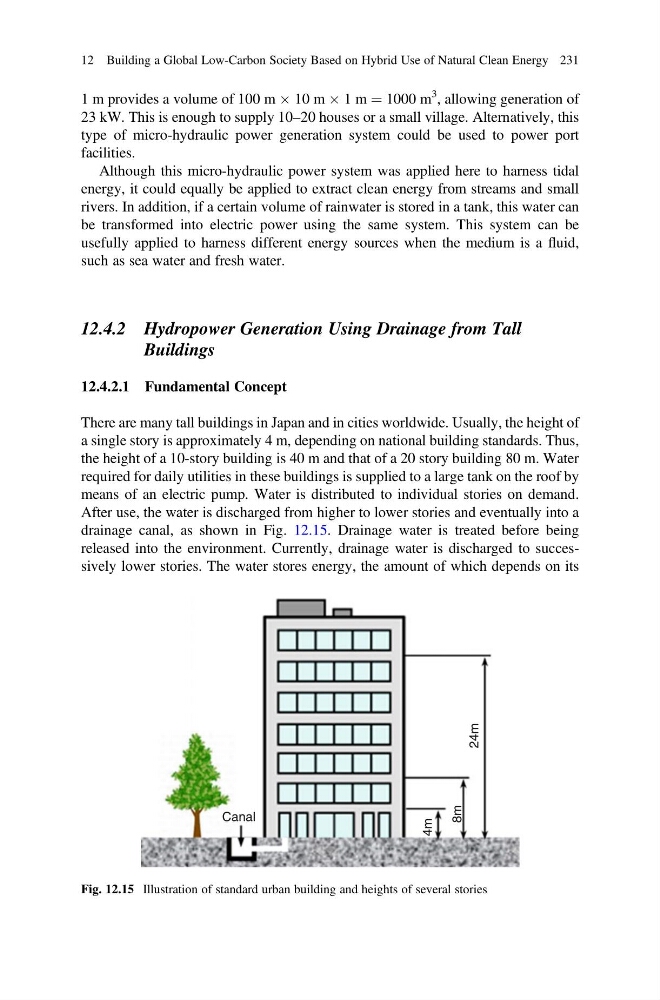
There are many tall buildings in Japan and in cities worldwide. Usually, the height of
a single story is approximately 4 m, depending on national building standards. Thus,
the height of a 10-story building is 40 m and that of a 20 story building 80 m. Water
required for daily utilities in these buildings is supplied to a large tank on the roof by
means of an electric pump. Water is distributed to individual stories on demand.
After use, the water is discharged from higher to lower stories and eventually into a
drainage canal, as shown in Fig. 12.15. Drainage water is treated before being
released into the environment. Currently, drainage water is discharged to successively lower stories. The water stores energy, the amount of which depends on its
Canal
4m
8m
24m
Fig. 12.15 Illustration of standard urban building and heights of several stories
12 Building a Global Low-Carbon Society Based on Hybrid Use of Natural Clean Energy 231
3 , allowing generation of
23 kW. This is enough to supply 10–20 houses or a small village. Alternatively, this
type of micro-hydraulic power generation system could be used to power port
facilities.
Although this micro-hydraulic power system was applied here to harness tidal
energy, it could equally be applied to extract clean energy from streams and small
rivers. In addition, if a certain volume of rainwater is stored in a tank, this water can
be transformed into electric power using the same system. This system can be
usefully applied to harness different energy sources when the medium is a fluid,
such as sea water and fresh water.
12.4.2 Hydropower Generation Using Drainage from Tall
Buildings
12.4.2.1 Fundamental Concept
There are many tall buildings in Japan and in cities worldwide. Usually, the height of
a single story is approximately 4 m, depending on national building standards. Thus,
the height of a 10-story building is 40 m and that of a 20 story building 80 m. Water
required for daily utilities in these buildings is supplied to a large tank on the roof by
means of an electric pump. Water is distributed to individual stories on demand.
After use, the water is discharged from higher to lower stories and eventually into a
drainage canal, as shown in Fig. 12.15. Drainage water is treated before being
released into the environment. Currently, drainage water is discharged to successively lower stories. The water stores energy, the amount of which depends on its
Canal
4m
8m
24m
Fig. 12.15 Illustration of standard urban building and heights of several stories
12 Building a Global Low-Carbon Society Based on Hybrid Use of Natural Clean Energy 231