

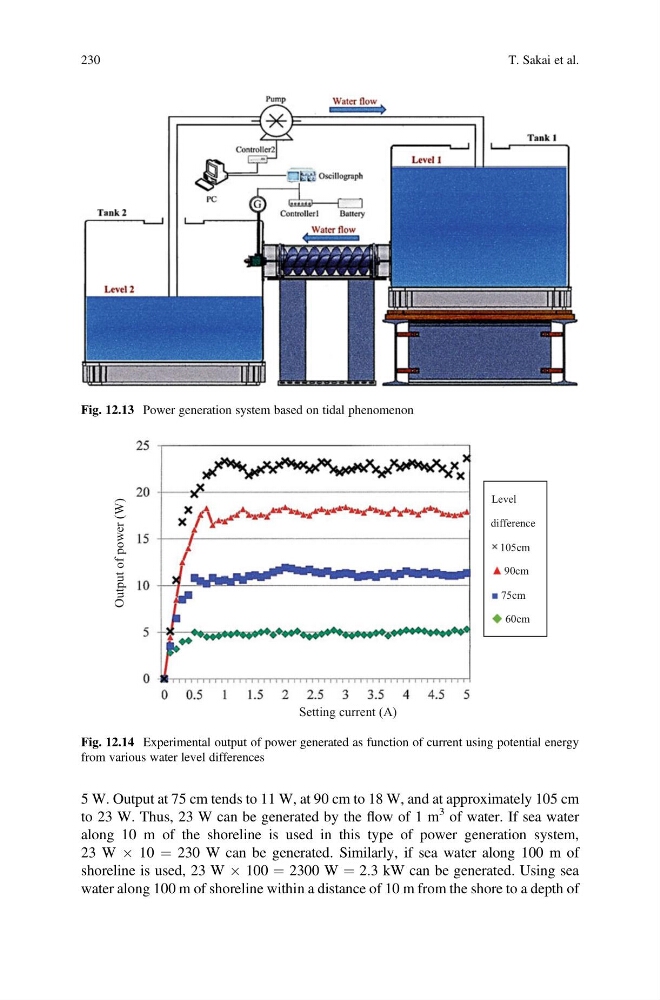
5 W. Output at 75 cm tends to 11 W, at 90 cm to 18 W, and at approximately 105 cm
to 23 W. Thus, 23 W can be generated by the flow of 1 m
3 of water. If sea water
along 10 m of the shoreline is used in this type of power generation system,
23 W Â 10 ¼ 230 W can be generated. Similarly, if sea water along 100 m of
shoreline is used, 23 W Â 100 ¼ 2300 W ¼ 2.3 kW can be generated. Using sea
water along 100 m of shoreline within a distance of 10 m from the shore to a depth of
Fig. 12.13 Power generation system based on tidal phenomenon
Level
difference
105cm
90cm
75cm
60cm
Setting current (A)
Output of power (W)
Fig. 12.14 Experimental output of power generated as function of current using potential energy
from various water level differences
230
T. Sakai et al.
to 23 W. Thus, 23 W can be generated by the flow of 1 m
3 of water. If sea water
along 10 m of the shoreline is used in this type of power generation system,
23 W Â 10 ¼ 230 W can be generated. Similarly, if sea water along 100 m of
shoreline is used, 23 W Â 100 ¼ 2300 W ¼ 2.3 kW can be generated. Using sea
water along 100 m of shoreline within a distance of 10 m from the shore to a depth of
Fig. 12.13 Power generation system based on tidal phenomenon
Level
difference
105cm
90cm
75cm
60cm
Setting current (A)
Output of power (W)
Fig. 12.14 Experimental output of power generated as function of current using potential energy
from various water level differences
230
T. Sakai et al.