

12.4 Development of a New Type of Micro-Hydropower
System
12.4.1 Hydropower Generation Based on Tidal Energy
12.4.1.1 Mechanism Causing Tidal Energy
Sea water levels change depending on the relative locations of the sun, Earth, and
moon. At certain points, all three bodies are arrayed linearly as shown in Fig. 12.12a,
while at other times they are arranged in an L shape, as illustrated in Fig. 12.12b.
Since forces of attraction act between each pair of bodies, sea water is attracted to the
nearest celestial body. Thus, sea water tends to either be pulled toward both the
moon and the sun, as indicated in Fig. 12.12a, or toward the moon instead of the sun
when the bodies are not aligned, because of the shorter distance between the Earth
and the moon.
The Earth rotates once daily (during 24 h). Accordingly, any site on the shore
passes through both deep and shallow areas of sea water, leading to two high and low
tides per day (bottom of Fig. 12.12). In Fig. 12.12a, the difference between high and
low water levels becomes more distinct due to the superimposed effect of the sun and
the moon, while the difference is smaller in Fig. 12.12b, resulting in spring and neap
tides.
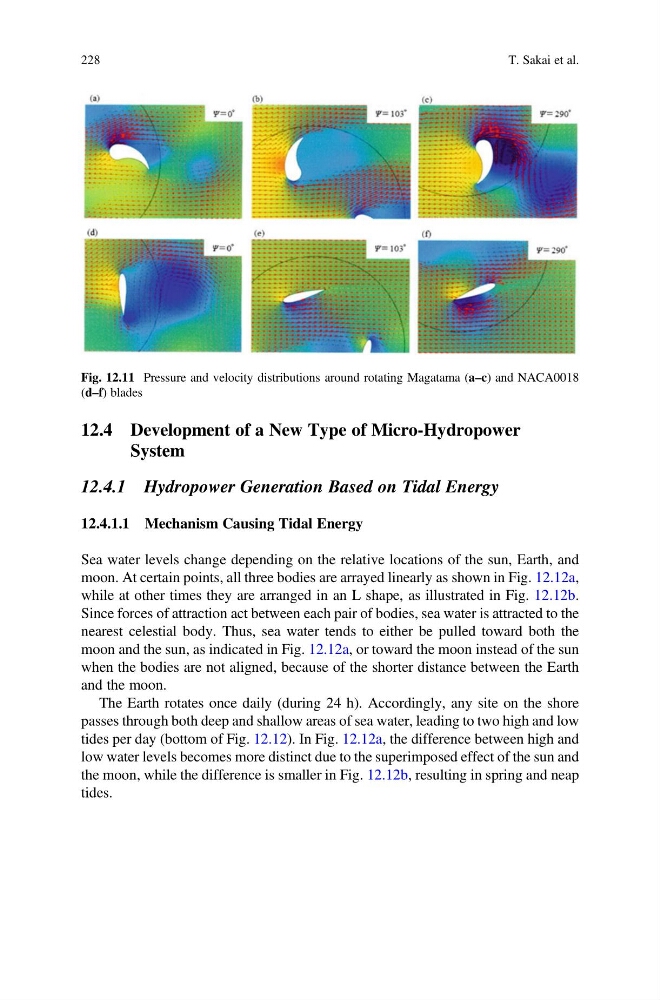
Fig. 12.11 Pressure and velocity distributions around rotating Magatama (a–c) and NACA0018
(d–f) blades
228
T. Sakai et al.
System
12.4.1 Hydropower Generation Based on Tidal Energy
12.4.1.1 Mechanism Causing Tidal Energy
Sea water levels change depending on the relative locations of the sun, Earth, and
moon. At certain points, all three bodies are arrayed linearly as shown in Fig. 12.12a,
while at other times they are arranged in an L shape, as illustrated in Fig. 12.12b.
Since forces of attraction act between each pair of bodies, sea water is attracted to the
nearest celestial body. Thus, sea water tends to either be pulled toward both the
moon and the sun, as indicated in Fig. 12.12a, or toward the moon instead of the sun
when the bodies are not aligned, because of the shorter distance between the Earth
and the moon.
The Earth rotates once daily (during 24 h). Accordingly, any site on the shore
passes through both deep and shallow areas of sea water, leading to two high and low
tides per day (bottom of Fig. 12.12). In Fig. 12.12a, the difference between high and
low water levels becomes more distinct due to the superimposed effect of the sun and
the moon, while the difference is smaller in Fig. 12.12b, resulting in spring and neap
tides.
Fig. 12.11 Pressure and velocity distributions around rotating Magatama (a–c) and NACA0018
(d–f) blades
228
T. Sakai et al.