

the centrifugal direction. The geometrical relation between the attack angle α and the
azimuth angle Ψ is depicted in Fig. 12.9, in which parameter λ indicates the ratio of
circumferential velocity of the blade to wind velocity. The revolution power is
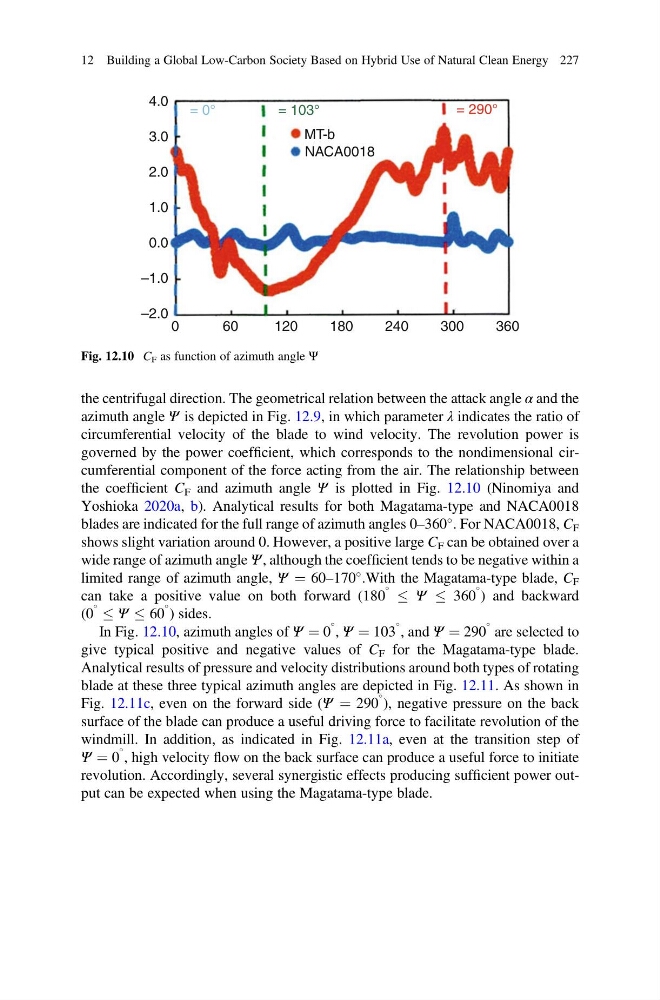
governed by the power coefficient, which corresponds to the nondimensional circumferential component of the force acting from the air. The relationship between
the coefficient C F and azimuth angle Ψ is plotted in Fig. 12.10 (Ninomiya and
Yoshioka 2020a, b). Analytical results for both Magatama-type and NACA0018
blades are indicated for the full range of azimuth angles 0–360
. For NACA0018, C F
shows slight variation around 0. However, a positive large C F can be obtained over a
wide range of azimuth angle Ψ , although the coefficient tends to be negative within a
limited range of azimuth angle, Ψ ¼ 60–170
.With the Magatama-type blade, C F
can take a positive value on both forward (180
Ψ
360
) and backward
(0
Ψ 60
) sides.
In Fig. 12.10, azimuth angles of Ψ ¼ 0
, Ψ ¼ 103
, and Ψ ¼ 290
are selected to
give typical positive and negative values of C F for the Magatama-type blade.
Analytical results of pressure and velocity distributions around both types of rotating
blade at these three typical azimuth angles are depicted in Fig. 12.11. As shown in
Fig. 12.11c, even on the forward side (Ψ ¼ 290
), negative pressure on the back
surface of the blade can produce a useful driving force to facilitate revolution of the
windmill. In addition, as indicated in Fig. 12.11a, even at the transition step of
Ψ ¼ 0
, high velocity flow on the back surface can produce a useful force to initiate
revolution. Accordingly, several synergistic effects producing sufficient power output can be expected when using the Magatama-type blade.
4.0
= 0°
= 103°
= 290°
3.0
MT-b
NACA0018
2.0
1.0
0.0
–1.0
–2.0
0
60
120
180
240
300
360
Fig. 12.10 C F as function of azimuth angle Ψ
12 Building a Global Low-Carbon Society Based on Hybrid Use of Natural Clean Energy 227
azimuth angle Ψ is depicted in Fig. 12.9, in which parameter λ indicates the ratio of
circumferential velocity of the blade to wind velocity. The revolution power is
governed by the power coefficient, which corresponds to the nondimensional circumferential component of the force acting from the air. The relationship between
the coefficient C F and azimuth angle Ψ is plotted in Fig. 12.10 (Ninomiya and
Yoshioka 2020a, b). Analytical results for both Magatama-type and NACA0018
blades are indicated for the full range of azimuth angles 0–360
. For NACA0018, C F
shows slight variation around 0. However, a positive large C F can be obtained over a
wide range of azimuth angle Ψ , although the coefficient tends to be negative within a
limited range of azimuth angle, Ψ ¼ 60–170
.With the Magatama-type blade, C F
can take a positive value on both forward (180
Ψ
360
) and backward
(0
Ψ 60
) sides.
In Fig. 12.10, azimuth angles of Ψ ¼ 0
, Ψ ¼ 103
, and Ψ ¼ 290
are selected to
give typical positive and negative values of C F for the Magatama-type blade.
Analytical results of pressure and velocity distributions around both types of rotating
blade at these three typical azimuth angles are depicted in Fig. 12.11. As shown in
Fig. 12.11c, even on the forward side (Ψ ¼ 290
), negative pressure on the back
surface of the blade can produce a useful driving force to facilitate revolution of the
windmill. In addition, as indicated in Fig. 12.11a, even at the transition step of
Ψ ¼ 0
, high velocity flow on the back surface can produce a useful force to initiate
revolution. Accordingly, several synergistic effects producing sufficient power output can be expected when using the Magatama-type blade.
4.0
= 0°
= 103°
= 290°
3.0
MT-b
NACA0018
2.0
1.0
0.0
–1.0
–2.0
0
60
120
180
240
300
360
Fig. 12.10 C F as function of azimuth angle Ψ
12 Building a Global Low-Carbon Society Based on Hybrid Use of Natural Clean Energy 227