

Thus, the Rankine cycle OTEC plant is designed with the following parameters:
T 0 ¼ 273.15 K, ψ ¼ 2.5 MW/K, ṁ ws ¼ 6.0 Â 10
3 kg/s, c p ¼ 3.9 kJ/(kgÁK),
t wsi ¼ 25
C, t csi ¼ 5
C, ρ ¼ 1025 kg/m
3 , h m ¼ 75 m, w ¼ 4 m/year,
K ¼ 2300 m
2 /year, z cs ¼ 925 m, and κ ¼ 0.4 (unitless). Based on this, A OTEC can
be calculated to be approximately 7.5 Â 10
12 m
2 , as shown in Fig. 9.9. The OTEC
discharge outlet is located at a depth of 145 m, which has a positive impact on
mariculture, and z mix ¼ 220 m.
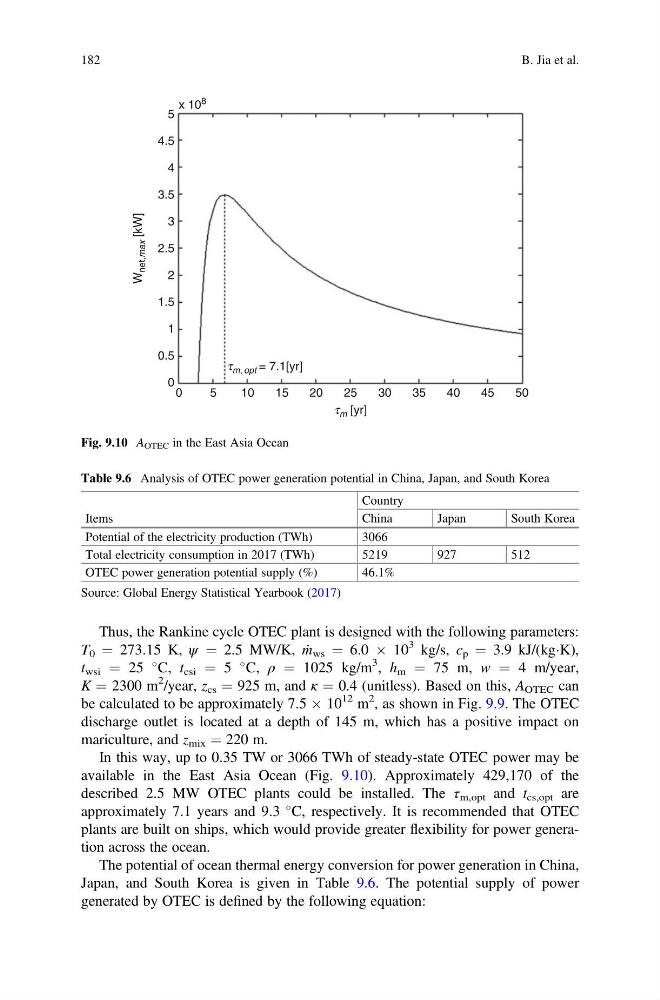
In this way, up to 0.35 TW or 3066 TWh of steady-state OTEC power may be
available in the East Asia Ocean (Fig. 9.10). Approximately 429,170 of the
described 2.5 MW OTEC plants could be installed. The τ m,opt and t cs,opt are
approximately 7.1 years and 9.3
C, respectively. It is recommended that OTEC
plants are built on ships, which would provide greater flexibility for power generation across the ocean.
The potential of ocean thermal energy conversion for power generation in China,
Japan, and South Korea is given in Table 9.6. The potential supply of power
generated by OTEC is defined by the following equation:
x 10
8
W
net,max [kW]
5
4.5
4
3.5
3
2.5
2
1.5
1
0.5
0
0
5
10
15
20
t m [yr]
25
30
35
40
45
50
t m, opt = 7.1[yr]
Fig. 9.10 A OTEC in the East Asia Ocean
Table 9.6 Analysis of OTEC power generation potential in China, Japan, and South Korea
Items
Country
China
Japan
South Korea
Potential of the electricity production (TWh)
3066
Total electricity consumption in 2017 (TWh)
5219
927
512
OTEC power generation potential supply (%)
46.1%
Source: Global Energy Statistical Yearbook (2017)
182
B. Jia et al.
T 0 ¼ 273.15 K, ψ ¼ 2.5 MW/K, ṁ ws ¼ 6.0 Â 10
3 kg/s, c p ¼ 3.9 kJ/(kgÁK),
t wsi ¼ 25
C, t csi ¼ 5
C, ρ ¼ 1025 kg/m
3 , h m ¼ 75 m, w ¼ 4 m/year,
K ¼ 2300 m
2 /year, z cs ¼ 925 m, and κ ¼ 0.4 (unitless). Based on this, A OTEC can
be calculated to be approximately 7.5 Â 10
12 m
2 , as shown in Fig. 9.9. The OTEC
discharge outlet is located at a depth of 145 m, which has a positive impact on
mariculture, and z mix ¼ 220 m.
In this way, up to 0.35 TW or 3066 TWh of steady-state OTEC power may be
available in the East Asia Ocean (Fig. 9.10). Approximately 429,170 of the
described 2.5 MW OTEC plants could be installed. The τ m,opt and t cs,opt are
approximately 7.1 years and 9.3
C, respectively. It is recommended that OTEC
plants are built on ships, which would provide greater flexibility for power generation across the ocean.
The potential of ocean thermal energy conversion for power generation in China,
Japan, and South Korea is given in Table 9.6. The potential supply of power
generated by OTEC is defined by the following equation:
x 10
8
W
net,max [kW]
5
4.5
4
3.5
3
2.5
2
1.5
1
0.5
0
0
5
10
15
20
t m [yr]
25
30
35
40
45
50
t m, opt = 7.1[yr]
Fig. 9.10 A OTEC in the East Asia Ocean
Table 9.6 Analysis of OTEC power generation potential in China, Japan, and South Korea
Items
Country
China
Japan
South Korea
Potential of the electricity production (TWh)
3066
Total electricity consumption in 2017 (TWh)
5219
927
512
OTEC power generation potential supply (%)
46.1%
Source: Global Energy Statistical Yearbook (2017)
182
B. Jia et al.