

OTEC plants, which is decided by n ¼ (A OTEC Áh m Áρ)/(ṁ ws Áτ m ); ṁ ws is the mass flow
rate of warm seawater, c P shows the specific heat at constant pressure, T 0 represents
the absolute temperature of 0
C; h m reflects the thickness of the warm seawater
layer; ρ is average seawater density; τ m is the utilization time of the mixed layer; and
ψ shows the performance of the heat exchanger. Finally, t csi and t wsi are the initial
temperature in OTEC of cold and warm seawater, respectively; and t cs and t ws are the
OTEC operating temperatures.
It can be assumed that OTEC operations exert little influence on the temperature
of warm seawater (t ws ¼ t wsi ), since energy is supplemented from solar radiation and
surface ocean currents. However, the temperature of cold seawater is easily affected
by bulk OTEC operations. Through reference (1D) analysis of OTEC (Nihous
2005), t cs can be given as follows:
t cs ¼
Àκ
ϕ
ϑ Á
h m t cs
τ m
w À κ
ϕ
ϑ :
h m
τ m
þ
t ws þ t cs Á κ Á ϕ þ ϑ
ð
Þ
1 þ κ Á ϕ=ϑ
À
Àκ
ϕ
ϑ Á
h m t cs
τ m
w À κ
ϕ
ϑ Á
h m
τ m
!
Á e
wÀκ
ϕ
ϑ Á
hm
τm
ð
Þ
z mix Àzcs
K
ð
Þ
ð9:13Þ
where w reflects the upwelling rate; K is the vertical eddy diffusion coefficient; z cs
and z mix are vertical water column coordinates of cold seawater withdrawal and
mixed effluent discharge, respectively; z mix ¼ h m À ln([t wsi + t csi Á(κÁφ/ϑ)]/(1 + κÁφ/
ϑ)/t wsi )ÁK/w; and κ is the additional seawater mixing coefficient that has a positive
impact on mariculture.
60
55
45
40
35
North latitude (degree)
30
25
20
15
10
100 105 110 115 120
East longititude (degree)
125 130 135 140 145 150
50
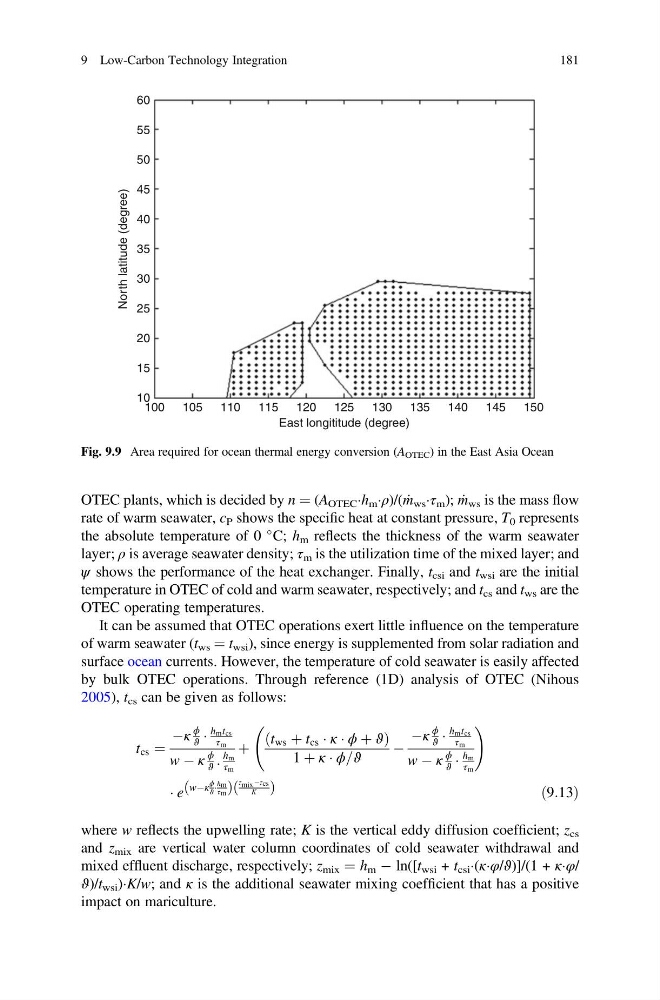
Fig. 9.9 Area required for ocean thermal energy conversion (A OTEC ) in the East Asia Ocean
9 Low-Carbon Technology Integration
181
rate of warm seawater, c P shows the specific heat at constant pressure, T 0 represents
the absolute temperature of 0
C; h m reflects the thickness of the warm seawater
layer; ρ is average seawater density; τ m is the utilization time of the mixed layer; and
ψ shows the performance of the heat exchanger. Finally, t csi and t wsi are the initial
temperature in OTEC of cold and warm seawater, respectively; and t cs and t ws are the
OTEC operating temperatures.
It can be assumed that OTEC operations exert little influence on the temperature
of warm seawater (t ws ¼ t wsi ), since energy is supplemented from solar radiation and
surface ocean currents. However, the temperature of cold seawater is easily affected
by bulk OTEC operations. Through reference (1D) analysis of OTEC (Nihous
2005), t cs can be given as follows:
t cs ¼
Àκ
ϕ
ϑ Á
h m t cs
τ m
w À κ
ϕ
ϑ :
h m
τ m
þ
t ws þ t cs Á κ Á ϕ þ ϑ
ð
Þ
1 þ κ Á ϕ=ϑ
À
Àκ
ϕ
ϑ Á
h m t cs
τ m
w À κ
ϕ
ϑ Á
h m
τ m
!
Á e
wÀκ
ϕ
ϑ Á
hm
τm
ð
Þ
z mix Àzcs
K
ð
Þ
ð9:13Þ
where w reflects the upwelling rate; K is the vertical eddy diffusion coefficient; z cs
and z mix are vertical water column coordinates of cold seawater withdrawal and
mixed effluent discharge, respectively; z mix ¼ h m À ln([t wsi + t csi Á(κÁφ/ϑ)]/(1 + κÁφ/
ϑ)/t wsi )ÁK/w; and κ is the additional seawater mixing coefficient that has a positive
impact on mariculture.
60
55
45
40
35
North latitude (degree)
30
25
20
15
10
100 105 110 115 120
East longititude (degree)
125 130 135 140 145 150
50
Fig. 9.9 Area required for ocean thermal energy conversion (A OTEC ) in the East Asia Ocean
9 Low-Carbon Technology Integration
181